
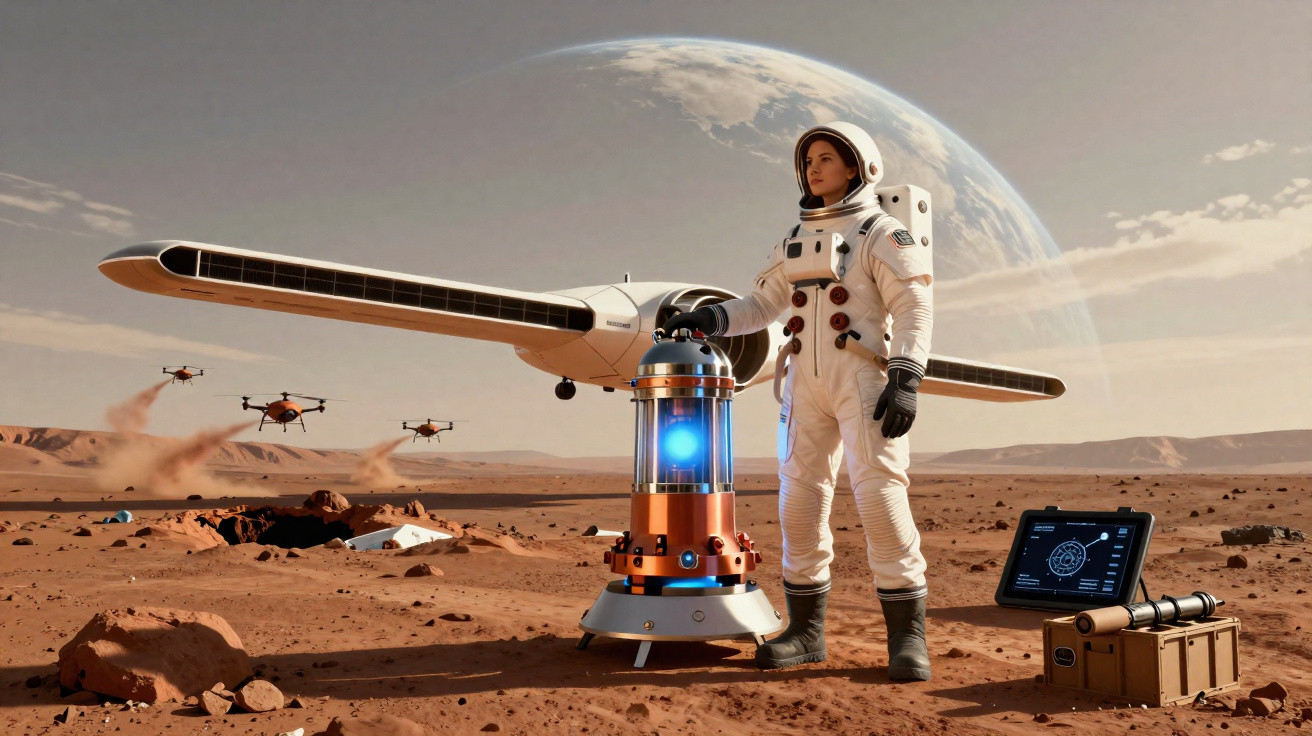
For decades, engineers have envisioned spacecraft powered not solely by the Sun or chemical engines, but by nuclear fission. NASA is now taking a serious step in that direction: the “Space Reactor-1 Freedom” mission is intended to demonstrate a compact nuclear reactor in space, showing how distant worlds such as Mars could one day be reached more quickly and supplied on a permanent basis.
Moving beyond solar panels to a nuclear reactor
Until now, spaceflight has depended almost entirely on sunlight. Large solar arrays, used on many probes, do provide power, but their limits soon become apparent. The farther a spacecraft travels from the Sun, the lower the output becomes.
A reactor on board is expected to provide around 20 kilowatts of electrical power – day and night, entirely independently of sunlight.
Mars receives only around 43 per cent of the solar energy that reaches Earth. The planet is also regularly engulfed by vast dust storms. Rovers such as “Opportunity” lost their source of energy during these events and ultimately came to a permanent halt.
The SR1 Freedom mission addresses precisely this issue. It carries a compact fission reactor, which generates heat through the controlled splitting of uranium and then converts that heat into electricity. NASA intends to use low-enriched uranium and turn the heat into electrical energy via a Brayton cycle. The principle is familiar from modern gas turbines on Earth, but here it is miniaturised for use in space.
How the mission is expected to unfold
Launch is planned for December 2028, most likely aboard a heavy-lift rocket such as Falcon Heavy or a comparable launch vehicle. The rocket will first place the probe into Earth orbit before sending it onto an escape trajectory.
- Probe launch: carried by a heavy-lift rocket in late 2028
- Reactor activation: within 48 hours of leaving the near-Earth region
- Propulsion: electric engines powered directly by reactor-generated electricity
- Objective: travel towards Mars and demonstrate sustained operation
Once the probe is sufficiently distant from Earth, the team will switch on the reactor. The first 48 hours will determine whether the concept works: the reactor must start up reliably, supply electricity continuously and power new types of electric propulsion. These engines are highly efficient but produce only gentle, continuous thrust, making them well suited to long-duration missions.
With this move, NASA is reviving technology from an earlier era. In the 1960s, SNAP-10A became the first US nuclear satellite to fly. Safety concerns and a lack of necessity subsequently slowed further projects. SR1 Freedom is now designed to validate several technologies that have long been planned, under real operational conditions.
Recycling from the lunar programme saves billions
NASA’s practical approach to the project is notable. Rather than developing an entirely new platform, the agency is using components from the planned “Gateway” lunar station. Its Power and Propulsion Element, the module responsible for energy supply and propulsion, forms the foundation of the new probe.
The nuclear satellite is essentially a converted Gateway module – high-tech recycling on a billion-dollar scale.
As development of this module is already well advanced, NASA can save both time and money. At the same time, it is shifting its priorities: the Gateway lunar station is moving into the background while the US agency directs around 20 billion dollars towards a permanent base on the Moon’s surface. SR1 Freedom fits this wider strategy: first establish dependable power in space, then establish dependable power on other celestial bodies.
Small helicopters are to search for hidden water
The probe will not travel through space empty. It will carry three small Mars helicopters under the project name “Skyfall”. They build on the success of “Ingenuity”, the miniature helicopter that has flown repeatedly on the Red Planet since 2021 and proved that flight is possible in Mars’s thin atmosphere.
The new helicopters are intended to gather data on the surface and subsurface. Their primary task is to identify signs of water, whether in the form of ice or even liquid water beneath the ground. Such deposits would be immensely valuable for any future crewed Mars mission.
Using high-resolution cameras and dedicated sensors, the helicopters can map areas that are difficult for larger rovers to access, including rugged terrain, steep slopes and regions of soft sand. They would therefore act as scouts for future landing sites and potential locations for an initial Mars base.
Why nuclear power in space could be a game changer
SR1 Freedom is more than a one-off experiment. The mission forms part of a long-term strategy. If it proves that a compact reactor can operate safely and reliably in space, several new possibilities could emerge.
| Field of application | Benefit of nuclear technology |
|---|---|
| Faster space travel | Thermal nuclear propulsion could reduce the journey to Mars to around three to four months. |
| Power on Mars | Continuous electricity for habitats, laboratories, communications systems and resource extraction. |
| Deep-space probes | Missions far beyond Jupiter, where solar power is barely practical. |
A shorter journey would not merely be more convenient. It would substantially reduce radiation exposure for the crew. During a trip to Mars, astronauts have little protection from cosmic radiation. Every week saved lowers the risk of long-term damage, while also reducing the demands on supplies and life-support systems.
The Martian surface presents a different challenge: future settlers will require vast amounts of energy to extract water from ice, produce oxygen and manufacture fuel. Huge solar fields could provide this only to a limited extent, not least because of dust storms and weaker sunlight. A small reactor delivering 40, 60 or 100 kilowatts of electrical power could sustain many of these tasks continuously.
Safety concerns and political sensitivity
Nuclear technology in space is sensitive territory. Critics are particularly concerned about launch failures that could release radioactive material into the atmosphere. Supporters point out that many spacecraft already use radioisotope power sources (RTGs). These contain plutonium and also operate using decay heat, although they do not involve a controllable chain reaction.
The difference with SR1 Freedom is that, for the first time, a fully fledged fission reactor is intended to operate continuously. NASA plans to incorporate several layers of protection, from robust fuel design to delaying reactor start-up until the craft is at a safe distance from Earth. An intensive approval process will also take place at national and international level.
The political implications are equally delicate. A successful test could encourage other spacefaring nations to advance their own nuclear missions. The United States, Russia and China are already developing concepts for nuclear propulsion and power systems in space. In practical terms, SR1 Freedom could serve as the technical starting signal for a new race.
How nuclear propulsion actually works
For many people, “nuclear propulsion” sounds like a term from science fiction. In SR1 Freedom’s case, however, the initial aim is electricity generation rather than a jet directly driven by nuclear power. The reactor creates heat, and a closed turbine cycle converts it into electrical energy. That electricity then runs electric engines which expel ions or plasma at high speed.
At a later stage, thermal reactors could be used instead. These would directly heat a working fluid such as hydrogen, causing it to expand greatly and escape through a nozzle. Thrust remains limited compared with conventional rockets, but specific impulse – in other words, efficiency – is considerably higher. This enables spacecraft to achieve much greater speeds with the same amount of propellant.
In practice, this would mean Mars missions could be planned not only more quickly, but with greater flexibility. They would be less dependent on specific launch windows and could follow routes that avoid radiation belts and particularly hazardous periods of solar activity.
What SR1 Freedom means for future Mars colonies
With SR1 Freedom, NASA is ultimately testing the central component of future Mars colonies: a dependable, compact “power station box” that could be deployed with a lander and activated on site. Building on this principle, modular systems are conceivable, with several reactors buried underground to provide a growing base with power and heat.
Solar cells, batteries and potentially fuel cells could be added alongside them. A well-designed combination of energy sources improves resilience. If one system fails or is damaged, the others can take over. On a planet where assistance from Earth is months away, redundancy remains vital to survival.
For researchers, a stable surplus of energy would create new opportunities: more powerful communications aerials, large scientific laboratories, energy-intensive facilities for 3D-printing spare parts, or even greenhouses with artificial lighting. All of this requires reliable electricity – and that is exactly where the vision behind SR1 Freedom begins.






Comments
No comments yet. Be the first to comment!
Leave a Comment