
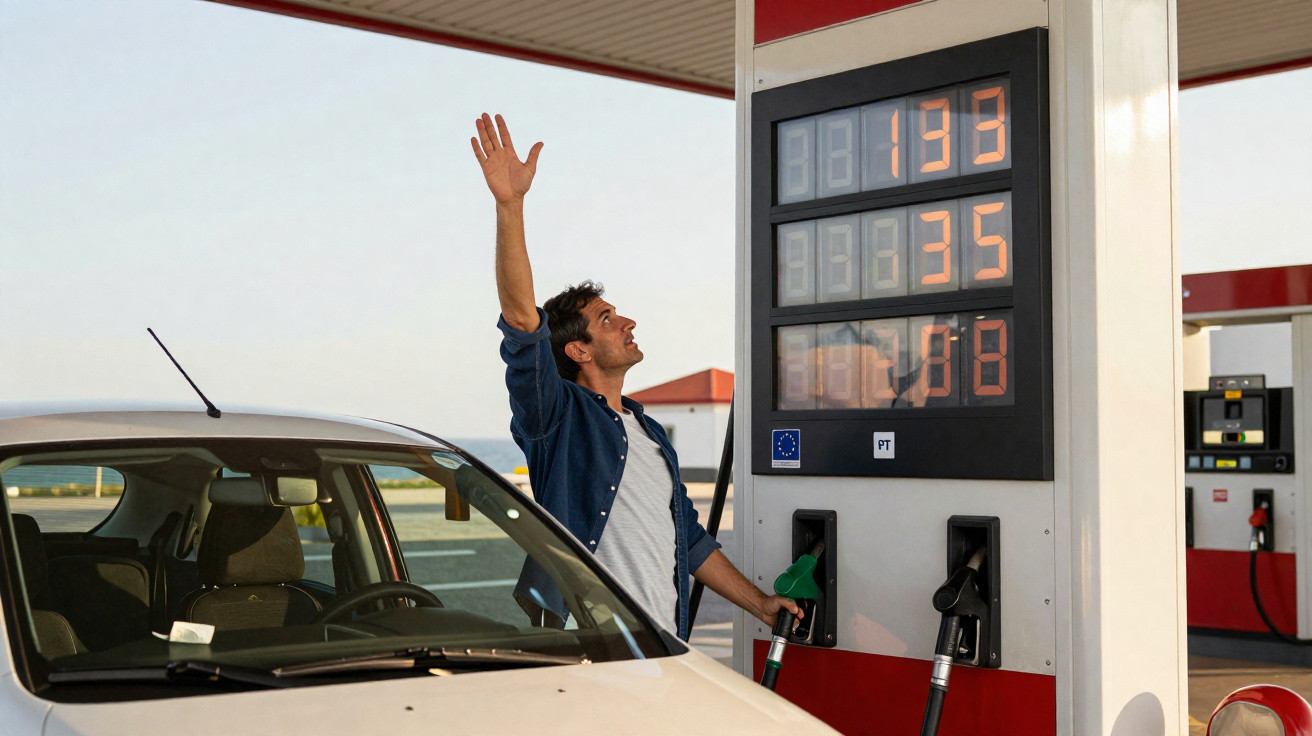
While many drivers across Europe can only stare in disbelief at fuel-station price boards, one government has pulled the emergency lever. In Portugal, an automatic system obliges the state to limit its own revenue once fuel prices pass a specified level. Its purpose is to ease anger at the pumps without draining public finances altogether.
Portugal responds to the fuel-price shock
Portugal is at the centre of this approach. The centre-right government led by Luís Montenegro has introduced a model that differs markedly from conventional fuel discounts. There is no conspicuous discount notice at the filling station; instead, a mechanism operates quietly in the background.
The central principle is that the tax burden on fuels adjusts automatically when prices rise too sharply. Prices from early March form the benchmark. If the price per litre moves significantly above that level, a so-called protective mechanism comes into force.
“If the fuel price rises by ten cents per litre above the spring level, the state must immediately give up part of its own tax margin.”
The key instrument is the tax on petroleum products. This is reduced when pump prices breach the set threshold. The government intends to prevent the state from profiting from a crisis simply because VAT is charged on a higher base price.
How Portugal’s fuel-price safety net works
The scheme has deliberately been kept straightforward so that it can respond rapidly to developments in the oil market. In effect, it functions as a tax balancer.
- Starting point: Reference price from early March
- Threshold: Ten cents per litre above that reference price
- Result: Once the threshold is exceeded, the petroleum-products tax falls
- Aim: Additional VAT revenue generated by higher crude-oil prices is offset again
Put simply, if higher prices automatically generate more VAT for the state, it returns that additional income at the same time through a lower fuel tax. In theory, its revenue per litre therefore remains broadly unchanged. For motorists, the intention is to stop the Treasury becoming a beneficiary of the crisis.
Diesel already affected, petrol may follow
The mechanism has already been triggered for diesel, whose price has crossed the critical line. Without the tax reduction, haulage firms, delivery services and high-mileage drivers in particular could have faced an increase of up to 25 cents per litre. The tax cut made the rise substantially smaller.
The position for petrol is tense, although it has not yet reached the same point. Portuguese filling stations are currently reporting an increase of around seven cents per litre compared with the reference price. Only a few more cents are needed before the safeguard is activated for petrol as well.
“One more small price rise – and the state will also have to adjust the tax on petrol automatically.”
For consumers, that means the bill at the pumps will remain high, but should not rise entirely out of control. The intervention softens the peak without completely cancelling out price movements.
Pressure from Brussels: state aid or crisis protection?
Alongside the domestic debate, a quiet power struggle is under way with the European Commission. Brussels watches closely whenever member states intervene in the energy market. Fuel tax relief can be viewed as an indirect subsidy that distorts competition and market prices.
Portugal’s Finance Minister, Joaquim Miranda Sarmento, nevertheless remains relaxed. His position is that this is not a permanent gift to motorists or haulage companies, but a tightly time-limited response to an exceptional situation.
“The reference to the escalation in the Middle East serves as a political shield – the tax measure is presented as a crisis measure, not as a new permanent subsidy.”
With crude oil having moved above 100 dollars per barrel, concern is growing across the EU. Energy ministries regard this level as psychologically sensitive. From that point onwards, movements on commodity exchanges are passed on relentlessly to commuters, tradespeople and logistics firms.
A possible signal for other EU states
What Portugal is testing in these weeks could become a model case. If oil prices stay at their current level or climb further, other governments could quickly find themselves under similar pressure. Protests over high fuel prices have a long history in Europe, including nationwide blockades.
Many finance ministers recognise the dilemma:
- Excessive pump prices fuel public discontent.
- Direct fuel discounts or subsidies place a major burden on public budgets.
- The EU closely monitors aid that distorts competition.
An automatic tax adjustment of the type used in Portugal could offer a compromise. The state gives back only the additional revenue created by the price surge. This supports the argument that no new extra state aid is being introduced; rather, money is being redistributed within the same source of revenue.
Dependence on oil remains the underlying problem
Despite the cleverly designed mechanism, there is still an uncomfortable reality. The measure tackles the point at which people feel the impact most sharply in daily life: the filling station. It does not, however, alter the structural dependence on fossil fuels.
As long as Europe’s transport sector relies mainly on diesel and petrol, every major crisis in the Middle East or at other oil hotspots will directly affect consumers’ wallets. Tax measures can only conceal that to a limited extent.
| Factor | Effect on fuel prices |
|---|---|
| Global oil price | Sets the base price for refineries |
| Euro–dollar exchange rate | Makes oil imports more expensive or cheaper |
| Taxes and levies | Account for the largest share of the final price |
| Competition between suppliers | Affects the margins of filling stations and oil companies |
What does this mean for drivers in German-speaking countries?
For Germany, Austria and Switzerland, Portugal’s move raises one central question: could a similar mechanism work there? Germany introduced a temporary fuel discount in 2022. However, it was relatively blunt, set at a flat rate and prompted debate about windfall gains for oil companies.
A dynamic system linked directly to VAT receipts would work differently. The logic is simple: when pump prices increase, VAT revenue rises automatically. That extra income could be returned to consumers in real time through a lower energy tax.
For commuters with long journeys to work, or small businesses operating vehicle fleets, such a buffer could be significant. Even a few cents per litre make a noticeable difference over annual mileages of 30,000 or 40,000 kilometres.
Risks and unanswered questions
Portugal’s model does not come without drawbacks. Several issues are also being debated there:
- Budget planning: Government revenue from energy taxes becomes more volatile and harder to forecast.
- Climate policy: Cheaper fuel may undermine climate targets by making car journeys more attractive.
- Distributional effects: Frequent drivers benefit more from lower fuel prices than people without a car.
On the other hand, there is the argument for social stability. In rural areas without reliable public transport, a car remains essential for many households. Every increase of ten or twenty cents per litre directly affects everyday life there: commuting, medical appointments and shopping.
Anyone assessing such mechanisms politically should distinguish between two things: short-term crisis responses and the long-term transition in transport. A temporary tax buffer can help cushion acute price shocks. It is no substitute for a strategy covering greater electric-vehicle uptake, better public transport or alternative propulsion systems for freight.
This is especially likely to shape the debate in German-speaking countries. The more often governments have to adjust taxes, the clearer it becomes how vulnerable the current mobility system is to geopolitical crises.






Comments
No comments yet. Be the first to comment!
Leave a Comment