
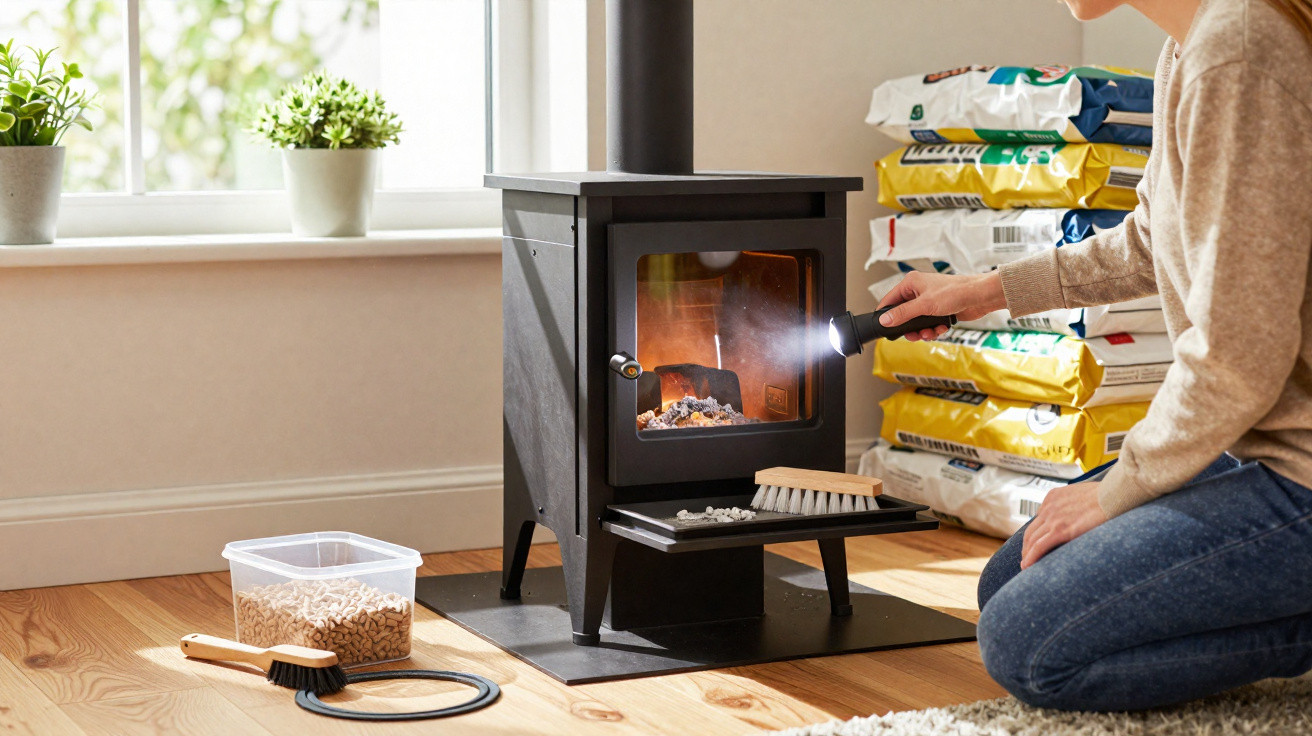
When the sun grew stronger in May, I simply switched off my pellet stove – as I do every year. No spring service, no inspection, no cleaning. Months later, the appliance stopped working: faults, smoke and costly repairs. Only then did I realise how essential thorough spring maintenance really is.
Why spring servicing for a pellet stove matters so much
Even when a pellet stove is used only occasionally in spring, it is under considerable strain whenever it runs. Every burn leaves behind residues: fine ash, soot and dust. Much of this is invisible because it collects in narrow ducts and concealed corners.
Anyone who fails to maintain their pellet stove in spring risks faults, higher consumption and, in the worst case, a safety issue in winter.
These deposits can:
- obstruct the air supply;
- restrict the removal of flue gases;
- significantly reduce efficiency;
- noticeably increase pellet consumption.
Ultimately, this means paying twice: once for extra fuel and again for repairs that a little maintenance could have prevented.
The key steps in a pellet stove spring check
1. Clean the burn pot and ash drawer thoroughly
The burn pot – also often called the burner cup or firebox – is the stove’s core. This is where the pellets burn. If ash blocks the air holes, the fire burns poorly, the flame becomes sluggish and the stove produces more soot.
A sensible schedule is:
- during the heating season: sweep it out daily to weekly, depending on use;
- in spring: carry out an especially thorough clean before leaving it unused.
A dedicated ash vacuum with a HEPA filter is ideal. Fine ash can quickly damage a standard household vacuum cleaner, which may also blow particles back into the room. Most importantly, only vacuum ash once it has cooled completely.
2. Inspect seals and replace them where necessary
Door seals and other rubber profiles ensure that a pellet stove burns cleanly and in a controlled manner. Once they become brittle, unwanted air can enter the stove. As a result, the controls respond incorrectly, combustion becomes unstable, and soot and ash increase.
Worn seals can be identified by looking closely for:
- cracks or crumbly sections;
- distorted areas that no longer sit flush against the metal;
- glass that becomes noticeably sooty more quickly than it used to.
Many manufacturers supply suitable seal kits that a qualified engineer can fit promptly. This often overlooked weak point is particularly worth checking on older appliances.
3. Clean the glass for appearance and safety
Clean stove glass is not a luxury. It indicates how cleanly the stove is burning. If the glass is constantly black, there is usually a problem with the air supply or the fuel.
In most cases, all you need is:
- a soft cloth or kitchen paper;
- a specialist stove-glass cleaner; or
- a paste made from a little fine, dry ash and water as a simple, inexpensive alternative.
Avoid metal scouring pads and harsh cleaners, as they can permanently scratch the glass.
4. Keep air channels and flue-gas routes clear
A small shovel, a soft dusting brush and an ash vacuum are useful for cleaning the air channels. Air needs an unobstructed path for the pellets to burn evenly. Blocked channels can cause error messages, an unclean flame or sudden shutdowns.
The flue-gas routes are just as critical. If soot builds up here, it increases the risk of a smouldering fire in the pipe or dangerous carbon monoxide exposure. This is also where the chimney sweep plays an important role.
The essential requirement: annual servicing by a professional
Many countries now have clear requirements: anyone operating a pellet stove must have it serviced regularly by a specialist company. The aim is to keep the appliance safe, efficient and environmentally compatible.
A typical annual service includes:
- complete cleaning of the stove inside and out;
- inspection of the burn pot, ignition element, fans and sensors;
- checking the safety devices;
- fine-tuning settings where needed;
- cleaning or inspecting the flue pipe and chimney.
Following this maintenance, the operator will generally receive a certificate. It provides evidence to insurers and authorities that the stove has been maintained in accordance with the relevant requirements.
The benefits of spring servicing
Spotting problems early
Having a pellet stove checked immediately after the heating season means faults can be found in good time: split seals, corroded metal panels or faulty sensors. In autumn, spare parts are often less readily available, appointments are scarce and waiting times are lengthy. During spring, these issues can usually be resolved calmly and often at lower cost.
Greater availability from specialist firms
Heating engineers and stove installers are often working at full capacity in autumn and the depths of winter. Between October and January, it can be difficult to secure a maintenance appointment. April, May and June are different: scheduling is more flexible, you do not have to stay cold for ages while waiting for a visit, and early-booking discounts on service packages are sometimes available.
Improved efficiency, lower costs
A clean, correctly adjusted pellet stove needs fewer pellets to deliver the same heat output. This lowers heating bills and reduces emissions. With energy prices rising, even a few percentage points of efficiency improvement can make a difference to your budget.
Clean stove, clean combustion: those who maintain it in spring save real money in winter.
Common pellet stove owner mistakes – and how to avoid them
- No regular cleaning of the stove: Even light use creates residues that build up layer by layer.
- Cheap pellets from questionable sources: Lower-quality products often contain more dust, bark and binding agents – leading to more ash and blocked components.
- Leaving the pellet hopper full for months: In damp cellars, pellets absorb water, swell and disintegrate. This can jam the auger drive.
- Constantly postponing annual servicing: Those who act too late often get an unpleasant surprise in the middle of a cold spell.
Practical everyday tips for your pellet stove
A simple maintenance plan makes it easier to stay on top of things:
| Interval | Task |
|---|---|
| weekly during the heating season | Empty the burn pot, remove loose ash and quickly wipe the glass |
| monthly | Check air channels, inspect seals and examine the pellet silo |
| spring | Thoroughly clean the interior, empty the ash drawer completely and empty the pellet silo |
| annually | Professional servicing, including measurement and checks of all safety functions |
If you put these tasks in your calendar, you can avoid the stove eventually “presenting the bill” – with an error message and a cold home on a frosty January evening, as happened to me.
What many people do not know: the risks and added benefits of proper care
Pellet stove operators often underestimate carbon monoxide. The gas is invisible, odourless and can be dangerous even in small quantities. A poorly maintained system with blocked flue-gas routes raises this risk. A CO alarm near the stove provides extra protection and costs only a fraction of a repair.
On the other hand, a well-maintained pellet stove offers a considerable advantage: when it runs efficiently, it provides comparatively climate-friendly heating because pellets are often made from residual wood. The better the stove is adjusted, the less fine particulate matter and unburned residue are released into the air.
For households considering an energy-efficiency refurbishment, a properly maintained pellet stove can also be an important element. Combined with a heat pump, solar thermal system or photovoltaic system, it creates a flexible heating concept that smooths peak loads and saves money over the long term. The condition remains the same: regular care – and the spring check that I ignored for far too long.






Comments
No comments yet. Be the first to comment!
Leave a Comment