
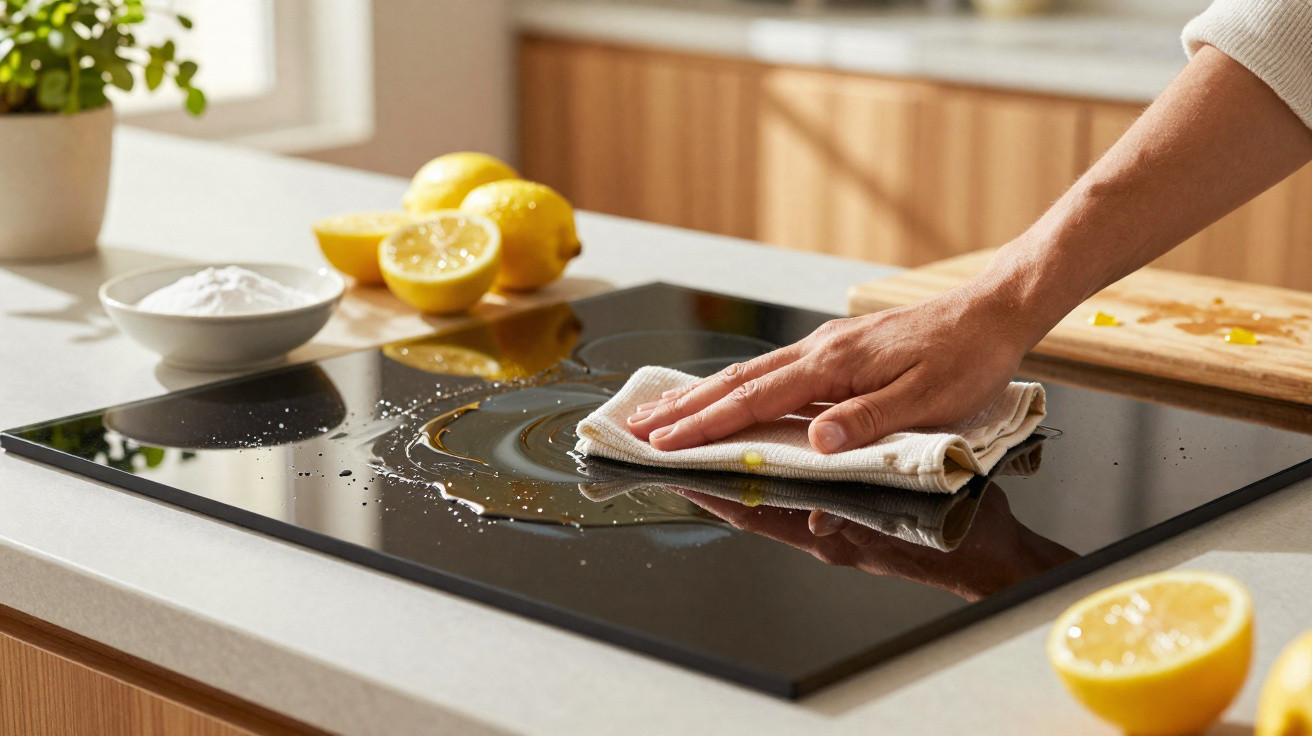
Many people instinctively reach for harsh sprays and expensive “power cleaners” when faced with burnt-on residue. Yet an everyday food that is probably already sitting in the fruit bowl is often enough to clean a ceramic hob or gas rings thoroughly. And no, this is not about a trendy foam advertised on television, but something far simpler.
Why a hob quickly starts to look neglected
Fat splatters during cooking, starch caramelises and sauces boil over. Fail to wipe it up straight away, and the edges soon bake themselves on. Over time, an unattractive film develops that makes the entire hob appear dull. Using the wrong sponge or overly abrasive products at this point can lead to scratches or matt patches.
There is another issue: many cleaners leave streaks or a greasy residue behind. The surface may look better briefly, but after the next cooking session it is blotchy again. This is exactly where a natural helper proves useful, cutting through grease, tackling limescale marks and even reducing slight discolouration.
The overlooked star: lemon for cutting grease and adding shine
A classic lemon usually ends up in tea or salad dressing. However, it can do considerably more in the kitchen: the fruit contains plenty of citric acid, which emulsifies fats and loosens mineral deposits. This is especially noticeable on smooth surfaces such as ceramic, induction and enamelled gas hobs.
“Lemon works like a gentle, natural cleaner: it dissolves grease, lightly brightens surfaces and leaves a fresh fragrance at the same time.”
Anyone wishing to avoid chemicals, or with sensitive skin, benefits twice over: cleaning can be done with one biodegradable food item that produces no irritating fumes.
Step by step: clean your hob using only lemon
Before you begin, allow the hob to cool down completely. Hot plates and acid are a poor combination - and there is a risk of burns as well.
Simple basic cleaning with half a lemon
- Cut the lemon in half: Slice a fresh lemon across the middle. The cut side provides the acid, while the flesh creates a mild “exfoliating” effect.
- Wipe the surface first: Remove large crumbs and loose food debris with a damp cloth, so that nothing scratches across the surface.
- Rub with the lemon: Move the cut side directly over the hob. Apply light pressure in circular motions, paying particular attention to greasy areas.
- Leave it to work: Let the lemon juice sit on the marks for two to five minutes. This gives the acid time to loosen grease and light baked-on residue.
- Wipe with a damp cloth: Remove everything using a soft, slightly damp sponge or microfibre cloth.
- Dry without streaks: Buff the hob with a dry cloth until it shines again.
After this process, the hob will often already look noticeably cleaner and feel smoother. Slight odours from the last frying session disappear, leaving a fresh citrus note behind.
When the hob looks really bad: lemon plus bicarbonate of soda
For burnt-on edges or old layers of grease, acid alone may sometimes not be enough. In this situation, a simple cupboard staple from the baking aisle boosts the effect: bicarbonate of soda, or traditional baking powder made with bicarbonate of soda.
“The combination of acid and fine particles works in two ways: it dissolves dirt chemically while providing gentle mechanical abrasion - without causing coarse scratches.”
How the powerful combination works
- Prepare half a lemon: Set aside another lemon half, with the cut side facing upwards.
- Sprinkle on bicarbonate of soda: Add a small amount of bicarbonate of soda directly to the cut surface. This forms a light paste.
- Work it over the hob: Rub the heavily soiled areas using the prepared lemon half. The mixture will begin to fizz lightly.
- Treat stubborn marks: Rub very dark stains a little more firmly, but do not use abrasive scouring pads.
- Wait for a few minutes: Allow the reaction to work briefly, then lift it away with a damp sponge.
- Rinse thoroughly and dry: Wipe several times with clean water until no bicarbonate of soda or lemon juice residue remains visible.
The gently fizzing layer produced in this way removes dried sauce, cooking residue and greasy crusts far more effectively than lemon juice alone. On smooth surfaces, bicarbonate of soda acts as a very fine abrasive which does not scratch when used with normal pressure.
Where this method works best - and where to take care
Using lemon and bicarbonate of soda is particularly suitable for:
- Glass-ceramic hobs (Ceran or induction) without deep scratches
- Enamelled gas hobs and metal covers
- Oven fronts and lightly soiled metal frames
- Greasy stainless-steel areas around the hob
On highly sensitive surfaces, including natural-stone worktops, unfinished wood or soft plastics, use the acid sparingly and only on small areas. It may attack the surface or create dull patches. If in doubt, test it first in an inconspicuous corner.
Benefits compared with conventional kitchen cleaners
Many households keep several sprays, gels and foam cleaners in the cleaning cupboard. However, there are several reasons to choose the simple citrus solution:
| Aspect | Lemon / bicarbonate of soda | Commercial cleaner |
|---|---|---|
| Cost | Inexpensive and often already at home | Significantly more expensive per use |
| Smell | Fresh, not harsh | Often heavily perfumed or chemical |
| Environment | Readily biodegradable | Some contain problematic ingredients |
| Handling | Gentle and can be used without gloves | Pay attention to warning labels |
People with children or pets at home often feel more comfortable using natural products. Any residue on the surface can be removed completely with water, without leaving irritating substances behind.
How to keep the hob clean for longer
A simple routine keeps the hob looking presentable for much longer, preventing thick crusts from forming in the first place.
- After cooking, briefly wipe over the surface while it is still slightly warm, but not hot.
- Remove boiled-over liquids immediately, before they dry.
- Give it a small “lemon treatment” once a week rather than tackling major cleaning jobs only occasionally.
- For Ceran, use only soft cloths and suitable scrapers.
These small measures save time in everyday life. Rather than having to use force every few weeks, just a few minutes of regular care will do.
The science behind lemon and bicarbonate of soda
The acid in lemon weakens the bond between grease and the surface, while bicarbonate of soda reacts with it to create a lightly foaming mixture. This breaks down the bonds within layers of dirt without requiring strong solvents. The fine bicarbonate particles also act like micro-abrasives, lifting residue away.
Naturally, a little manual effort is still required. But if you spread the work sensibly, there is no need to scrape and scrub until your fingers hurt. A few targeted movements with the right combination are enough to make the hob presentable again.
Other uses around the kitchen
Lemon and bicarbonate of soda are not just useful for the hob. Used in moderation, the mixture can also help with:
- Light discolouration in stainless-steel or ceramic sinks
- Odours in the fridge (use bicarbonate of soda on its own in a bowl here)
- Greasy extractor hood surfaces
- Limescale rings on taps (use lemon on its own here and do not leave it on for too long)
Keeping these household staples close to hand saves the need for several specialist bottles. The kitchen stays more organised, the cleaning cupboard less cluttered - and the hob shines as if it had been cleaned professionally.






Comments
No comments yet. Be the first to comment!
Leave a Comment