
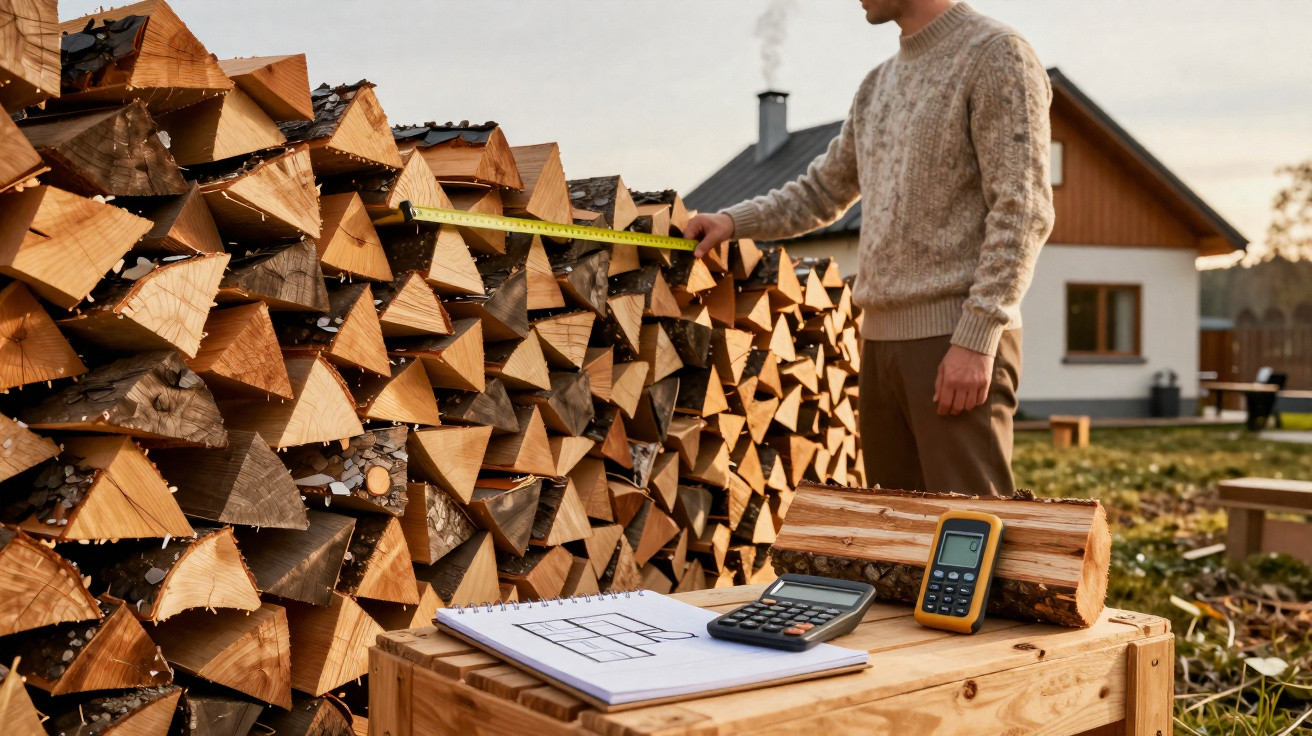
If you are getting ready for winter and intend to heat with a wood-burning stove or range, one practical question soon arises: how many stacked cubic metres of logs should you buy to keep a detached house of around 80 to 120 m² dependably warm? The answer varies considerably according to the property, appliance, timber species and where you live.
The factors that genuinely determine log consumption
Although asking for the “right” quantity of logs sounds straightforward, the real-world answer depends on several variables. Understanding them allows you to estimate your needs fairly accurately and avoid costly over- or under-buying.
- Floor area: A larger home has more air volume to heat and loses more heat.
- Insulation standard: A well-insulated home needs less heating, whereas a poorly insulated older property needs substantially more logs.
- Heating appliance and efficiency: A modern stove operates far more efficiently than an open fire.
- Local climate: In exposed, colder areas, the stove will run for longer and at a higher output than in milder locations.
- Wood type and quality: Hardwood provides more energy per log than softwood, while dry wood burns better than damp timber.
- How you use it: Someone using the stove as their main heating source will burn more wood than a person who lights it only in the evening “for a cosy atmosphere”.
For the same house, annual use can range from 4 to 12 stacked cubic metres, depending on insulation, climate and the type of stove.
How much wood does a stove actually need?
The key consideration is the heating appliance’s efficiency: how much of the energy stored in the wood reaches the room rather than disappearing up the chimney.
Typical guide figures by appliance type
- Modern wood-burning stove (high efficiency, clean combustion): For an averagely insulated home of roughly 100 m², 4 to 6 stacked cubic metres per winter will usually be enough.
- Built-in fireplace / cassette fire (closed glass door): For 100 m², you are more likely to need 6 to 8 stacked cubic metres.
- Open fireplace (very inefficient): The same floor area may require 12 to 15 stacked cubic metres, as a substantial share of the heat escapes directly through the chimney.
For the common home size of 80 to 120 m², use the following approximate ranges when wood is the principal heating source:
| Floor area | Insulation standard | Heating appliance | Guide figure: stacked cubic metres per winter |
|---|---|---|---|
| 80 m² | well insulated | modern stove | 3–4 |
| 100 m² | average insulation | modern stove | 4–6 |
| 100 m² | average insulation | built-in fireplace / cassette | 6–8 |
| 120 m² | average insulation | built-in fireplace / cassette | 7–9 |
| 80 m² | poorly insulated | open fireplace | 10–12 |
These figures are intended only as a guide. Requirements can be noticeably higher in areas with prolonged severe frosts, while mild winters can reduce them considerably.
Insulation: the biggest opportunity to use less firewood
If you want to cut log consumption, examine the building envelope before focusing on the stove. Otherwise, some of the expensively purchased warmth will escape through the roof, windows and uninsulated walls.
- New windows and well-sealed doors cut draughts and heat loss.
- Insulating the roof and top-floor ceiling often delivers the quickest improvement.
- Sealing common weak points, including shutter boxes, gaps and basement ceilings, saves heating energy immediately.
A well-insulated 100 m² house can manage with 4–6 stacked cubic metres, while a poorly insulated older home of the same size can easily consume 8–12.
Even without undertaking major refurbishment, simple measures such as sealing strips around windows, curtains in front of external doors and closing shutters on cold nights can make a noticeable difference.
Wood is not all the same: choosing the right type
Your choice of timber affects how much energy you obtain from each stacked cubic metre. Hardwood has a clear advantage over softwood.
Recommended wood types for a stove
- Oak, beech, ash and hornbeam: These are hardwoods with high calorific value and long-lasting embers, making them ideal for the base heating load in winter.
- Birch: It has a slightly lower calorific value, but burns very pleasantly with a calm flame.
- Spruce, fir and pine: These softwoods burn down more quickly and work well for lighting the fire or during milder periods.
Residual moisture is equally important. Freshly felled timber can contain more than 40 per cent water and does not belong in a stove. A moisture content below 20 per cent is ideal.
Only dry wood heats efficiently: damp wood uses up some of its energy evaporating water and puts strain on the chimney.
Storing logs correctly to keep them properly dry
To deliver their full heating output, logs need suitable storage for at least one to two years, depending on the wood species.
- Stack wood with good airflow, rather than pressing it directly against a completely enclosed wall.
- Always place it on battens or pallets so that moisture cannot rise from the ground.
- Cover the top, for example with a sheet that still permits airflow at the sides.
- Position stacks facing south or west, where the timber will dry faster.
If space permits, many people keep a two-year supply. This provides a sufficient buffer if winter proves colder than expected and gives the logs time to dry out fully.
Practical examples for homes with 80 to 120 m² of floor area
To put the figures into perspective, here are several typical scenarios for a winter in which heating is mainly provided by wood:
- Terraced house, 90 m², good insulation, modern stove: In an average winter, 4 to 5 stacked cubic metres of hardwood are often sufficient.
- Detached house, 120 m², average insulation, fireplace cassette: A realistic allowance is 7 to 9 stacked cubic metres, depending on how warm you want the rooms.
- Small house, 80 m², little insulation, open fireplace: Budget for 10 to 12 stacked cubic metres if the fire is expected to heat the house rather than merely serve as decoration.
- Well-renovated older property, 150 m², high-output wood-burning stove: Despite the larger floor area, many households manage with 8 to 10 stacked cubic metres.
Stacked cubic metre, loose cubic metre, solid cubic metre: what merchants mean
Different terms used when buying wood can be confusing. Knowing what they mean makes it easier to compare prices.
- Stacked cubic metre (rm): 1 m³ of stacked logs, including the gaps between them; the traditional measure for split firewood.
- Loose cubic metre (srm): Loosely tipped logs, for example in a container. It contains more air and less wood than a stacked cubic metre.
- Solid cubic metre (fm): 1 m³ of pure timber with no air gaps, a measure used more commonly in forestry.
As a rule of thumb, 1 stacked cubic metre is equivalent to approximately 0.7 solid cubic metres. If converting from loose-tipped wood to neatly stacked logs, it is best to ask the merchant specifically which definition they are using.
How to estimate your real wood requirement more accurately
When planning a full heating season with wood for the first time, it is easy to get the purchase quantity wrong. A two-stage approach is practical: buy slightly generously in the first year, record usage, then make a more targeted purchase in the second.
- Record how many stacked cubic metres are in storage at the start.
- Check how much remains at the end of the heating season.
- Keep track of temperatures and your personal heating habits (are you at home a lot? Do you prefer 22 rather than 20 °C?).
This will give you a fairly precise sense of how much wood your home actually “gets through” within one or two winters. Many households with a modern stove and standard insulation fall within 5 to 8 stacked cubic metres when heating 80 to 120 m² mainly with wood.
Using another heating system as well - such as gas, a heat pump or pellets - can reduce log demand dramatically. In these mixed systems, one to three stacked cubic metres of wood are used more for comfort and covering peak demand than for the entire basic heat supply.




Comments
No comments yet. Be the first to comment!
Leave a Comment