
Three simple tricks can make your home noticeably warmer.
For many households, winter becomes a minor ordeal: heating bills rise, yet the home still feels chilly. Anyone unable to replace windows or pay for insulation will be looking for quick, low-cost fixes. That is where three physics-based measures come in, making indoor conditions far more comfortable with items that most people already have at home.
Why it often stays cold despite the heating
When temperatures fall below freezing outside, several issues tend to coincide: poorly insulated walls, draughty windows, cold floors and radiators that send some of their heat in the wrong direction. The result is familiar: the thermostat is turned up, the bill increases, but comfort barely improves.
Anyone who understands how heat moves – through conduction, radiation and air movement – can gain several degrees of comfort with just a few simple steps.
Physicists identify three key mechanisms:
- Conduction: Heat travels through solid materials, but can also escape outdoors through joints and gaps.
- Radiation: Radiators emit heat in every direction, including towards cold walls.
- Convection: Warm air rises while cold air falls, causing heat to circulate around the room.
Addressing these three areas often means you do not need to turn the heating up as far to feel considerably more comfortable.
Trick 1: Seal gaps more effectively and keep heat indoors
Some heating energy simply disappears through cracks and gaps. Cold air creeps beneath doors, whistles past windows and leaves rooms feeling draughty. This reduces not only the actual temperature but also how comfortable the room feels – even at a seemingly “normal” 20 degrees.
Where the usual weak points are
The trouble spots are nearly always the same:
- old wooden windows with hardened or missing seals
- balcony doors where light can be seen through the gap
- gaps beneath doors leading to a hallway, cellar or entrance door
- uninsulated roller-shutter boxes and letterboxes
Holding a hand near a gap, or carefully moving a tealight along it, will quickly reveal where the draught is strongest.
Straightforward measures that work immediately
The good news is that sealing the biggest leaks does not require a large budget. Useful options include:
- Self-adhesive seals for windows and doors, which can be cut to size with scissors.
- Door seals or “draught excluders” along the floor, such as foam strips or fabric rolls.
- Heavy curtains in front of windows and external doors, ideally made from thermal fabric.
- Rugs on tiled or laminate floors, especially in living rooms and bedrooms.
A well-sealed curtain and a thick rug can raise the perceived temperature around a window by up to two degrees – without adjusting the thermostat.
Anyone with particularly sensitive feet will notice the difference straight away: cold floors take away a great deal of comfort. A wool or jute rug interrupts this cold effect, keeps feet warm for longer and usually removes the need for extremely high room temperatures.
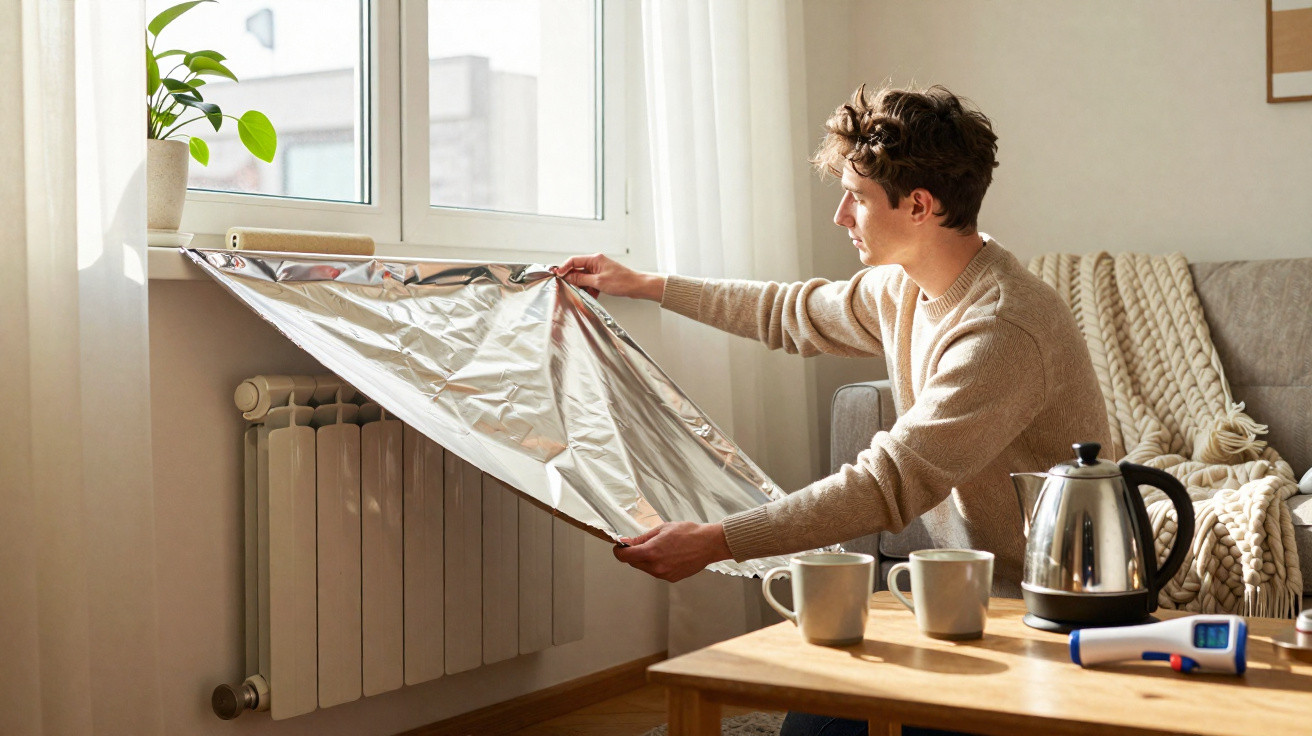
Trick 2: Upgrade radiators with aluminium foil
Many radiators are positioned directly in front of external walls. As a result, a significant share of their radiant heat simply disappears into the wall. This is where an unexpected household helper comes in: ordinary kitchen aluminium foil.
How the heat trick works physically
A radiator releases energy not only into the air, but also as infrared radiation in all directions. When that radiation hits a cold external wall, it warms the wall rather than the room air to the same extent. Aluminium reflects much of this radiation back into the room.
Reflective surfaces behind a radiator can save roughly five to ten percent of heating energy, depending on the building condition and the radiator’s position.
Step by step: make your own heat reflector
- Cut a piece of cardboard to match the radiator’s surface area.
- Cover it smoothly with aluminium foil or an emergency blanket, with the shiny side facing outwards.
- Position or hang the cardboard behind the radiator, leaving a little space from the wall so that air can circulate.
- Make sure that nothing rests directly on hot surfaces and that there is no contact with electrical components.
Ready-made reflective panels made from rigid foam with an aluminium surface are available from retailers. They cost more than a homemade version, but are sturdier and usually easier to fit, particularly in rented homes.
Where caution is needed
This approach is primarily suitable for conventional hot-water radiators on external walls. Keep the following in mind:
- Do not stick foil directly onto damp walls at risk of mould, as moisture can build up behind it.
- The benefit is minimal with modern, slim electric heaters; check the manufacturer’s instructions first.
- Do not leave aluminium foil hanging loosely – avoid fire hazards and maintain the minimum clearance.
Trick 3: Make better use of everyday heat sources
People, appliances and cooking release more heat than many realise. A resting person gives off approximately as much power as an old-style light bulb. When several people are in a smaller room, the temperature rises noticeably.
Concentrate warmth rather than spreading it around
A practical method is to group activities together. Rather than spreading out across several rooms in the evening, focus on one living area. The television, laptop and lighting can all be used there too – each is a small heat source. In an enclosed room, their effect adds up.
Households can also use cooking more strategically:
- Leave the oven open after switching it off, provided nobody could burn themselves.
- Keep doors to less-used rooms shut while cooking, so the heat remains where people are sitting.
- Use a lid when heating a pan, so energy reaches its contents more quickly.
Kettle instead of hob – using energy wisely
For hot water, an electric kettle is often worthwhile. It is generally more efficient than a hob because the heat goes directly into the water. Heating only the amount actually needed delivers a double saving.
| Use | Energy needed for 1 litre of water* | Typical mistake |
|---|---|---|
| Kettle | lowest | heating too much water, failing to remove limescale |
| Hob | medium to high | pan too large, no lid, ring set too large |
| Microwave | often highest | long running time, unsuitable container |
*Indicative figures, heavily dependent on the appliance and how it is used.
Filling the kettle only halfway rather than to the brim can significantly reduce everyday electricity use – while making the same amount of tea or coffee.
Residual heat can be used creatively: hot water can go into a hot-water bottle, a flask for later, or be used for washing up. All of this adds to the feeling of warmth in everyday life.
Atmosphere and light: enhancing the sense of warmth
There is also an interesting psychological effect: warm, yellowish light makes a room feel cosier than cold, white light. Modern LED bulbs at around 2,700 Kelvin create this “candlelight effect” while using very little electricity.
In the evening, placing a few warm-white light sources and some safe tealights in sturdy glass or ceramic holders will automatically make a room feel snugger. Important: never leave candles burning unattended, and ventilate sufficiently because they consume oxygen.
How to combine the effects effectively
The greatest impact comes when all three approaches are used together:
- Seal draughty areas and reduce the effect of cold surfaces with rugs and curtains.
- Fit radiators with reflective surfaces so that the heat remains in the room.
- Deliberately concentrate everyday heat sources, such as cooking, people and lighting, in one main room.
If you then lower the heating slightly, you can save money while still enjoying a pleasant indoor climate. Reducing the thermostat by one degree means roughly five to six percent lower heating costs – and consistent insulation and use of these tricks makes that far easier.
The older the building and the poorer its starting condition, the more noticeable the improvements will be. In modern, well-renovated flats, these measures are more about fine-tuning and comfort; in older buildings, they can make the difference between “constantly freezing” and “finally cosy”.



Comments
No comments yet. Be the first to comment!
Leave a Comment