
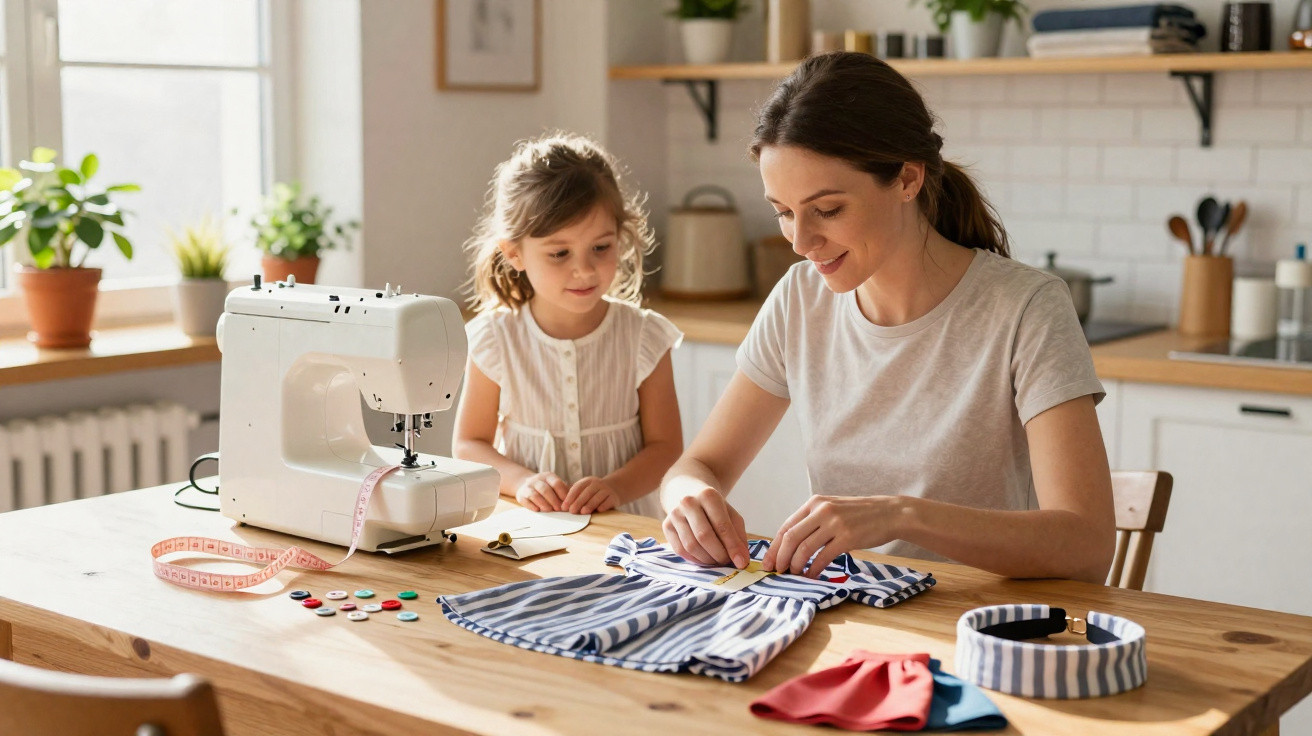
Old shirts are piling up in the wardrobe, but they seem too good to throw away?
A simple sewing idea can turn them into much-loved dresses for children.
Anyone with children knows the issue: little ones outgrow their clothes faster than replacements can be bought. At the same time, long-forgotten business shirts are hanging in the wardrobe, unworn by anyone. One smart upcycling idea solves both problems, transforming Dad’s shirt into a child’s new favourite dress without any fabric costs.
Why a men’s shirt is an ideal starting point for a child’s dress
A classic men’s shirt in size L or XL provides a surprisingly generous amount of material: it contains around 1.5 to 2 square metres of fabric. In a fabric shop, comparable high-quality poplin could easily cost €15 to €25 per metre. Yet this fabric is effectively waiting in the wardrobe for free, already washed, soft and durable.
An old shirt can become a high-quality, hard-wearing dress for children at no cost – without buying new fabric.
Densely woven materials such as poplin, Oxford cloth and chambray are particularly suitable for children’s clothing. They are comfortable against the skin, robust, and can cope easily with running about, climbing and playing in the sandpit. There is another advantage too: because the shirt has already been through the washing machine many times, it is unlikely to shrink further or lose its colour.
The project also benefits the environment. The textile industry is among the sectors that use the most resources. Every garment that remains in use for longer or is given a second purpose reduces pressure on both the household budget and the bin.
Step by step: turning a shirt into a child’s dress
Preparation: checking what can still be used
Before picking up the scissors, inspect the shirt carefully:
- Wash and iron the shirt thoroughly so that markings can be drawn accurately.
- Identify heavily worn areas, usually the inside of the collar and the cuffs.
- Mark stains and small holes so they do not end up on the front of the dress.
- Keep the button placket where possible, as it is the most technically demanding feature and can simply be reused.
The back, front panels and sleeves make up the available fabric supply. Rather than unpicking the entire shirt, it is worth cutting strategically: leave seams intact wherever they do not get in the way to save time.
Getting the size right with an existing dress as a template
For children aged between two and six, one men’s shirt will generally be enough. The easiest approach is to use a well-fitting child’s dress as a guide. It provides a natural template for the width, length and neckline.
A typical layout is as follows:
- The back of the shirt becomes the skirt section.
- The sleeves are used for the bodice or a small attached chest panel.
- The front section with the button placket remains at the front or is used for the back.
Place the child’s dress on the shirt fabric, trace around it while allowing a little seam allowance, then cut out the pieces. Any stains or worn patches can simply be avoided at this stage.
Save time by reusing the finished hem
One particularly useful trick involves the hem: the shirt’s already sewn lower edge can be used directly as the skirt hem of the child’s dress. This avoids one of the more tiresome jobs normally involved in sewing.
Using the shirt’s existing hem saves a good 20 minutes of work and creates a neat, even finish.
Then sew the bodice and skirt together. Gentle pleats or gathers will give the skirt a pleasing swish. Shirts with curved front and back hems are especially effective, as they create an attractive line for toddlers’ dresses.
Design ideas: small details make the dress unique
Button placket at the front or back: both work
The shirt design already offers one major benefit: the button placket is in place. You can choose between the following options:
- Leave the button placket at the front for a classic look that also makes dressing easier.
- Move the button placket to the back, an option many particularly like for toddlers because it is both decorative and practical.
The curved hem found on many shirts can also be put to good use. It gives the skirt a subtly playful shape without requiring complicated pattern pieces.
Turn fabric offcuts into accessories
There is no need to throw away what remains from the sleeves, collar and front panels. These pieces can become useful extras:
- A hairband made from the same fabric as the dress
- A miniature dress or skirt for a favourite doll
- Fabric flowers or bows for the shoulder area
- Small pockets for treasures collected at the playground
When a dress is made from Dad’s shirt, the finished item also takes on a strong emotional significance. Many parents enjoy telling their children later which office shirt or special-occasion shirt the dress came from. That story gives the garment a very different character from an anonymously bought item.
Choosing materials and practical questions: what works best
Which shirts are most suitable for a child’s dress?
In principle, many types of shirt can be reused. The following work especially well:
- Cotton in poplin, Oxford or chambray weaves
- Linen shirts with a weave that is not too loose
- Fine stripes, checks or small patterns, which often look far more charming at a child’s scale than on an adult
A slightly “tacky” pattern that looks out of place on a man can look unexpectedly sweet as a child’s dress. A heavily worn collar or stains around the breast pocket are not a problem, as those sections can simply be excluded during cutting.
Can it be made without a sewing machine?
Yes, the project can also be completed by hand. Strong, straight stitches will create durable seams. A sewing machine makes the process much quicker, but a basic hand-sewing kit is enough for a first upcycling project.
A professional paper pattern is not essential either. A well-fitting child’s dress provides reliable measurements for the neckline and width. Those wanting to develop their skills can add extra features next time:
- Add small side pockets made from leftover pieces.
- Sew narrow straps instead of sleeves, ideal for summer.
- Shape the former cuffs into short “flutter sleeves”.
Benefits for family and environment
Sewing a child’s dress from a men’s shirt is more than a craft project. It playfully shows children that clothes have value and do not need to be discarded straight away. Involving a child in choosing the shirt or decorating the completed dress creates shared memories while also teaching an appreciation of sustainable consumption.
There is a financial benefit too. Good-quality children’s clothing can quickly cost €30, €40 or more. Altering an unused shirt saves money while still producing an individual garment that cannot be found in a shop. Families with several children can use the method repeatedly, creating a small “family collection” from different shirts.
Anyone who enjoys the process can easily apply the technique to other projects: two shirts can become a casual summer dress for a teenager, a flannel shirt can be turned into cosy pyjama trousers, or several shirts can make a patchwork blanket. The principle is always the same: rethink fabric already available instead of immediately buying something new.






Comments
No comments yet. Be the first to comment!
Leave a Comment