
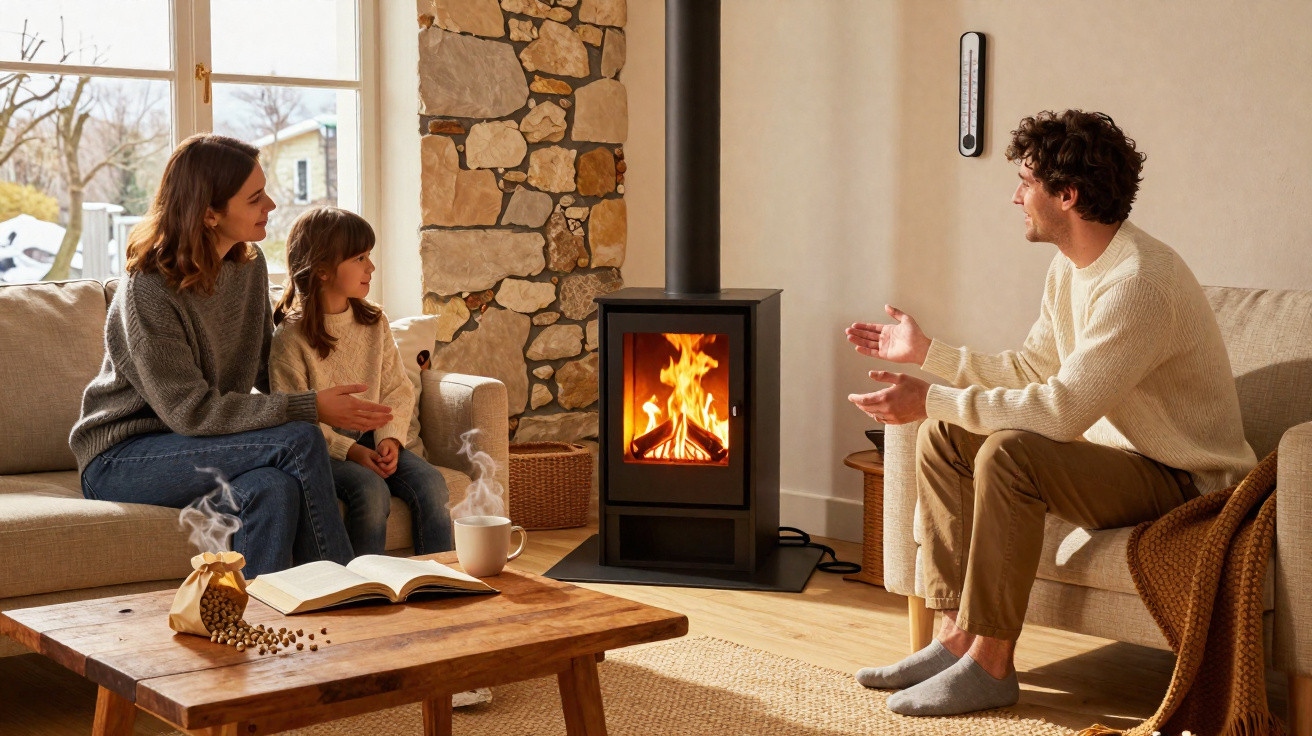
The lights flicker before failing altogether. The fridge stops, Wi-Fi disappears and electric heaters fall silent. Even so, the room remains warm, while the fire in the corner continues burning steadily by itself. There is no display to operate, no app on a phone and no fan droning away.
This is not a throwback to the 1970s. It is rural France in winter 2025, where the evening’s focal point is a pellet stove that operates without electricity. Its small wood pellets are supplied through gravity and traditional mechanical engineering. It seems at once old-fashioned and unexpectedly current.
An increasing number of French households are making the same decision: fewer technologies and greater self-reliance. They want a flame they can watch, feel and rely on. Their motivations extend well beyond simply cutting household bills.
From high-tech frustration to low-tech comfort
Visit a French DIY retailer today and the contrast is apparent. Connected thermostats and smart plugs fill the shelves, yet shoppers tend to stop around pellet stoves that do not need electricity. They run their hands over the cast iron, ask detailed questions and photograph the models to consider later. Sales staff regularly find themselves saying the same thing: “Yes, it heats even during a power cut.”
There is a subdued form of rebellion behind the trend. Many people no longer want apps and software updates to stand between them and a warm home. A non-electric pellet stove reverses the usual arrangement: no display, no whirring fan, just a straightforward mechanism and a visible fire. Its appeal is simple and powerful - warmth that keeps going when the electricity grid fails.
A couple in their forties in Brittany recently fitted one in their renovated farmhouse. They had endured two winters of rotating power cuts and unreliable electric radiators. Their decisive moment came one January evening, when a storm left them without power for 14 hours. Research began the following day.
Initially, they considered conventional pellet stoves equipped with electric feeders and fans. Although the figures looked favourable, every question about a blackout was met with vague references to battery back-ups, generators or blankets. They eventually chose a gravity-fed non-electric model, with no electronics, passive convection and basic draught control. It may have looked less efficient on paper, but it was much more persuasive in everyday conditions.
French energy data reflects the wider shift. Gas and electric heating dominated new construction for years, but wood energy is once again growing in popularity, particularly in detached houses. Higher electricity prices after 2022, combined with concerns about energy dependence, led thousands of families to seek more resilient options. Pellet stoves without electricity are benefiting from that movement - not because they are the most eye-catching choice, but because they continue operating quietly when everything else stops.
The principle is remarkably straightforward. Ordinary pellet stoves use electronics to dispense pellets, control airflow and force warm air into the room. They are efficient, but they also have weaknesses: a power surge, damaged circuit board or faulty sensor can shut down the entire appliance. A non-electric pellet stove removes much of that vulnerability. Pellets descend under gravity, air circulates naturally and the fire behaves more like one in a classic wood-burning stove.
Servicing can be simpler as well. There is no motherboard to replace after a thunderstorm, no fan collecting fine dust and no error message flashing at 7 a.m. on a bitterly cold Monday. Pellets are still required, the chimney must draw properly and the stove needs some attention. However, the relationship with the heating changes: rather than operating a machine, you are looking after a fire.
That distinction has more psychological weight than people often acknowledge. Heat is no longer an abstract thermostat reading; it becomes physical, visible and reassuring. In a country where winter storms regularly interrupt electricity supplies in coastal and mountainous regions, that reassurance spreads quickly through word of mouth.
How French households use non-electric pellet stoves every day
Most French buyers of a non-electric pellet stove do not immediately remove their previous heating system. A hybrid set-up is usually the sensible approach. They retain their gas boiler, electric radiators or heat pump as background heating, while using the pellet stove in the principal living area, especially through the coldest part of the year.
This arrangement can reduce a substantial share of heating costs without placing all their trust in one technology. The stove becomes the home’s “heart”: where children do their homework, clothes dry more quickly on racks and friends gather after a long walk. Central heating shifts from being the main system to a reserve.
In practice, owners experiment. They learn the typical duration of a hopper full of pellets. They test leaving internal doors open so warmth can move into adjoining rooms. Some use basic rechargeable-battery fans to move hot air along a corridor when necessary. Others simply accept that one room will be the cosy, warm centre of the house, while the remaining rooms stay a little cooler.
A single mother living on a suburban street outside Lyon describes her routine. At about 6 p.m., when she and her son arrive home, she lights the stove. The flame warms the living space, and by bedtime the upstairs rooms have risen by a couple of degrees. At weekends, she keeps it lit for longer, holding a coffee and watching the small glazed panel glow orange. Her old convector heaters are now off most of the time. Last December, her electricity bill fell by almost a third.
There is also a quiet satisfaction in owning an object that is genuinely understandable. No software update and no unexplained beeping in the middle of the night: simply pellets, air and fire. People who once dreaded technical faults often feel more capable, because a problem with the stove is frequently visible and mechanical rather than concealed on a circuit board full of chips and acronyms.
Naturally, this low-tech comfort has its demands. Bags of pellets need dry, accessible storage space for winter. Deliveries must be arranged from a dependable supplier at a price that does not suddenly double. There is also a modest daily routine: topping up the hopper, inspecting the glass and checking the ash pan. On a hectic weekday, it can be tempting to ignore these tasks and turn up the thermostat instead.
Yet that small ritual brings an unusual sense of satisfaction. Feeding the fire becomes a gesture that marks the day, much like making morning coffee or locking the door at night. It creates some rhythm in lives that are often broken up by screens and notifications. When people explain why they value a non-electric pellet stove, they often describe sensations rather than figures: the silence, the scent of hot metal and the way the flame changes as the wind turns outside.
Choosing, installing and living with a non-electric pellet stove
The first meaningful decision is not the brand. It is defining the stove’s purpose. Is it intended to warm one living room, or should it serve as the primary heater for a small house? That answer determines everything else, including size, output, location and even the way winter evenings are spent.
French installers commonly advise matching the output to the space rather than to personal ambition. A slightly smaller stove running consistently with a moderate flame is often more comfortable than an oversized powerhouse that constantly needs restraining. Consider where people actually spend their time: beside the kitchen, at the dining table or around the sofa. That is generally the right location for the stove.
The next consideration is technical: the chimney, flue and airflow. Since non-electric pellet stoves depend on natural draught, flue height, diameter and routing matter far more than they do with forced-vent appliances. What appears to be a minor issue - one bend too many or a chimney that is too short - may result in poor combustion and blackened glass. This is where a competent installer proves their worth. A thorough site inspection, perhaps including a smoke test, can prevent many frustrating winter evenings.
Once the stove has been installed, the practical learning starts. Owners find out which pellets burn most cleanly, how a westerly wind affects the draw and how rapidly the room warms from a cold start. The first few days can resemble a modest science experiment. Within a few weeks, it becomes instinctive.
Let us be honest: nobody truly does all this every day. Nobody cleans the glass meticulously, empties the ash and inspects each seal with the consistency set out in manuals. Life is untidy. Children become ill, work finishes late and a bag of pellets gets forgotten in the car. The aim is not perfection, but a workable balance in which the stove performs well without making its owner a full-time keeper of the flame.
New owners often repeat the same early mistakes. They choose the cheapest discounted pellets, then object to soot and weak performance. They install the stove in a photogenic corner that restricts airflow. Or they use it like an electric heater, expecting immediate warmth the instant it is lit. A non-electric pellet stove is slower and more gradual. It favours those who plan ahead - lighting it before the house becomes freezing, keeping a sensible supply of pellets indoors and adjusting the draught patiently rather than turning the controls in irritation.
After these initial difficulties, another quality develops: trust. It is the kind of trust that arrives only after getting through a first winter together.
“During the big storm, we lost power for almost two days,” says Alain, 63, in the Landes. “The freezer was done, the router was dead… but the house stayed at 19°C. We played cards by candlelight next to the stove. At that moment, I told myself: this was the best investment I’ve made in ten years.”
That confidence also contributes to a wider sense of autonomy that many French households now seek quietly. They understand that they are not off-grid, and that supermarkets, networks and public services still matter. Nevertheless, having a heat source that does not fail when power lines go down changes their relationship with winter.
- Keep at least two weeks’ worth of pellets at home during the coldest months, stored away from damp.
- Arrange chimney sweeping before the first serious cold spell, rather than during January.
- Try the stove on a mild autumn evening to identify draught or smoke issues early.
- Speak to neighbours with the same sort of stove - their advice can often be more useful than a manual.
These modest, practical habits make a simple appliance feel more like a winter companion. It is neither flawless nor magical, only dependable.
A quiet change in how France wants to stay warm
The growing popularity of non-electric pellet stoves in French homes reveals something about the country’s current mood. At first glance, the story concerns heating bills and energy crises. More deeply, it concerns people weary of feeling helpless whenever the grid falters or prices rise overnight.
Buyers are acquiring more than heat. They are gaining a measure of control over their comfort without requiring an engineering qualification or smartphone app. It is a small appliance that does one job effectively: converting straightforward, locally available fuel into a calm, steady flame. The choice carries a hint of nostalgia, even for those who never lived with coal fires or wood ranges.
The same scene unfolds throughout the country on winter evenings. A hand opens the hopper; pellets make a soft rattle; there is a faint resin scent; then an orange flame takes shape behind the glass. Beyond the home, alerts and headlines may focus on grid strain and the energy transition. Indoors, the experience is more elemental: warmth, light and time moving a little more slowly.
Everyone has known the moment of sitting before a fire and becoming quiet without knowing quite why. Non-electric pellet stoves make that experience part of ordinary daily life. They concern emotion as much as kilowatt-hours. That may be why the trend shows no sign of disappearing, even while new technologies promise increasingly “smart” heating. Sometimes, the priority is not a smarter home, but a flame that can be trusted.
| Key point | Details | Why it matters to readers |
|---|---|---|
| Genuine independence during power cuts | Non-electric pellet stoves use gravity-fed hoppers and natural convection, allowing them to continue operating even when an entire street loses power. No batteries, generator or UPS is required. | In areas affected by storms or recurring outages, the living room can remain warm for hours while neighbours depend on blankets and candles. |
| Realistic heating capacity | Most non-electric models can comfortably heat 30–80 m² of open living space, depending on insulation and layout, but have difficulty with distant enclosed rooms. | This helps establish whether the stove should be the main heater in a small home or a cosy addition to an existing system. |
| Running costs compared with electric heating | With pellets costing around €300–€450 per tonne in many French regions, a carefully operated stove often costs less over a whole winter than electric radiators alone. | Understanding the approximate scale helps readers judge whether the investment could reduce their monthly outgoings rather than merely add another appliance. |
FAQ
- Do non-electric pellet stoves heat as well as electric models? They can, although they heat differently. Electric stoves use fans to push warm air, which spreads heat more rapidly and evenly. Non-electric versions depend on natural convection, making the effect slower and gentler. The area close to the stove is often exceptionally cosy, while more distant corners remain cooler. In an open-plan living area, the level of comfort is usually very satisfying.
- Are they really ecological compared to gas or electric heating? Pellet stoves burn compressed sawdust and wood waste, which are often made locally in France. When the material comes from responsibly managed forests, the carbon balance is generally better than that of fossil fuels. Choosing certified pellets and correctly setting the stove for clean combustion is crucial. Low-quality pellets and a poorly maintained flue can remove many ecological advantages.
- What kind of maintenance do they need? The ash pan must be emptied regularly, the glass cleaned when it darkens and the chimney professionally swept at least once a year. Some owners also vacuum fine dust around the burner area every few weeks. The work is straightforward, but cannot be completely neglected if performance is to remain steady and operation safe.
- Can I install a non-electric pellet stove in a flat? It can sometimes be done, but it is considerably more complex. An approved flue is needed, building regulations must permit individual stoves, and permission from the landlord or residents’ management body is required. In many urban flats, the absence of a suitable chimney or outlet makes fitting one unrealistic. Local rules and building restrictions should always be checked before getting too carried away.
- Are they noisy? This is one of their major benefits. As they have neither fans nor electric feeders, they are almost silent while operating. Usually, all that can be heard is the gentle sound of combustion and the occasional pellet falling. For anyone sensitive to a constant hum or buzz, this may be a decisive benefit.
- How long does a bag of pellets last? In an average living room with moderate winter temperatures, a 15 kg bag may provide between 8 and 20 hours of effective heating, depending on the stove’s output setting and the home’s insulation. After several weeks, owners usually understand their own consumption pattern very precisely and can stock up accordingly.
- Is a non-electric stove compatible with a modern, well-insulated house? Yes, although choosing the right size is critical. In an extremely efficient property, an oversized stove can quickly make the room too hot, forcing it to run at its lowest and less clean setting. A suitably selected smaller model, used alongside the main heating system, often provides the best comfort without wasting heat.
- What should I look for when buying my first non-electric pellet stove? Consider the rated output against the size of the room, the quality of the cast-iron or steel body, access for cleaning and the reliability of the local installer. Ask to see the stove working, listen to it and ask how it performs in strong winds. A good installer will discuss the chimney as thoroughly as the stove itself.

Comments
No comments yet. Be the first to comment!
Leave a Comment