
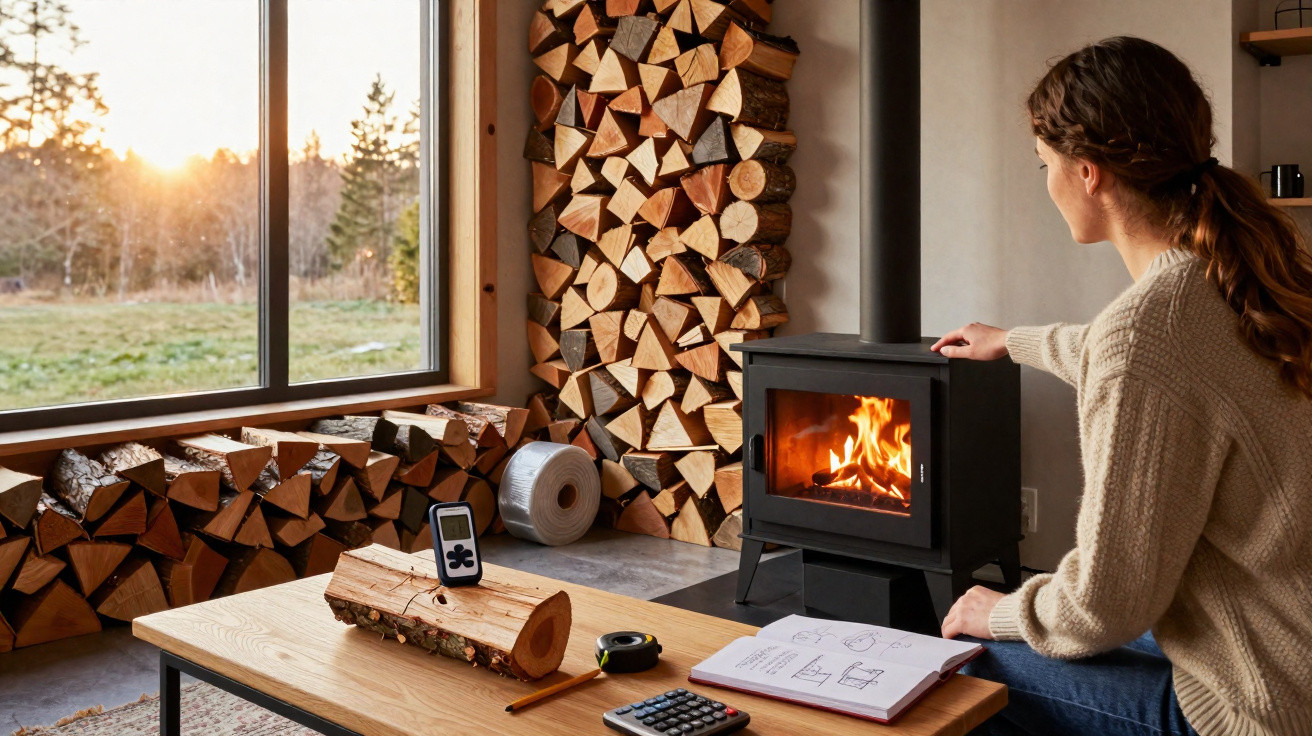
Heating a house with firewood can often reduce costs – but only if the amount needed for the entire winter period is planned carefully.
More and more households are returning to wood as a heating fuel. The appeal is clear: comparatively low costs, a comfortable indoor atmosphere and greater independence from oil and gas. The key issue, however, remains the same: how much firewood should be allowed for in a home of between 80 and 120 m², so that the heating does not run out between November and March?
How much firewood does a house actually need?
There is no single short answer, as consumption is shaped by several factors. Calculating purely by floor area can easily lead to an inaccurate estimate. The most important considerations are:
- Living area: An 80 m² home needs substantially less firewood than a 120 m² home – obvious perhaps, but frequently underestimated.
- Insulation: A well-insulated property retains heat, while a poorly insulated one effectively sends the firewood's heat straight out through the windows.
- Heating appliance: A modern wood-burning stove, an inset fireplace or an open fire can differ enormously in fuel consumption.
- Location and winter severity: A mild lowland area and an exposed upland location can have very different numbers of heating days.
- Wood type and quality: Hardwood supplies more energy per stacked cubic metre than softwood, while damp wood provides far less than dry wood.
As a broad guide, many households in a well-insulated detached home of around 100 m² use 4 to 8 stacked cubic metres of firewood per heating season.
With poor insulation or outdated heating equipment, this figure can readily rise to 10 to 15 stacked cubic metres, along with the cost.
Stacked cubic metres, loose cubic metres and solid cubic metres: what do these terms mean?
Anyone ordering firewood soon encounters several different measurements. Three units are particularly relevant:
- Stacked cubic metre: Timber stacked with the gaps between logs included, measuring 1 × 1 metre across and 1 metre in length.
- Loose cubic metre: Logs tipped loosely into a container of one cubic metre, meaning it contains less timber than a stacked cubic metre.
- Solid cubic metre: The pure volume of wood with no air gaps; this is mainly a forestry term.
Private buyers commonly order either stacked or loose cubic metres. One loose cubic metre is equal to roughly 0.7 stacked cubic metres, depending on log length and how the wood has been sorted. When comparing quotations, it is therefore essential to check exactly which unit is being offered.
Firewood consumption by heating system: stove, inset or open fire?
The efficiency of the heating system determines how much of the energy stored in the wood actually reaches the room. The differences can be considerable.
Modern wood-burning stove for 80–120 m²
A modern wood-burning stove with effective combustion technology can achieve efficiencies of 75 per cent or more. For a reasonably well-insulated home, the following is a realistic range:
- 80 m², well insulated: around 3 to 5 stacked cubic metres per season
- 100 m², well insulated: around 4 to 6 stacked cubic metres
- 120 m², well insulated: around 5 to 7 stacked cubic metres
If the stove is positioned centrally in the living area and internal doors can remain open, its warmth can often spread through large parts of the home. In that case, the lower end of the range is often sufficient.
Fireplace inset or closed fireplace
Fireplace insets are slightly less efficient than modern stoves, but they perform far better than an open fire. A 100 m² house with average insulation and a fireplace inset may require about 6 to 9 stacked cubic metres. For a well-insulated 80 m² home, 4 to 6 stacked cubic metres is often enough, whereas a 120 m² property of older construction is more likely to need 8 to 10 stacked cubic metres.
Open fire – the firewood guzzler
An open fire may look romantic, but from an energy perspective it is highly inefficient. Most of the heat disappears directly up the chimney. For 100 m² of living space with moderate insulation, using 12 to 15 stacked cubic metres of firewood is not unusual, and poor insulation can push the requirement even higher. As a main source of heat for 80 to 120 m², an open fire would make little sense.
Anyone seriously intending to heat with firewood should consider a modern stove or a fireplace inset – it saves wood, money and effort.
Insulation: the overlooked way to use less firewood
Even the best heating system achieves little if the house cannot retain warmth. Insulation acts like an invisible firewood reserve: the better it is, the less often you need to refuel the stove. The following have a particularly strong effect on consumption:
- uninsulated loft spaces
- old single-glazed or draughty windows
- uninsulated cellar ceilings
- gaps around doors and roller-shutter boxes
Even modest improvements can noticeably cut demand, such as sealing strips around windows, insulating the cellar ceiling or adding roof insulation later. Anyone who has refurbished their home or lives in a newer building can manage with substantially less firewood in winter – compared with an uninsulated older property, the requirement is often halved.
Which types of firewood are worth using for heating?
Not every log provides the same amount of energy. Hardwoods are denser, burn more slowly and release more heat. Particularly sought-after options include:
- Beech: very high calorific value, an even flame and ideal for continuous use.
- Oak: also has a high calorific value and burns for a long time, although it needs a well-adjusted stove because it produces plenty of embers.
- Ash and hornbeam: similarly powerful, often slightly more expensive but efficient.
Softwoods such as spruce and pine catch fire quickly and are well suited to lighting the stove, but burn away faster. Those using mainly softwood will need more stacked cubic metres to meet the same heating demand than they would with hardwood.
Dry hardwood with less than 20 per cent residual moisture offers the best combination of heating output, clean combustion and low consumption.
Proper storage: keeping firewood genuinely dry
Wood left exposed to rain or placed directly on the ground loses a substantial part of its potential. A few straightforward rules apply to an efficient winter supply:
- Stack the wood with good airflow rather than packing it too tightly.
- Store it on pallets or battens instead of directly on the ground.
- Protect it from rain above, but leave the sides as open as possible so wind can pass through.
- Allow the wood to dry for at least one to two years, depending on the species and the size of the split logs.
A moisture meter costs only a few pounds, yet it can prevent partially dry wood from ending up in the stove. Continually burning damp wood means using considerably more fuel, creating a great deal of smoke and risking deposits in the chimney.
Practical examples for 80, 100 and 120 m²
The following typical scenarios provide a clearer picture of the possible range:
| Living area and condition | Heating system | Estimated requirement per winter |
|---|---|---|
| 80 m², well-insulated flat | modern wood-burning stove | 3–5 stacked cubic metres |
| 100 m², detached house, average insulation | fireplace inset | 6–9 stacked cubic metres |
| 120 m², older property, poor insulation | open fire | 10–15 stacked cubic metres |
| 120 m², well-insulated house | high-output wood-burning stove | 5–7 stacked cubic metres |
These examples show that the same floor area can consume twice as much firewood, or only half as much, depending on the heating system and insulation.
Planning before winter: calculating your firewood supply
People new to heating with firewood almost always misjudge their first winter supply slightly. A basic calculation can reduce the risk:
- Establish the living area, for example 100 m².
- Assess the insulation standard: good, average or poor.
- Identify the heating appliance: modern stove, inset or open fire.
- Use the ranges above to select a midpoint.
- Include a safety margin of 20 to 30 per cent.
If some wood remains after the first winter, it creates a buffer for the following year – dry leftover firewood generally improves with time rather than deteriorating.
Health, comfort and cost: other points households should consider
Wood-burning heating creates a homely atmosphere, but it also comes with responsibility. A stove that is too small is constantly run at its limit, while an oversized one often operates at a smouldering setting. Both can harm the appliance, the chimney and air quality. Qualified installers can calculate the appropriate output for the floor area and insulation level, while chimney sweeps can also advise on fireplace safety.
Those who use firewood wisely usually combine several measures: improved insulation, modern technology, careful storage and a realistic assessment of their own heating habits. This keeps the living room warm, firewood use manageable and the next winter far less daunting.



Comments
No comments yet. Be the first to comment!
Leave a Comment