
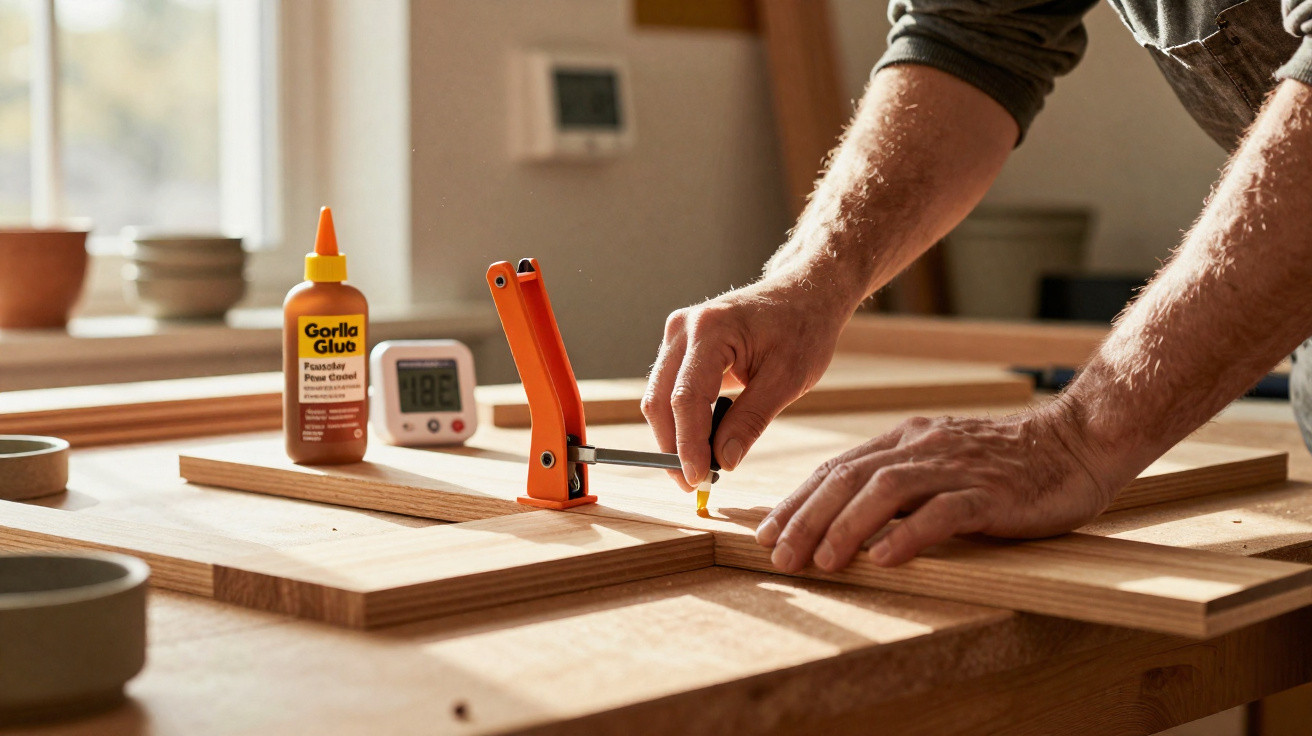
Gorilla Glue is unquestionably extremely strong. However, it only delivers its full performance when it has been given the correct drying and curing time. Putting stress on a repair too soon can cause the bond to fail in everyday use. This guide explains how long Gorilla Glue genuinely needs to dry, what affects that period, and how to avoid common mistakes.
Why Gorilla Glue bonds differently from ordinary wood glue
Gorilla Glue is a polyurethane adhesive. These glues react with moisture and expand slightly, or “foam”, as they cure. This produces a very robust bond, but it also means that two stages need to be considered:
- Initial set (early bond strength): the parts can no longer be moved.
- Full cure: the adhesive reaches its maximum strength.
“Most projects fail not because of the glue, but because it was not allowed to rest for long enough.”
During the initial setting stage, the repair may already appear secure. Inside the joint, however, the chemical reaction is still continuing. Screwing, loading or bending the item at this point can permanently weaken the bond.
How long Gorilla Glue takes to dry and cure
Precise timings vary according to the product version. Gorilla offers different adhesives for wood, metal, plastic and quick repairs.
| Gorilla product | Initial set | Fully cured |
|---|---|---|
| Original Gorilla Glue (polyurethane) | approx. 10–45 minutes | after about 24 hours |
| Gorilla Super Glue (cyanoacrylate adhesive) | approx. 10–45 seconds | after about 24 hours |
| Gorilla Wood Glue (wood adhesive) | approx. 20–30 minutes | after about 24 hours |
| Gorilla Epoxy | approx. 5 minutes | after about 24 hours |
As the table shows, the initial set is reached fairly quickly, depending on the product. Yet for a dependable joint that can withstand stress, you will almost always need to leave it undisturbed for a full day. With especially thick layers of adhesive or very dense materials, full strength can even take up to 72 hours.
What “dry” really means with Gorilla Glue
Many people mistake being dry to the touch for being fully cured:
- After a few minutes: the surface appears non-tacky or firm, but the adhesive is still reacting.
- After several hours: the bond can be handled carefully and may take light stress.
- After 24 hours: the adhesive will generally have reached its full performance.
“Allow at least 24 hours without any stress – regardless of how sturdy the repair already feels.”
The main factors affecting drying time
Temperature: cold slows the adhesive down
Gorilla Glue works best at temperatures of roughly 4 to 38 degrees Celsius. The warmer it is within this range, the more quickly the glue reacts.
- In a warm room (15–27 degrees), the initial set is achieved noticeably sooner.
- In a cold garage or on a balcony during winter, the process takes considerably longer.
If you are making something during winter, it is best to glue it indoors or warm the room slightly. Ice-cold workpieces and a cold workbench will noticeably delay the reaction.
Humidity: polyurethane glue needs moisture
Gorilla Glue requires moisture to react. In very dry air, it may cure more slowly. A simple method can help: lightly dampen one of the two surfaces.
- Wipe the material with a barely damp cloth.
- Do not leave standing water, droplets or puddles.
Too much water makes the glue foam heavily, become porous and form a weaker bond.
Material: wood cures faster than metal
The nature of the surface matters greatly. Polyurethane adhesive behaves differently on different substrates:
- Porous materials, such as wood, fabric or open-pore ceramic: moisture can penetrate easily, so the adhesive cures more quickly.
- Dense materials, including metal, glass or smooth plastic: the reaction proceeds more slowly and curing can take substantially longer.
For metal tubes, tiles or glass, careful preparation is worthwhile: clean the surface, roughen it slightly, apply the glue sparingly and work in as warm an environment as possible.
Amount of adhesive: a thick layer means a longer wait
Many people assume: “More is better.” With Gorilla Glue, the reverse is usually true.
“A thin, even layer is almost always stronger than a thick bead of glue.”
Applying too much slows curing dramatically. The glue expands more, spills out of the joint and sticks where it is not wanted. It adds very little strength to the bond.
Practical guide: getting the best from Gorilla Glue
Preparing the surfaces
No adhesive can perform properly without clean contact surfaces. Dust, grease, dirt and old glue residue all prevent a stable bond.
- Clean with a suitable cleaner or alcohol.
- Remove greasy marks thoroughly.
- Lightly roughen smooth, glossy surfaces, for example with fine sandpaper.
For shoe repairs or trainers, it is also worth checking the inside. Dirty or damp areas within the footwear can reduce the hold of a glued section on the outside.
Correct application in five steps
- Lightly dampen one surface (do not soak it).
- Apply the adhesive in a thin layer.
- Position the parts precisely.
- Clamp or press them firmly for at least 1–2 hours.
- Leave the item for at least 24 hours without stress.
If you do not have proper clamps, improvised options can work: a tension strap, heavy books, adhesive tape or tension straps. The important thing is that the parts do not shift during the first few hours.
Work area and protection
Gorilla Glue expands as it cures and can leave stubborn marks. While fresh, it can still be removed with acetone. Once it has hardened, mechanical scraping is usually the only option.
- Cover the work surface with newspaper or cardboard.
- Protect nearby areas using masking tape.
- Wear gloves, as the glue stains and adheres stubbornly to skin.
Common uses – and how long to wait
Wooden furniture, chairs and shelving
Gorilla Glue performs particularly well on wood. Even so, do not properly load the item until a day has passed. A repaired chair should not go straight back to the dining table after gluing; leave it overnight instead.
Ceramics, porcelain and decorations
Mug handles, vases and ceramic figures all need time to rest. Once glued, place the items so that there is no tension on the joint. Then wait at least 24 hours before exposing them to water, heat or weight.
Outdoor garden projects
This is where Gorilla Glue benefits from its water and weather resistance. Garden furniture, ornaments and plant pots can often be repaired securely. If working outdoors, pay attention to temperature and humidity, and keep glued areas protected from rain until the adhesive has cured.
Risks, sources of error and useful background information
One widespread misconception is that Super Glue or Epoxy from the range is instantly “fully strong”. Although parts may feel secure after seconds or minutes, the adhesive’s internal structure still needs around a day to react completely. This waiting period is particularly important for items exposed to pulling forces or impacts.
With thick adhesive layers, an area in the middle can sometimes react only partially. Everything may feel hard on the outside while the glue remains rubbery inside. These sections can split under stress. It is therefore better to use several thin layers of adhesive than one huge application at once.
It is also helpful to understand the distinction between “drying” and “curing”: drying usually means that solvents or water evaporate. With Gorilla Glue, the key process is instead a chemical reaction with moisture. That reaction takes time, even when nothing appears damp any longer.
Anyone who carries out repairs regularly benefits from knowing several types of adhesive and selecting the right one for each task: super glue for tiny breaks without stress, wood glue for bonding large surface areas, and Gorilla Glue for durable joints even in demanding conditions. Patience remains essential with all of them. Those extra few hours often make the difference between a temporary fix and a repair that lasts for years.

Comments
No comments yet. Be the first to comment!
Leave a Comment