
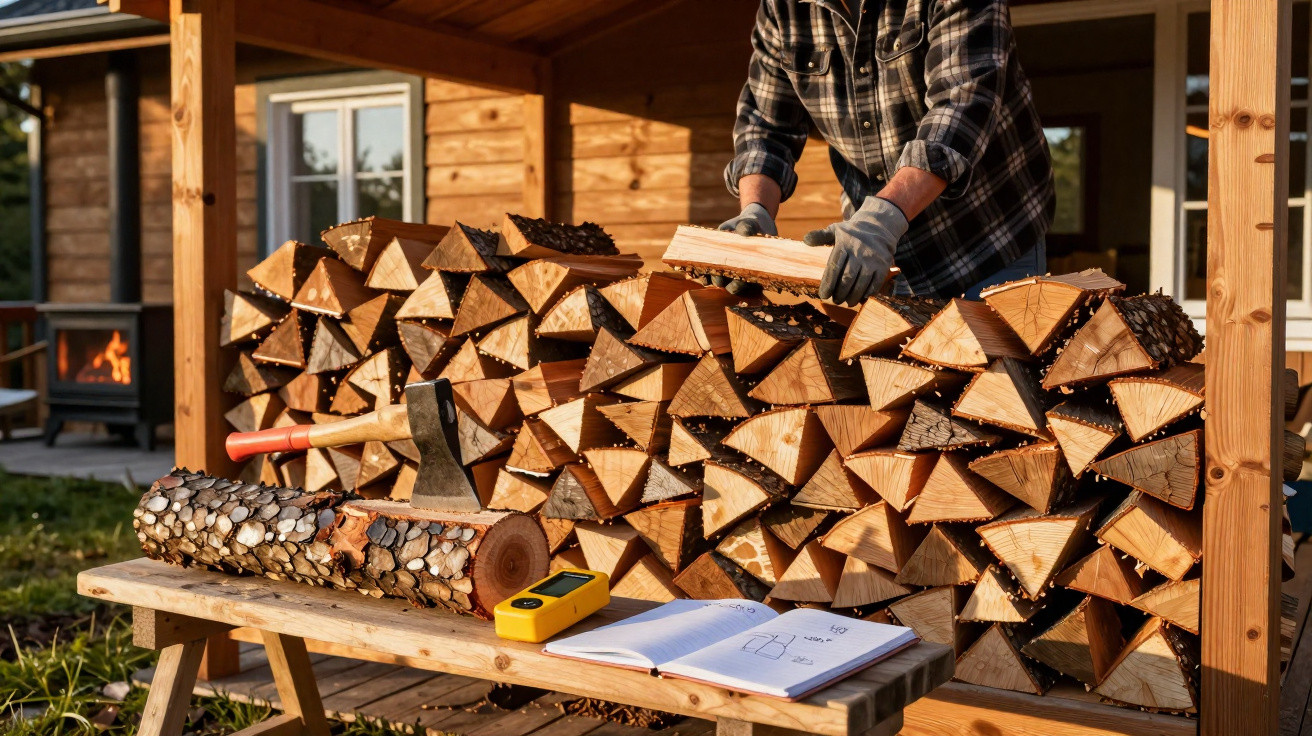
If you underestimate the amount required, you could quickly be sitting in a cold living room by January.
Anyone intending to heat a flat or house measuring between 80 and 120 square metres with wood faces a practical question: how many stacked cubic metres of firewood are needed to make it through to spring? The answer depends on more than floor area alone; insulation, the stove, the wood species and even personal sensitivity to cold all matter.
What really determines firewood consumption
Before ordering wood, it is worth taking a realistic look at your own circumstances. Two homes with the same floor area can use entirely different quantities of firewood.
- Living area: An 80 m² home naturally needs less energy than a 120 m² one, although the difference is not always linear, particularly in older properties.
- Thermal insulation: Well-insulated homes retain heat for a long time. In poorly insulated buildings, some of the wood is, quite literally, heating the outdoors.
- Heating appliance: A modern wood-burning stove, room heater, inset fireplace or open fire can vary enormously in efficiency.
- Location and climate: In snowy upland areas or the Alps, a stove will be used for considerably longer than it would be in milder lowland locations.
- Wood type and quality: Hardwood burns for longer and provides more heat than soft coniferous wood. Moisture content is just as important.
- How it is used: Does the wood-fired appliance heat the whole home or only the living room? Is it used continuously or just in the evenings?
For a well-insulated home of around 100 m² with a modern wood-burning stove, many households find that an average of 4 to 6 stacked cubic metres is enough for one winter.
How many stacked cubic metres of wood are realistic for 80 to 120 m²?
The figures below are not laboratory measurements, but practical guide values that many households in central Europe can use when planning.
Typical consumption ranges by heating system
- Modern wood-burning stove / room heater: For approximately 100 m² of living space, the usual winter requirement is 4–6 stacked cubic metres.
- Inset fireplace (closed heating insert): Allow for 6–8 stacked cubic metres for 100 m².
- Open fire: Highly inefficient; 12–15 stacked cubic metres for 100 m² is not unusual.
These estimates assume average insulation and normal winter temperatures. In draughty older homes or during extended cold spells, consumption rises noticeably.
Specific examples for 80, 100 and 120 square metres
| Living area & condition | Heating system | Expected requirement |
|---|---|---|
| 80 m², poorly insulated | Open fire | 10–12 stacked cubic metres, sometimes more |
| 100 m², well insulated | Modern wood-burning stove | 4–6 stacked cubic metres |
| 120 m², average insulation | Inset fireplace | 7–9 stacked cubic metres |
| 150 m², well insulated | High-output wood-burning stove | 8–10 stacked cubic metres |
If you are undecided between two figures, plan for at least half a stacked cubic metre extra. There is little more frustrating than having to place another order during the first cold spell in March, often at higher prices.
Why insulation is often more important than the stove
Many people first invest in an attractive stove with a glass front, while giving little thought to the building envelope. Yet this is where substantial savings can be made.
A properly insulated home holds its warmth for hours, even after the stove has gone out. In a poorly insulated older property, the fabric of the building cools much more quickly. The effects are clear: you need to refuel more often, and the woodpile is markedly smaller by the end of the season.
Anyone who invests first in new windows, roof insulation or façade insulation can sometimes reduce annual wood consumption by several stacked cubic metres.
Even modest measures make a difference: seal draughts around doors, close shutters at night, lay rugs on cold floors and hang heavy curtains in front of poorly insulated windows. These steps reduce demand without immediately requiring major renovation work.
Choosing the right firewood: hardwood outperforms softwood
Not every log produces the same amount of heat. The key factors are the calorific value of the species and its moisture content.
Recommended wood species for winter heating
- Oak: Very high calorific value; it burns slowly and creates long-lasting embers.
- Beech: A classic choice for living spaces, with an attractive flame, plenty of heat and good controllability.
- Ash and hornbeam: These are also high-quality hardwoods with strong heat output.
Soft coniferous woods such as spruce or pine burn away quickly and tend to provide “quick heat”. This can be useful during the milder autumn period, but considerably more volume is needed for long winter evenings.
Moisture content is at least as important. Wood should have a residual moisture content well below 20 per cent. Freshly felled timber generally needs two to three years to dry sufficiently.
Damp wood wastes energy, creates smoke, blackens the stove and increases the risk of costly chimney problems.
Storing, splitting and stacking firewood so it dries properly
Even excellent hardwood is of limited use if it is stored incorrectly. Through lack of knowledge, this is often where people make their biggest mistake.
- Always store wood split, rather than as whole logs.
- Build the stack with plenty of airflow and avoid packing it too tightly, so air can circulate.
- Do not place it directly on the ground; use pallets, bearers or a timber base.
- Protect it from rain from above, but leave the sides open.
- Store it somewhere exposed to sun and wind, not in damp cellars or enclosed garages.
Ordering wood now for use in two years’ time usually secures better prices as well as ideal drying conditions, meaning more heat from every log.
How households can plan their firewood needs more realistically
People new to wood heating commonly misjudge their requirements at first. A practical approach can help:
- During the first winter, deliberately order a little more generously, for example 1–2 stacked cubic metres above the guide figure.
- Keep a rough record of how much is actually burned throughout the heating season.
- At the end of the season, check what remains; that becomes the reserve for the following winter.
After collecting figures over two or three winters, you will know your typical requirement quite accurately. At that point, buying larger quantities can also be worthwhile, often with a volume discount.
Common mistakes that drive up wood consumption
Many complaints about “excessive consumption” can be traced back to a few familiar issues:
- Refuelling too late, so the stove repeatedly has to be lit again from cold.
- Draughts caused by windows being left tilted open in the heated room.
- Thermostats on the remaining radiators set too low, causing continual switching back and forth between heating systems.
- Overfilling the firebox instead of maintaining an even fire.
- Flue passages and glass left uncleaned, which reduces efficiency.
A modern stove with clean glass, a regularly swept chimney and dry hardwood not only saves fuel, but also provides noticeably greater comfort.
A note on safety and combining wood with other heating systems
Heating extensively with wood places far greater strain on the chimney and stove than an occasional “atmospheric fireplace”. An annual inspection by a chimney sweep, along with compliance with every required clearance from combustible materials, is essential.
Combining wood with another energy source can be sensible, such as a heat pump, gas heating or pellet heating. Many people use a wood-burning stove to cover peak demand on cold days and reduce the load on their central heating. This lowers overall consumption and creates a very comfortable indoor climate, especially in older properties where low-temperature systems alone can sometimes reach their limits.
Those who assess their home, their own comfort expectations and their stove realistically can calculate their firewood requirement with reasonable accuracy. With dry hardwood, good storage and an efficient appliance, 80 to 120 square metres can be heated so that winter may be long, but it need not be cold.



Comments
No comments yet. Be the first to comment!
Leave a Comment