
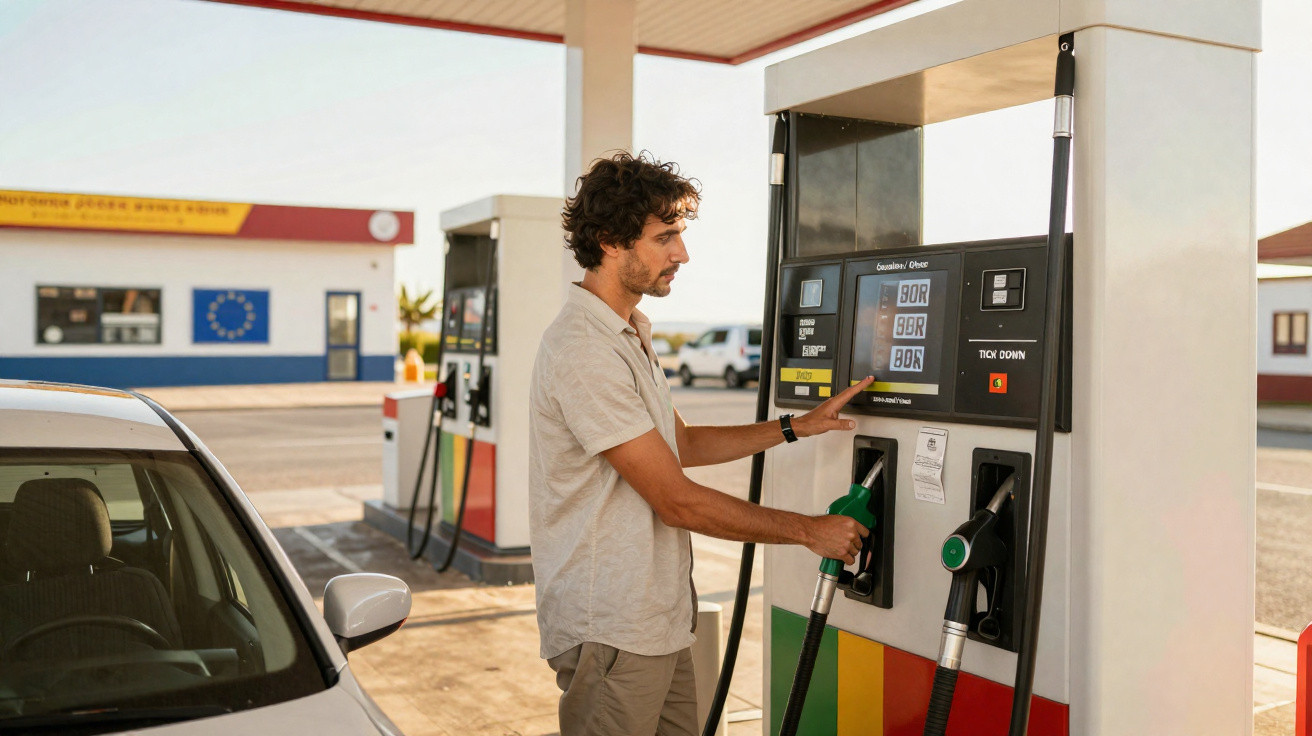
Petrol station prices are rising, oil has climbed above the $100 mark, and many drivers are asking how long this can continue. One EU country has now put forward an answer that is being closely watched in Berlin and Vienna as well. Portugal’s government has adopted a dedicated scheme intended to provide direct relief at the pump without placing an excessive burden on public finances.
How Portugal plans to cushion the fuel price shock
The decision follows a familiar pattern: geopolitical tensions, particularly in the Middle East, push up the oil price. Once crude becomes more expensive, diesel and petrol prices generally rise almost in parallel. What is often overlooked is that the government automatically receives more tax revenue too, because VAT is charged on the higher final price.
Portugal’s scheme is aimed precisely at this point. The government does not want to face accusations that it is profiting from the crisis, so it is introducing an automatic adjustment mechanism that activates when fuel prices rise too sharply.
“If the fuel price rises by more than ten cents per litre compared with the beginning of March, the state will reduce its fuel duty and return the additional VAT revenue to drivers.”
The central principle is that the state should not gain when international crises send prices soaring. Any extra revenue generated through higher VAT is handed back through lower energy duty. This is not a conventional ‘discount’, but rather a form of tax-neutral brake.
Diesel has already triggered the protection mechanism
For diesel, events overtook the plan faster than the government might have wished. The fuel price has already crossed the specified threshold. Government calculations suggest that, without intervention, prices could have risen by up to 25 cents per litre more – a serious blow for haulage firms and commuters.
Lisbon has therefore applied a kind of emergency brake, temporarily cutting diesel fuel duty to soften the increase at the forecourt. The effect is felt most directly by transport companies, delivery services and commuters who cover substantial distances each month.
- Threshold: +10 cents per litre compared with the beginning of March
- Once that threshold is reached, the government lowers energy duty
- Aim: additional VAT revenue is fully neutralised
- Result: prices still increase, but by less than the market alone would dictate
This mechanism is already in force for diesel. In practical terms, prices are higher than they were in winter, but noticeably lower than they would have been without the tax brake.
Petrol is approaching the next price increase
The situation for petrol is similarly tense, although the decisive increase has not yet happened. At the start of the week, the price had already risen by seven cents per litre. That automatically brings extra tax revenue into state coffers – precisely the outcome the government is seeking to avoid.
Only around four cents are now needed before the protection mechanism is activated for petrol as well. From that point, the state must reduce its energy duty to offset the additional VAT receipts. This will not be decided case by case, but through a fixed formula that is continuously adjusted to market movements.
“The government wants to demonstrate that it is not making money at drivers’ expense during the crisis – and is deliberately putting itself before the judgement of voters.”
Brussels views tax measures at the pump with scepticism
While Portuguese motorists watch the price boards at filling stations, a second dispute is playing out in the background: one with the European Commission. Energy-sector subsidies are a red flag in Brussels. Competition authorities fear that unilateral national measures could distort the market.
Portugal’s finance minister appears unfazed. His argument is that the government is giving citizens some breathing space while simultaneously foregoing additional revenue. In his view, this is not an impermissible discount, but a kind of ‘emergency brake’ against crisis-driven excess state revenue.
His political advantage is the reference to the Middle East conflict. The government is relying on the current exceptional circumstances and presenting the tax brake as a temporary crisis measure. This is exactly what it hopes will count when Brussels examines whether the intervention complies with strict state-aid rules.
Europe is under growing pressure
An oil price above $100 per barrel is more than a figure. Psychologically, it acts as a significant barrier. Hauliers, tradespeople, delivery services and millions of commuters across Europe are facing rising costs. Sooner or later, those additional costs reach consumers.
Portugal’s model opens a route that other EU countries may have to follow, whether they want to or not. If crude prices remain this high, governments will come under pressure from every direction: citizens, businesses and trade unions.
“The longer the oil price remains high, the greater the pressure on all EU countries to introduce their own emergency tax instruments at the pump.”
Many countries already use time-limited energy relief measures, especially following the shocks experienced in 2021 and 2022. However, the systems differ significantly, ranging from straightforward tax cuts to fuel vouchers. By fully linking the measure to VAT receipts, Portugal is taking a radically symmetrical approach.
What Germany and Austria could learn from Portugal
In Germany and Austria, intervention in energy prices is politically sensitive. Temporary fuel tax rebates introduced in the past prompted, in some cases, intense debate. Critics accused oil companies of simply building part of the relief into their prices and keeping the benefit themselves.
Portugal’s model offers an important distinction here: the state returns only what it collects additionally because of the crisis. It therefore gives up windfall revenue instead of creating new subsidies. That may appeal to finance ministers because it places less strain on the budget than traditional rebates.
| Model | Core element | Risk to public finances |
|---|---|---|
| Portugal | Offsets additional VAT receipts through lower energy duty | Limited, because only extra revenue is forgone |
| Typical tax cut | Fixed reduction per litre, regardless of the oil price | High, because continuing revenue may be lost |
| Fuel vouchers | Direct grants to citizens or businesses | Very high, because the state actively pays out money |
For consumers in German-speaking countries, the question is straightforward: could such a model help here too? In practice, the answer depends on many factors, including the existing tax structure, political majorities and the willingness to challenge Brussels.
What this means for drivers in practice
For Portuguese motorists, the situation is already clear: fuel remains expensive, but it is less painfully expensive than the market price alone would make it. Commuters travelling long distances, delivery services and taxi operators can see the difference in their monthly bills.
The underlying problems do not disappear, of course. Anyone dependent on a car remains reliant on fossil fuels and therefore exposed to crises, conflicts and speculation in commodity markets. The tax brake eases the symptoms, but does not solve the fundamental issue.
At the same time, Portugal’s experiment shows how strongly tax policy has become a form of crisis firefighting. Finance ministers must respond with short-notice emergency measures whenever oil prices rise too sharply. Long-term plans for climate-friendly mobility can quickly be pushed into the background.
Consumers would do well to look carefully at their receipts. Those who understand current price movements can make better decisions, whether in choosing a vehicle, planning journeys, or deciding whether car sharing or switching to buses and trains is worthwhile.
Even if Portugal may seem distant, the mechanisms being used there could soon serve as a blueprint. At the latest, when the next price surge reaches German or Austrian filling stations, the question will return: should the state really take a share of every additional cent drivers have to pay during a crisis?




Comments
No comments yet. Be the first to comment!
Leave a Comment