
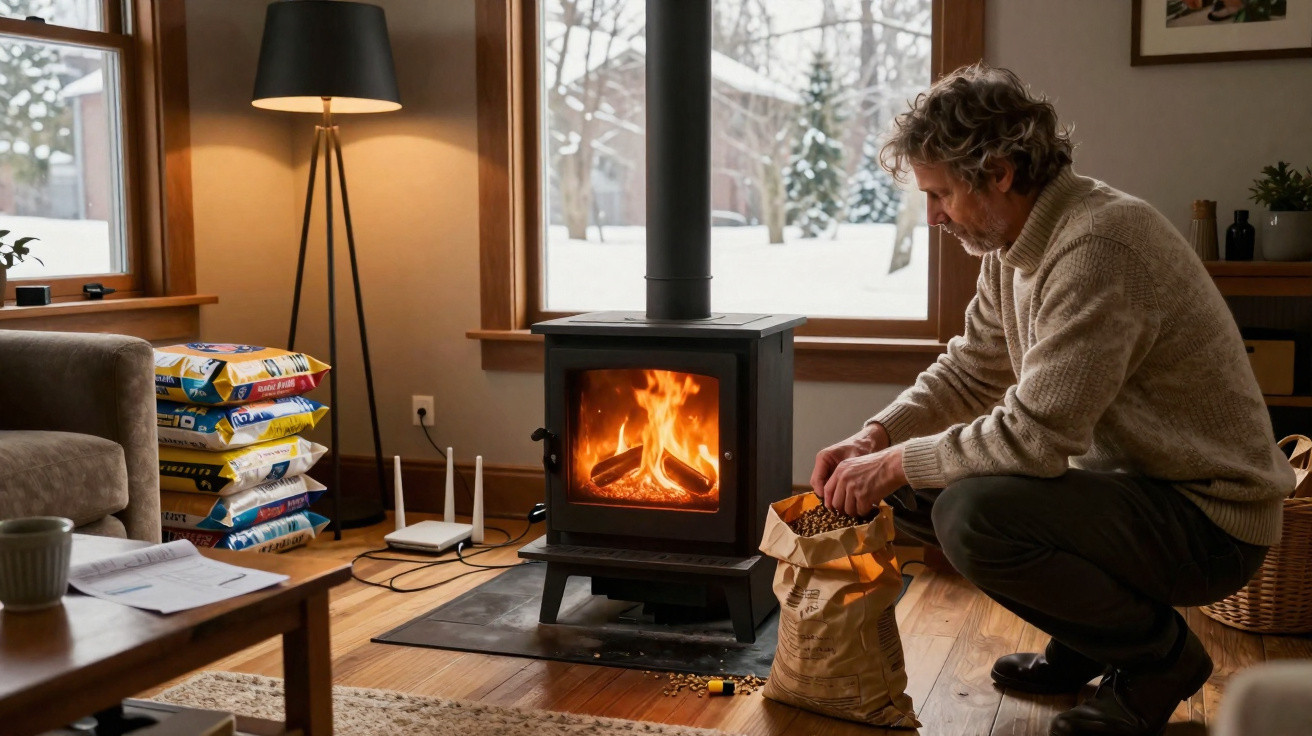
As electricity networks face increasing strain and energy costs remain unpredictable, many households in France are reassessing the way they heat their homes. An unlikely option gaining attention is the non-electric pellet stove: an appliance fuelled by wood pellets that needs no mains connection, electronic components or digital display.
Back to basics: heating that still works when the power goes out
For many years, pellet stoves in France have been linked with technology-led heating, including programmable thermostats, fans and smartphone remote controls. A non-electric pellet stove takes almost the opposite approach, relying instead on gravity, manual lighting and naturally circulating air.
Its operation is straightforward. Pellets sit in a hopper above the firebox and fall by gravity into a small burn pot as they are used. There is no motor, auger feed or control board.
When the power fails, a non-electric pellet stove continues to run exactly as before, with no change in comfort or safety.
The fire is lit manually, generally with a firelighter or a small piece of kindling. After ignition, the pellets burn at a slow, even rate and create a consistent flame. Mechanical controls regulate the air supply, allowing the user to alter the combustion speed and the amount of heat produced.
Rather than using an electric fan, the stove works through convection. Warm air rises naturally, drawing cooler room air towards the appliance and creating a gentle airflow. Its casing also gives off radiant heat, warming nearby people, furnishings and walls.
Why households in France are choosing non-electric models
Energy security when the grid is under pressure
France has repeatedly been warned of possible electricity shortages during winter, particularly in cold spells and periods of nuclear reactor maintenance. Power cuts are still a regular worry in rural communities and smaller towns.
Against that backdrop, households are increasingly looking at emergency heating solutions. A non-electric pellet stove can serve as a form of “insurance policy” during a blackout.
- It can keep occupied rooms above freezing when electricity is unavailable.
- It lowers reliance on electric radiators and heat pumps.
- It gives households confidence that they can keep at least one room warm in almost any circumstances.
This dependability is particularly important for families in remote locations or older stone properties that are hard to upgrade. The stove has no reliance on Wi-Fi, electronics or a stable electricity supply.
Fewer components to fail and repair
Conventional pellet stoves include a range of electrical components, such as control boards, temperature sensors, fans and motors. These parts can malfunction, need specialist repairs and occasionally involve lengthy waits for replacements.
Non-electric pellet stoves remove much of that complexity. Their construction is more comparable to that of a conventional log-burning stove, with fewer moving elements.
The simpler the mechanism, the lower the risk of sudden breakdowns in midwinter and the lower the long-term bill for maintenance.
Many installers in France say that households frustrated by recurring error messages on older pellet stoves are intentionally selecting “low-tech” replacements. For people intending to remain in their property for decades, durability can matter as much as maximum efficiency.
Reducing energy costs as well as emissions
Since these stoves do not use electricity, they eliminate one element of the monthly energy bill. Although a standard pellet stove usually consumes only a modest amount of power, that cost can build up over several winters.
Wood pellets also remain competitively priced against heating oil and direct electric heating, particularly in well-insulated properties. Made from sawmill waste and forestry by-products, they align with France’s broader move towards locally sourced renewable energy.
| Heating option | Needs electricity to run? | Main fuel | Typical use in France |
|---|---|---|---|
| Non-electric pellet stove | No | Wood pellets | Backup or main heating in rural homes |
| Electric pellet stove | Yes (fans, motors, controls) | Wood pellets | Main heating with automation and programming |
| Traditional wood stove | No | Logs | Supplementary heating, atmosphere |
A quieter living room
Anyone who has used a fan-assisted stove will recognise the quiet yet persistent hum produced by its motors. It can become especially noticeable when the television is off or when reading in the evening.
A non-electric pellet stove produces almost no mechanical noise. Apart from the soft crackle of the pellets burning and the movement of air, it remains quiet, which many owners consider cosier rather than disruptive.
For bedrooms, open-plan living rooms or home offices, the absence of a fan can make the difference between tolerated heating and genuinely comfortable heating.
The compromises buyers need to consider
Frequent cleaning rather than a fit-and-forget appliance
A non-electric pellet stove requires practical maintenance. Ash accumulates in the burn pot and must be cleared regularly to maintain clean combustion. As with a log stove, the flue pipes also need sweeping.
The glass door may blacken more quickly than on certain fan-assisted stoves because there is no directed air curtain passing across it. Owners who want an unobstructed view of the flame will therefore need to clean the glass more regularly.
Marginally lower stated efficiency
Many non-electric models achieve efficiency levels of roughly 80–85%. Some of the most sophisticated electric pellet stoves can exceed this, thanks to managed airflow and optimised combustion cycles.
However, the practical difference is not necessarily substantial. When used properly in a suitably insulated room, a non-electric stove can still offer highly competitive running costs. Some households consider its resilience and independence more important than gaining the final percentage points of theoretical efficiency.
No app, no timer and greater manual involvement
A non-electric pellet stove cannot be programmed to start at 6am or adjusted by smartphone on the journey home. Users must light it themselves, regulate the air supply and refill the pellet hopper as required.
For technology-oriented households, this may seem like a backward step. Others see it as a welcome return to a more physical and manageable relationship with heating. It also avoids the possibility of software faults, firmware errors and connection problems.
Where non-electric pellet stoves work best in homes in France
In France, non-electric pellet stoves are especially common in mountainous regions, isolated villages and holiday chalets, where lengthy winters and power cuts are more likely. They are often used as the main heat source for one or two principal rooms, with electric radiators or existing heating systems supporting the rest of the home.
They are also attractive to environmentally conscious homeowners seeking to replace an oil-fired boiler but unwilling to take on the full expense of a modern heat pump. Wood pellets offer renewable, comparatively clean combustion while requiring less handling and storage space than traditional logs.
For many users, the sweet spot is a hybrid strategy: a main system like a boiler or heat pump, backed up by a non-electric pellet stove for resilience and comfort.
Key terms that buyers frequently ask about
Two terms are commonly found in product brochures in France:
- Running time – the number of hours for which the stove can operate from a full pellet hopper before it needs refilling.
- Efficiency – the percentage of energy contained in the pellets that is converted into useful heat.
A typical non-electric model may run for eight to twelve hours at a moderate heat output. The actual duration depends largely on the hopper capacity and how widely the air controls are opened.
Practical scenarios: who benefits most?
Take the example of a family living in a 110 m² stone house in central France. They retain their oil boiler for the coldest weather but fit a non-electric pellet stove in the main living room. On autumn evenings and milder winter days, they depend almost entirely on pellets and reduce their oil consumption. If the power fails, the living room remains sufficiently warm for work or, if necessary, sleeping.
Another example is an urban resident with a second property in the countryside. The house may be unoccupied for several weeks at a time. A non-electric stove reduces the chance of returning to frozen pipes following a storm-related power cut. A neighbour can simply visit, light the appliance and maintain a basic level of warmth without any concern about the electrical system.
Risks and issues to consider
Like every combustion appliance, these stoves come with safety requirements. Proper room ventilation is essential, while the flue must be correctly sized and professionally installed. Carbon monoxide alarms are strongly advised, and regular flue servicing remains a legal obligation in many areas of France.
Pellet quality is another consideration. Low-quality pellets generate more ash and soot, and may increase the risk of blockages. Choosing certified pellets and storing them somewhere dry are straightforward ways to keep the stove operating effectively and to reduce cleaning time.
For households comparing their choices, the decision is less about fashion than managing risk: the level of independence they want from the grid, their comfort with manual operation, and the way they weigh upfront spending against long-term resilience.





Comments
No comments yet. Be the first to comment!
Leave a Comment