
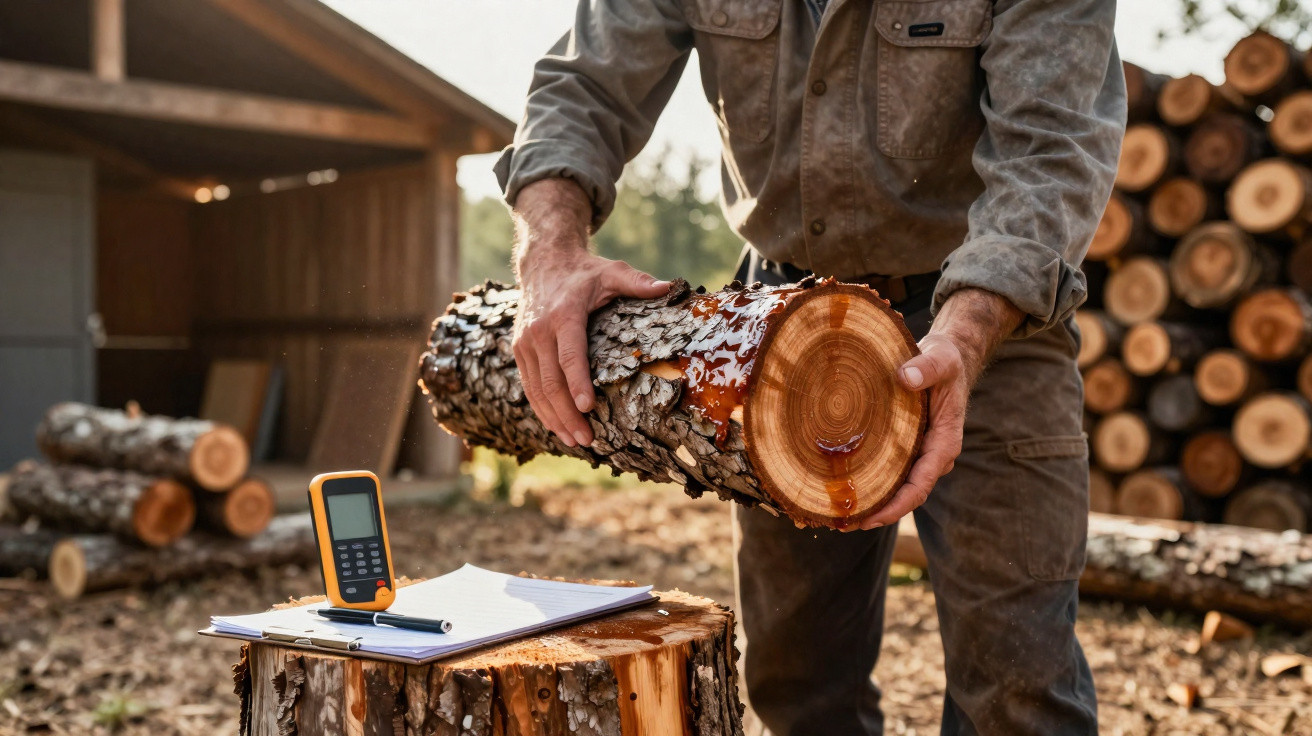
The winter evening looked perfect: sharp cold outdoors, a fire indoors that needed only a little more wood. The logs in the shed seemed ideal – grey on the surface, bark slightly cracked, and no longer cold and clammy to the touch but dry. “They’re ready,” I thought, picked out the best armful and stacked it beside the stove. Five minutes later, there was smoke instead of flame, a dull hissing as though the wood were protesting. The chimney draw was fine, as was the air supply. Even so, the fire sulked along.
At that point, it became clear: this apparently perfect firewood was hiding a secret that cannot be seen with the naked eye.
When dry firewood is not actually dry
Anyone who heats regularly with wood knows this form of self-deception: you inspect the surface, give it a quick tap, hear a reasonably bright sound and assume it will be fine. From the outside, everything appears bone-dry; the cut face is pale, while the cracks suggest it has been stored for ages. Yet the stove still smokes like an old locomotive.
This is where the rarely discussed issue begins: firewood can look dry for months while remaining soaking wet at its core.
A neighbour told me that two winters ago he bought 10 stacked cubic metres of supposedly “kiln-dried” beech firewood. The logs were immaculate, all cut to the same length, neatly split and carefully stacked on a pallet. He was proud of his “supply for years”. But by January, a grey haze drifted across the garden whenever he lit the fire. The flames stayed low, the wood hissed, and the stove glass became coated with black residue.
Later, a moisture meter delivered the disappointing truth: readings of between 25 and 30 per cent. For firewood, that is a complete failure.
The logic behind it is simple: wood does not release moisture evenly throughout. The bark may be dry and the ends may look cracked, while the centre is still saturated like a sponge. Thick logs and dense hardwoods in particular retain water for remarkably long periods. Air circulation, sunlight and the way the stack is built all determine whether moisture can escape from the inside or remains trapped there.
That invisible residue can turn seemingly well-prepared winter firewood into fuel that is suddenly smelly, inefficient and even harmful.
The hidden moisture fault: where firewood secretly stores water
The biggest mistake is rarely in the stove; it usually begins months earlier in the stack: logs that are too large, piles built too tightly and too little air in the places where it matters. Many people cut their wood once, split it roughly and think: “It’ll dry out.” It does to an extent, but never evenly.
The core is where true moisture pockets form. The surface turns grey and cracked, the end grain feels dry – yet inside there may still be 5–8 per cent too much water, which cannot be seen or felt and is only noticed when it is burned.
The classic scenario is this: wood is freshly felled in April, roughly split in May, then placed “somewhere airy” against the house wall over summer. The sun dries the front, but the air is stagnant behind it. The outer 2–3 centimetres become completely dry, while the rest remains at 23–28 per cent residual moisture. During the first winter, you may only notice that it is slightly harder to light. In the second winter, when you begin taking wood from deeper within the stack, the difference becomes painfully obvious: the same type of wood, but entirely different burning behaviour.
A chimney sweep once told me about a house where the rearmost row in the shed was almost raw – and had been slowly rotting away for years.
The physics is straightforward: water travels through wood along its grain and leaves through the surface, where air movement and temperature can carry it away. When logs remain large or are packed tightly together, areas with no meaningful airflow develop. The outer layer dries and almost forms a crust, while the moisture content inside remains consistently too high. What seems like dry storage actually preserves residual moisture in the core. This creates a damaging in-between state: no longer fresh, but not genuinely dry either – ideal conditions for mould and, later, disappointing evenings of heating.
How to identify genuinely dry firewood without fooling yourself
The simplest and most dependable solution is a small device many people put off buying for years: a wood moisture meter with probe pins. It is not a luxury, but more like a blood-pressure monitor for your firewood supply. Do not measure only at the end grain; split a log and test the freshly exposed core. Once you do that, every illusion disappears.
The target is below 20 per cent residual moisture, ideally between 15 and 18. Anything above that belongs back in the stack, not in the stove. Measuring it once makes the distinction between “feels dry” and “is dry” surprisingly clear.
A common mistake is placing too much trust in appearance and sound. The bright “clack” made when two logs are knocked together can be misleading if the surface is dry and hard but the core is still holding moisture. The finger test – briefly touching the cut surface to see whether it feels cool or damp – also has limits. On a cold autumn day, even good firewood feels cool.
What genuinely helps is a small change of routine: it is better to test a few logs too early than discover in January that half the supply is smouldering away as moist biomass.
“The most expensive wood isn’t the wood you buy – it’s the wood you burn wet,” an older heating engineer once told me. “You pay for energy that produces nothing but water vapour and coats your chimney.”
- Check a cross-section at least once per season: Split a log and measure the core, not only the outside.
- Let the stack ‘breathe’ deliberately: Do not lay a tarpaulin directly on the wood; leave a gap and keep the area beneath open.
- Split oversized logs decisively: Two medium-sized pieces are better than one attractive but permanently damp log.
- Mark damp areas in the shed: keep rows that are still too wet visibly separate and burn them later.
- Let us be honest: nobody checks wood moisture every day – one fixed testing date in autumn is often enough to save the winter.
What the hidden moisture fault does to your money, air and everyday life
Once you start paying attention, it quickly becomes obvious that the hidden moisture fault is not a niche concern for firewood purists; it has a noticeable effect on daily life. Wet or semi-dry wood does not merely burn poorly: it uses up your supply without delivering real heat. You may end up putting two to three extra logs on the fire each evening just to achieve the same comfort indoors. You watch a tired flame and hear the quiet hiss of water you never intended to burn.
At the same time, particulate emissions increase, the glass blackens more quickly, neighbours smell the smoke, and the chimney sweep finds in the flue what your wood store failed to release.
| Key point | Detail | Benefit for the reader |
|---|---|---|
| Looking “dry” is not enough | Cracks, a grey surface and a hard sound can mislead when the core still contains more than 20% moisture. | Readers understand why apparently good wood causes problems and where the real cause lies. |
| Measure instead of guessing | A simple moisture meter, used on the split core, exposes the hidden moisture fault. | A practical tool for objectively checking a personal supply and avoiding heating problems. |
| Correct storage is decisive | Air circulation, stacking method and log size determine whether wood dries evenly or stays wet in the core. | Practical ways to improve existing wood stores and prevent future mistakes. |
FAQ:
- How long does firewood really need to dry? Softwood generally requires 1–1.5 years, while hardwood such as beech or oak needs more like 2–3 years, depending on log size, storage location and weather conditions.
- Can I finish drying wet wood in the cellar? Only to a very limited extent: without good ventilation, moisture builds up, the wood dries poorly and mould becomes an issue.
- At what reading is wood considered “dry”? For stove use, below 20% residual moisture is the guideline; 15–18% measured in the core is optimal.
- Is sunshine alone enough for drying? Sun helps, but without moving air the moisture remains in the core. The essential combination is wind, clearance from the ground and protection from rain.
- Does repeatedly burning overly damp wood damage the stove? Yes, over time it can lead to increased tar deposits, chimney damage and more cleaning – not to mention unnecessary heating costs.





Comments
No comments yet. Be the first to comment!
Leave a Comment