
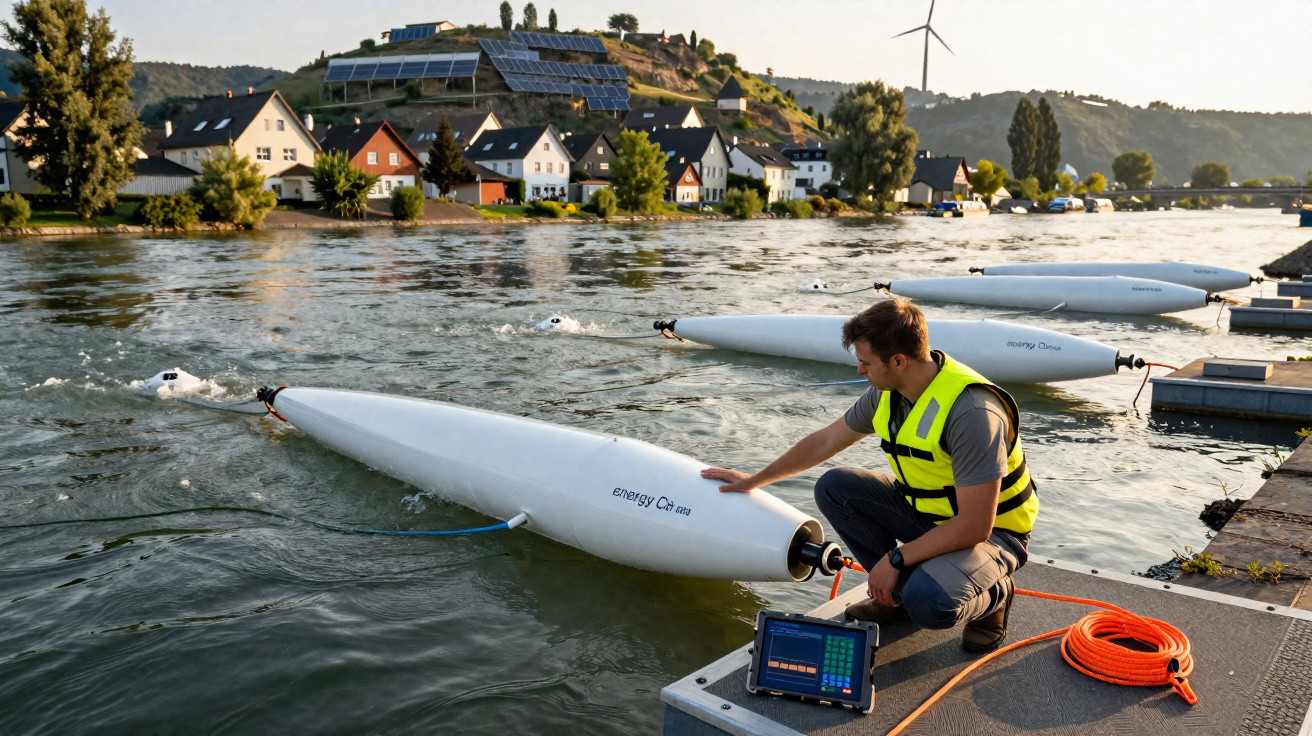
Between castles, rock faces and cargo vessels, an experiment is getting under way near Sankt Goar that could make the energy transition far more flexible. A Munich start-up aims to turn the Rhine itself into a power station, using dozens of floating turbines that resemble unremarkable boxes but are intended to generate electricity for hundreds of homes.
How “Energyfish” turn river currents into electricity
The young company Energyminer, based in Gröbenzell near Munich, calls its devices “Energyfish”. The underlying concept is straightforward: rather than damming a river or reshaping it with massive concrete structures, compact turbines are placed directly in the natural current.
Each of these “fish” measures roughly 2.8 by 2.4 metres, weighs around 80 kilograms and is secured to a fixed point on the riverbed. The turbine remains fully submerged, moves with the current and produces energy continuously as it does so.
Under ideal conditions, a single Energyfish delivers up to 6 kilowatts of output – without wind, without sunshine, around the clock.
According to the start-up, 100 of these modules generate around 1.5 gigawatt-hours of electricity per year. That would be enough electrical energy for approximately 400 to 500 average four-person households. The cost per kilowatt-hour is expected to be broadly comparable with that of wind and solar power installations.
How the mini hydropower station works in detail
The technology behind the floating turbines is based on a clear modular approach:
- The modules sit entirely below the water surface and are anchored to the riverbed.
- Their rotor blades are driven solely by the Rhine’s natural current.
- A generator inside the turbine converts the rotation into electrical energy.
- Underwater cables carry the electricity to the bank, where it is fed into the grid.
Unlike major weirs or reservoirs, the system requires neither dams nor extensive construction work along the bank. In principle, the river remains as it is; the technology merely “hangs” in the current.
Why Sankt Goar was chosen for the Energyfish project
The Middle Rhine is visually dramatic, but it is also particularly interesting from an energy perspective. Its narrow valleys accelerate the water to relatively high speeds. Flow velocities of between 1.5 and 2 metres per second are unusual in Germany, yet they are precisely what the turbine requires.
The faster the water moves, the more energy its current contains. Slow, sluggish river stretches are scarcely suitable. Sankt Goar, however, offers an almost ideal profile: sufficient depth, good flow speed and a side arm of the Rhine where the system can be tested without disrupting shipping.
Three Energyfish are already operating in the Rhine. The Rhineland-Palatinate environment ministry has now approved the first complete “swarm power station” in a side arm near Sankt Goar. As an interim stage, 21 additional turbines will initially be installed, before all 124 units ultimately operate together.
From a Munich test channel to the main river
The technology was not developed directly on the Rhine, but was first trialled in Bavaria. In April 2023, Energyminer installed a pilot facility in Munich’s Auer Mühlbach. There, the team assessed stability, output and maintenance requirements during continuous operation.
Since then, the company says it has refined the technology step by step, with more robust components, more efficient rotors and improved anchoring systems. Sankt Goar is now intended to demonstrate whether the system works not only in a small urban stream, but also in a large, heavily used river.
For the start-up, the Rhine location is regarded as “Proof of Scale” – evidence that the technology can be operated on a large scale.
How the Energyfish are designed to protect fish
New hydropower schemes immediately raise critical questions: what happens to fish populations? Conventional dams obstruct migration routes, flood natural habitats and alter entire river landscapes. Many species are severely affected as a result.
Energyminer is deliberately pursuing a different model. The modules are positioned individually in the current, without blocking the river from bank to bank. The developers have also incorporated their own protection system intended to prevent fish injuries. While the company keeps the precise design largely confidential, it refers to special shapes and flow guidance designed to keep animals away from the rotor blades.
Researchers at the Technical University of Munich have examined the system. Their findings state that the turbines do not endanger migratory fish species in the Rhine and do not trigger altered behaviour. This is a decisive issue for authorities and environmental organisations, as approval would not be granted without favourable assessments.
How the technology differs from conventional hydropower plants
Compared with traditional installations, the concept has several notable differences:
- No dam, no impoundment and very little structural intervention in the river.
- Significantly smaller units that are easier to transport and replace.
- Modules can be installed, removed or expanded individually.
- The force of the current is used directly, without fully regulating the waterway.
The system is therefore positioned more as “harvesting the current” than as a conventional hydropower plant. The Rhine remains a river, rather than becoming a reservoir.
Role in the energy transition: filling gaps when solar and wind are weak
Wind turbines stop when there is no wind, while solar installations generate very little electricity at night or in dense fog. These are exactly the circumstances in which a river power station can offer an advantage, operating on the current day and night.
The output of a single Energyfish is modest, but a swarm can produce a meaningful amount. Electricity from rivers fluctuates less sharply than wind and solar power, although high and low water levels naturally have an effect. A more consistent supply is valuable for energy providers because it allows them to plan grid stability more reliably.
| Technology | Dependence on weather | Typical generation |
|---|---|---|
| Photovoltaics | Very high (sunshine) | Daytime, with little output at night |
| Wind power | High (wind) | Highly variable, sometimes with prolonged lulls |
| Current turbines | Medium (water level, current) | Relatively consistent, including at night |
Rhineland-Palatinate’s climate protection minister, Katrin Eder, sees the approval as a signal to the entire sector. If the swarm at Sankt Goar runs reliably, similar projects could follow at other suitable river locations, in Germany and later in other European countries.
Where such power stations could be built in future
In theory, every major river carries enormous quantities of energy. In practice, however, a whole range of factors restricts possible locations: depth, flow speed, shipping density, nature protection requirements and options for connecting to the electricity grid.
Suitable locations are primarily stretches where the water flows quickly enough while still leaving adequate space for anchoring, maintenance and safety distances. In Germany, the Moselle, Weser and Elbe could be considered alongside the Rhine, wherever narrow valleys or gradients create sufficient speed.
- Rhine: Strong currents at narrow points and many potential side arms.
- Moselle: Some fast-flowing stretches, but also weirs.
- Weser and Elbe: Longer sections with usable currents, but busy traffic.
The approval at Sankt Goar serves as a reference for authorities in other regions. They can use the project’s legal requirements, environmental assessments and technical standards as a guide instead of having to assess every detail entirely from scratch.
Opportunities, risks and unanswered questions
Despite the encouraging signs, important questions remain. How resilient are the modules during flooding, when debris is carried downstream or in the presence of shipping? How frequently will they need servicing, and how costly are underwater repairs? How will the river ecosystem respond when not just 3, but 124 or even more turbines are operating?
Energyminer relies on a modular design: if one device fails or the technology becomes outdated, it can be replaced individually without shutting down the entire installation. At the same time, the operator must guarantee that nothing comes loose and becomes a hazard to vessels. Authorities will therefore monitor the first years of operation very closely.
For local residents, the key question is whether they will benefit directly from the installation on their doorstep, for example through regional electricity tariffs or participation models. So far, the turbines simply feed power into the general grid. How the electricity generated ultimately affects bills and tariffs depends on grid operators and energy policy.
How these projects can be combined with other renewable sources
The Energyfish concept is particularly effective when it forms one component of a broader mix. Municipal energy suppliers could, for example:
- use solar electricity during the day,
- increase wind power generation in windy weather,
- and rely on river current power during windless nights.
Together with battery storage or pumped-storage hydropower plants, this could create a considerably more stable supply than any single technology alone. Rivers do not provide vast volumes of energy, but they can close gaps that have often been filled by fossil-fuel power stations until now.
Whether the first 124 “Energyfish” will eventually become thousands across Europe remains uncertain. What is clear is this: if the Rhine at Sankt Goar supplies electricity for hundreds of households in everyday operation while the surface appears almost unchanged, this quiet technology could rapidly gather momentum.




Comments
No comments yet. Be the first to comment!
Leave a Comment