
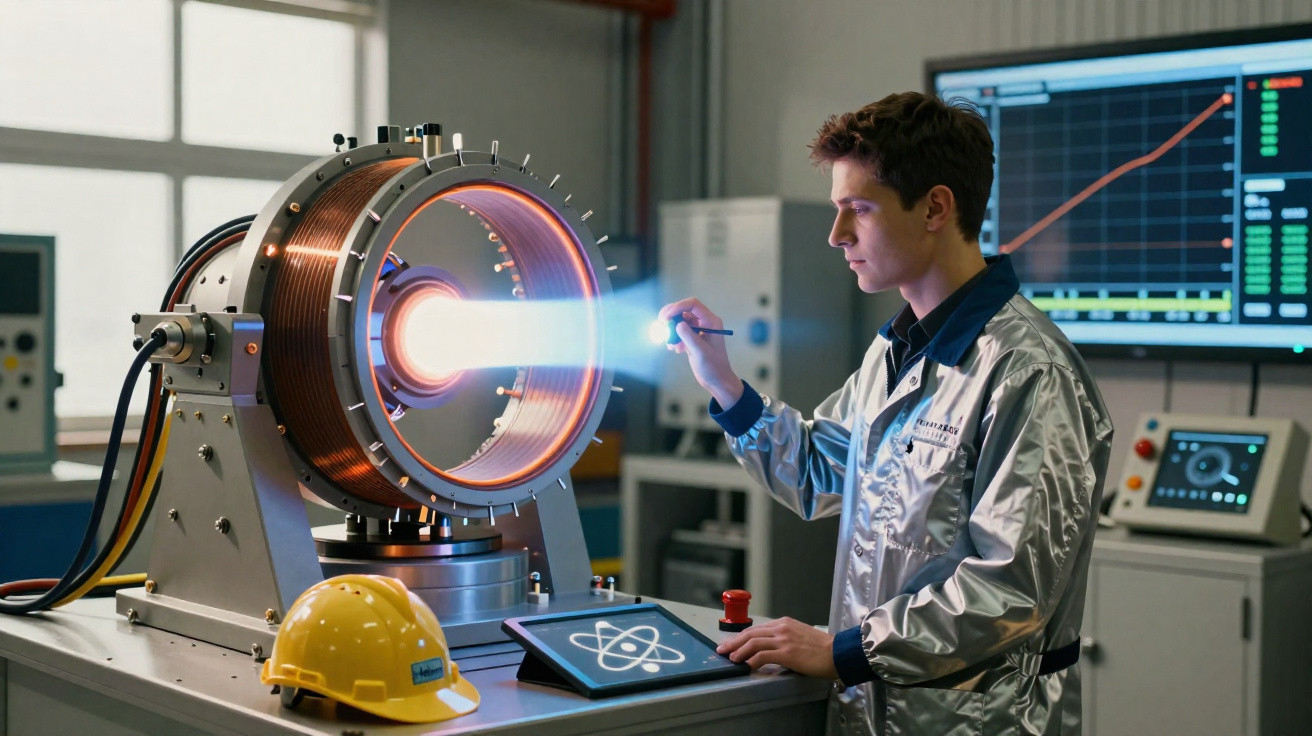
A new nuclear fusion breakthrough is attracting attention: US company Helion Energy says its “Polaris” prototype has reached temperatures far beyond those at the Sun’s core. For the first time, a wholly privately funded project has run a technically relevant reaction using today’s most sought-after fusion fuel – sending a clear signal to established research programmes such as ITER and others.
What Helion has achieved – and why 150 million degrees matters
Based in Everett, Washington, Helion Energy has spent years developing an alternative approach to nuclear fusion. The company now says that its “Polaris” prototype reached 150 million degrees Celsius in February – around ten times the temperature at the centre of the Sun.
The experiments used a fuel blend of deuterium and tritium, commonly shortened to D-T. In physical terms, this combination is regarded as the “easiest” usable fusion reaction because, at relatively “moderate” temperatures, it offers the greatest likelihood of fusion events.
For the first time, a machine funded exclusively by private capital has reached operationally relevant conditions with deuterium-tritium fuel and produced a measurable fusion signal.
Major public facilities, including ITER in France and the National Ignition Facility in the United States, also use this fuel. The distinction is that these projects are financed largely through public budgets. Helion, by contrast, is backed by investors and says it has secured roughly two billion US dollars in total.
Deuterium-tritium: today’s most attractive fusion fuel
Deuterium is a heavy form of hydrogen, while tritium is an even heavier, mildly radioactive form of hydrogen. When their nuclei fuse, they produce helium and an energetic neutron. This reaction has a particularly large so-called cross-section. Put simply, at the same temperature, D-T has a better chance of fusing successfully than alternative fuels.
This is precisely why much of the world’s fusion research is focused on this reaction. Anyone able to ignite and sustain D-T in a controlled way at extreme temperatures comes significantly closer to producing electricity from fusion.
Polaris: rapid learning rather than a century-scale project
Polaris is the seventh machine in Helion’s development line. Its company philosophy resembles the IT or space-start-up world more than conventional large-scale research: build quickly, test, gather data, adapt, and build again.
Where international schemes such as ITER are designed, constructed and modified over decades, Helion operates in short development cycles. Each successive machine is intended to deliver a noticeable performance improvement over its predecessor.
- The company’s 7th prototype
- Operations began in late 2024
- Switched to D-T experiments in January 2026
- Temperature record: 150 million degrees Celsius
The aim of this approach is to accelerate technical learning dramatically, even if that means sacrificing a degree of elegance and perfection. In practice, investors are primarily interested in how rapidly the concept can move towards a commercial plant.
A different route to fusion: Helion does not rely on a tokamak or lasers
Most people encounter nuclear fusion through reports about tokamak facilities or enormous laser systems. Helion has chosen a different route. The company uses what is known as a Field-Reversed Configuration (FRC), a specialised magnetic-field arrangement.
Its system differs substantially from the doughnut-shaped plasma ring used in a tokamak:
- Two plasma formations are created at opposite ends of the machine.
- They are accelerated towards one another and collide.
- The combined plasma is then compressed intensely.
- Compression raises its temperature and density into the range required for thermonuclear conditions.
There is another key difference: Helion intends to convert the energy produced into electricity as directly as possible. Rather than first using the plasma to heat water, drive steam turbines and run generators, an electromagnetic system is meant to feed the energy from charged particles back into electrical power directly.
Direct electricity generation from a fusion machine, without a conventional steam boiler – if successful, that would represent a radical departure from today’s power-station technology.
Tritium as a regulatory hurdle – and a test of maturity
Tritium is scarce, radioactive and tightly regulated. Estimates suggest that only a few dozen kilograms are available worldwide. Its use is subject to stringent requirements more akin to those governing nuclear power stations than laboratories.
Helion is the first private company in the United States to receive official authorisation to possess tritium and use it in fusion experiments. This indicates that regulators no longer view the project purely as a laboratory experiment. The requirements are increasingly similar to those that will later apply to real power stations.
That brings Polaris closer to quasi-industrial status. The question is no longer simply whether plasma can be made to glow. What matters is whether the process can operate under genuine safety and regulatory requirements.
Next step: a helium-3 reaction and the commercial “Orion” plant
Over the long term, Helion does not intend to connect a deuterium-tritium system to the grid. Its stated goal is a deuterium-helium-3 reaction, which produces considerably fewer neutrons. That would reduce material damage inside the reactor and radioactive waste.
The current D-T result serves as an intermediate milestone: it shows that the machine can reach extreme temperatures and generate fusion output in principle. Helion now plans to optimise towards helium-3 – a technically demanding move, as this reaction imposes even greater requirements.
In parallel, a highly specific project is already under way: “Orion”, Helion’s first commercial facility, is being built in Malaga, Washington. Within a few years, electricity from fusion is intended to flow into the grid there. A prominent customer has already been confirmed: Microsoft has signed a fusion-power supply agreement with Helion, targeting the end of this decade.
Global race: who will put fusion electricity on the grid first?
Helion is not alone. The number of private fusion companies has surged in recent years. Billions are being invested in widely differing approaches, from compact tokamaks to projectile-based fusion.
A selection of the most important players:
| Company | Country | Technology approach | Known projects | Target market launch |
|---|---|---|---|---|
| Commonwealth Fusion Systems | USA | Compact tokamak with high-temperature superconductors | SPARC demonstrator, ARC power plant | 2030s |
| Helion Energy | USA | FRC with pulsed magnetic fields | Polaris, Orion, electricity supply agreement with Microsoft | Late 2020s |
| TAE Technologies | USA | Advanced FRC variant | “Norman” facility, partnership with Google | 2030s |
| General Fusion | Canada | Magnetised Target Fusion with liquid metal | LM26 demonstrator | 2030s |
| Marvel Fusion | Germany | Laser fusion using nanostructures | Pilot facility in Colorado | 2030s |
Germany and Europe are therefore far from absent from the race. Start-ups such as Marvel Fusion and Proxima Fusion are pursuing entirely different concepts, but expect similar timelines for their first industrial demonstrators. Their shared promise sounds almost too good to be true: carbon dioxide-free, always-available, highly scalable energy.
New records in rapid succession: what public research is achieving in parallel
While start-ups make ambitious promises, large public projects are delivering a series of new benchmarks. They also demonstrate that endurance matters alongside peak performance.
- In February 2025, the French tokamak WEST kept a hydrogen plasma stable for more than 22 minutes – a world record in this category.
- In 2024, the European tokamak JET set a D-T experiment record with 69 megajoules of fusion energy produced in six seconds.
- The US National Ignition Facility first exceeded the celebrated threshold in 2022, extracting more energy from the fusion capsule than its lasers delivered to it.
Such results are highly valuable to private companies. Many use publicly available data and simulations to assess their own concepts more effectively. Put another way, the major public facilities are testing the limits of the physics, while start-ups are working in parallel on turning it into a business model.
What this breakthrough could mean for electricity prices, the climate and everyday life
Fusion energy is often described as the “holy grail” of energy policy. Realistically, numerous technical and economic obstacles remain: material damage from neutron bombardment, maintenance, plant costs, fuel supplies and grid stability. Not a single commercial fusion facility yet exists anywhere in the world.
Even so, Helion’s record is changing perceptions. If private companies can achieve temperatures comparable to those inside the Sun under realistic conditions, pressure will grow on governments and energy suppliers to prepare for possible breakthroughs. Should any of these companies deliver on its promise, entirely new options could emerge during the 2030s:
- Dispatchable, carbon dioxide-free power stations without conventional reactor risk
- Relief for countries with limited land available for wind power and solar photovoltaics
- New industrial projects that currently fail because of energy demand, such as large-scale hydrogen production or seawater desalination
Much of this still appears visionary. Yet the pace of progress is increasing, and the sums provided by investors show that nuclear fusion is no longer merely a playground for physicists, but a serious race to build the energy infrastructure of the future.






Comments
No comments yet. Be the first to comment!
Leave a Comment