
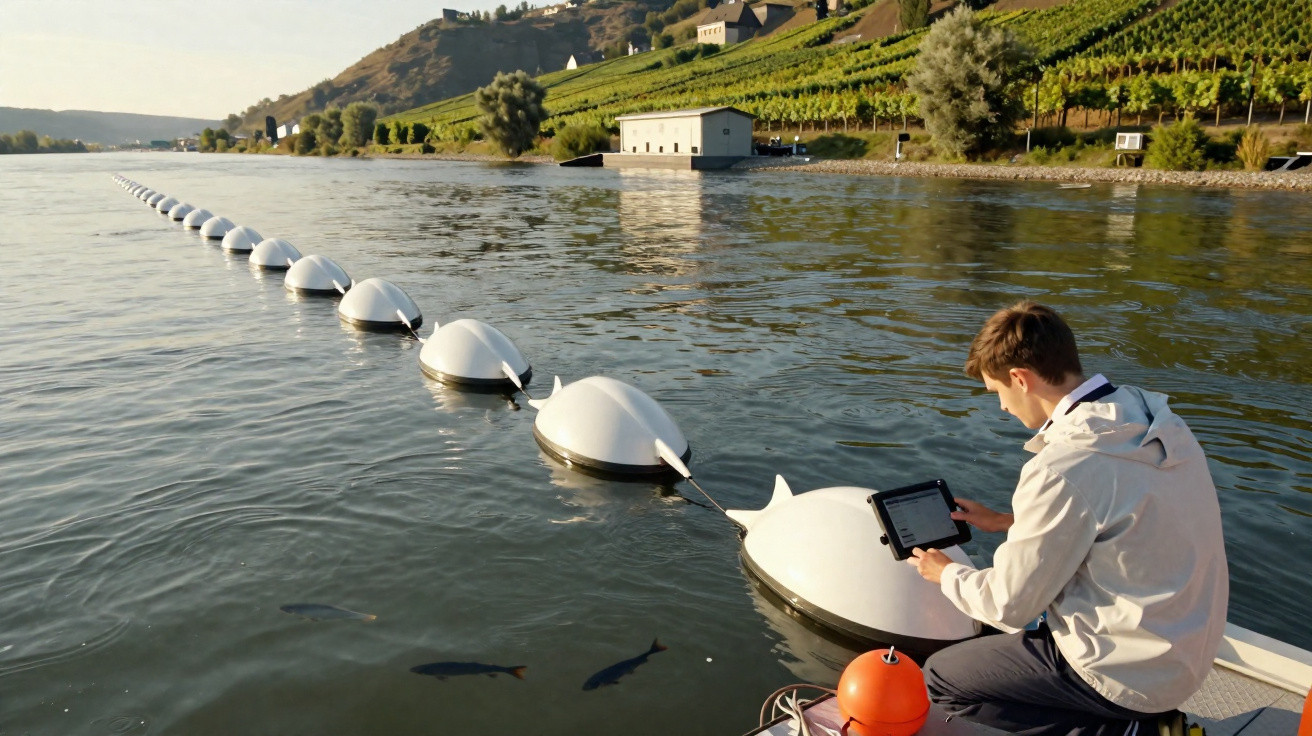
In the Middle Rhine near Sankt Goar, an unusual power station is taking shape: no concrete barrier, no barrage and no giant wheels in view. Instead, dozens of electricity-generating “fish” are intended to float beneath the surface, supplying power continuously. The concept is to harness rivers without building them over, creating a form of safeguard against dark doldrums in the electricity system.
Rhine swarm power station: electricity from the current
Wind power relies on wind, while photovoltaics needs sunshine. When both are unavailable at the same time, this is known as a dark doldrums period. A start-up from the Munich area aims to reduce precisely this gap. Energyminer is planning a swarm power station near Sankt Goar on the Rhine, comprising 124 floating small-scale power units known as Energyfish.
Rhineland-Palatinate’s Environment Ministry has approved the installation in a side channel of the Rhine. Three modules are already operating in the river, with another 21 due to be added in the next phase. Ultimately, all 124 turbines are expected to work together, generating electricity around the clock.
“A swarm of 124 floating turbines is set to draw energy from the Rhine’s current day and night – quietly, invisibly and without damming the river.”
How an Energyfish works
An Energyfish is essentially a compact hydroelectric power station that floats in a river. Anchored at a single point on the riverbed, it moves freely in the current and converts the force of the water directly into electrical energy.
Compact technology rather than a concrete giant
At first, the specifications appear modest: roughly 2.8 by 2.4 metres in size, weighing about 80 kilograms and with a maximum output of around 6 kilowatts in optimum conditions. Its potential only becomes clear when many units operate together. According to the manufacturer, 100 devices produce around 1.5 gigawatt-hours of electricity annually – enough for approximately 400 to 500 four-person households.
This is how a single Energyfish operates in a river:
- The entire module sits underwater and is secured to an anchoring point on the riverbed.
- Its rotor blades are turned solely by the natural current, with no weir or additional infrastructure required.
- A generator inside the unit transforms this rotational movement into electricity.
- Underwater cables carry the electricity to the bank, where it is fed into the existing grid.
Energyminer says the levelised cost of electricity should be comparable with that of modern wind turbines and solar installations. This could make the technology more than a niche project and potentially a credible addition to the energy mix.
Why Sankt Goar is such a compelling location
The site was selected for a reason. The Middle Rhine is among the few stretches in Germany where water flows consistently fast enough. Between rock faces and narrow valleys, the river accelerates here to around 1.5 to 2 metres per second – the speed required by the turbines.
Energyminer previously tested the technology in Munich’s Auer Mühlbach stream. Since that pilot installation entered service in 2023, the company says it has continuously worked on efficiency, durability and control systems. Sankt Goar now represents the move from testing towards serial deployment.
“The Middle Rhine site is regarded within the sector as a proving ground: if the swarm runs reliably there, the door opens to many more river projects.”
No reservoir, with consideration for fish
Hydropower has an image problem in Germany. Traditional large-scale schemes involving dams and reservoirs significantly alter ecosystems, obstruct fish migration routes and flood floodplains. Energyminer’s swarm power station follows a different approach: the current should remain largely unchanged and the river course will not be impounded.
Protection system for migratory fish species
Nevertheless, a key question remains: what happens to fish that come close to the turbines? The start-up says it has developed a protection system intended to prevent animals from being injured by the rotor blades. This includes, among other measures, specially designed turbine blades and their placement in the water.
Experts at the Technical University of Munich have examined the Energyfish. Their conclusion was that the energy units do not endanger migratory fish species found in the Rhine and do not cause behavioural changes in them. This gives supporters an important argument in the often emotive debate over interventions in rivers.
A signal for the energy transition
For the young Gröbenzell-based company, the approval has significance far beyond the region. Co-CEO Richard Eckl describes Sankt Goar as “Proof of Scale” – evidence that the technology can be operated economically not only in a laboratory or small stream, but also on a large scale.
Politicians in Rhineland-Palatinate are also clearly placing hopes on the scheme. The minister responsible for climate protection and energy sees swarm power stations as an opportunity to generate decentralised electricity at suitable river locations and allow local residents to benefit directly. River power is particularly valuable when solar output weakens: in winter, overnight or under heavy cloud.
Where future swarm power stations could make sense
Germany has many rivers, but not every stretch is suitable. Several factors are crucial:
- sufficient water depth to keep the modules fully submerged;
- steady current speeds over longer distances;
- a low risk of collisions with shipping;
- compatible nature-conservation requirements and spatial-planning rules.
Despite these limitations, rivers contain considerable energy potential. The Rhine, Moselle, Weser and Elbe could all, in principle, host swarm power stations wherever the water flows quickly enough. The Sankt Goar installation is therefore likely to serve as a reference point for future projects in Germany and other European countries.
What current power means for the electricity system
The technology will not replace coal-fired or gas-fired power stations on its own, but it fits an electricity supply that is becoming ever more decentralised. This type of river power station generates power relatively consistently, regardless of the time of day or weather conditions. When photovoltaic output is low, it could provide an important share of baseload supply.
Combined with storage, flexible demand and other renewable sources, this can create a more resilient system. Short periods of weak wind or sunshine can be cushioned more effectively because part of demand continues to be met by river-generated electricity. In areas with suitable locations, power could be used locally, for example by councils, commercial estates or electric-mobility charging infrastructure.
Opportunities, risks and unanswered questions
However promising the technology may appear, it still raises unresolved issues. Its long-term effects on river ecology, sediment transport and navigability will only become clear during continuous operation. Every anchoring point on the riverbed represents some degree of intervention in the system. Approval authorities will therefore assess each project individually.
The financial questions are equally important: how will maintenance intervals and repair costs develop in harsh river conditions? How resilient are the modules during floods, floating debris or ice runs? And how quickly can swarms be replaced or expanded when a region needs more electricity?
Terms and practical examples
The term “dark doldrums” refers to periods when both wind and solar energy are in short supply. At such times, other sources must take over: storage, fossil-fuel power stations – or, in future, more flexible hydropower from rivers.
One practical scenario would be a region with many solar rooftops, where PV output falls sharply during winter. A swarm power station in a nearby river could then provide part of the missing electricity without requiring additional land. At the same time, the landscape would remain largely unchanged, as the technology operates below the surface.
Councils could gain further options. They might partner with utilities to initiate their own river projects, secure long-term electricity prices or establish public-participation models. The operating installation at Sankt Goar will show whether these expectations can be fulfilled – or whether swarm power stations ultimately remain just one component among many in the major task of the energy transition.





Comments
No comments yet. Be the first to comment!
Leave a Comment