
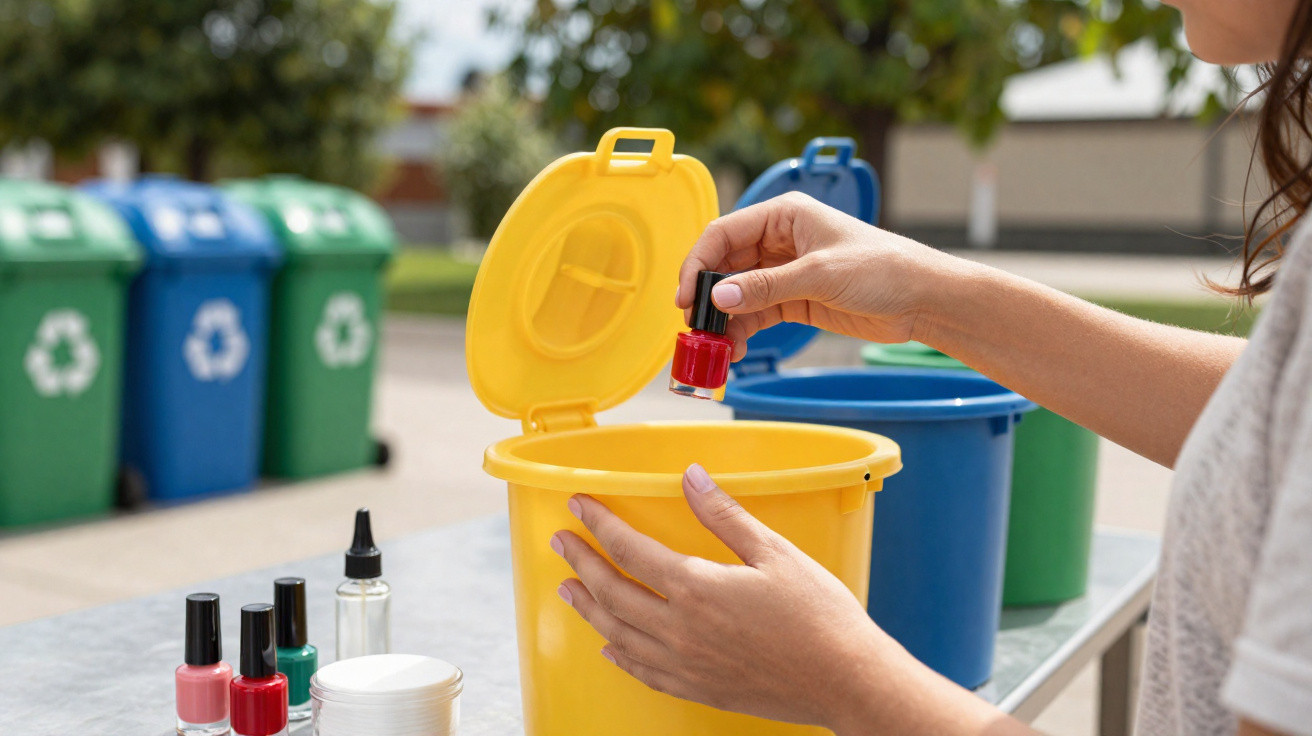
A seemingly harmless bottle of nail polish in the bathroom can quickly become an environmental hazard – and, in the worst case, could even result in a fine.
When tidying the bathroom, old nail polish is often dropped automatically into the nearest bin. Glass can be recycled, so into the bottle bank it goes – or so many people assume. This habitual approach frustrates waste operators, harms the environment and may prove costly for consumers.
Why nail polish in household waste causes problems
The familiar situation is this: the red polish has dried out, the bottle is half full and the brush is stuck together. The lid is screwed on and it is thrown into the bathroom bin. Visually, it appears to be an ordinary glass container among cotton pads and toothpaste tubes. In reality, however, it is a special case with little in common with normal residual household waste.
Legally and in practical terms, nail polish is classed as hazardous waste – even though it looks completely harmless in a make-up bag.
Why bottle banks are the wrong place
Many consumers place nail polish bottles in glass recycling. It seems logical, but it is incorrect. Cosmetic glass frequently differs substantially from glass used for bottles or jars. It may be coloured, specially toughened or chemically treated. Its different composition disrupts the melting process at glassworks.
Size is another issue: these small bottles can easily fall through sorting-plant conveyor systems or fail to be reliably detected by optical sensors. Their contents create the most serious problem: brushes, lids and remaining liquid polish contaminate the entire glass mix. Recyclable material can then quickly become unusable reject waste.
The residual waste bin is not the answer either
Putting nail polish into residual waste merely moves the problem elsewhere. The chemical mixture in polish is unsuitable for standard household-waste treatment. Improper incineration can produce toxic fumes at waste-to-energy facilities, while landfill disposal risks long-term contamination of soil and groundwater.
There is also a fire risk: polishes and the removers used with them are considered highly flammable. Waste is heavily compacted in refuse vehicles, then stored and moved in bunkers. If a bottle bursts and reacts with other materials, it can, in unfavourable circumstances, trigger fires or flash ignitions – a genuine danger for refuse workers.
What nail polish actually contains
Behind imaginative colour names lies a chemical cocktail. Even modern “free from” formulations usually still contain potentially problematic ingredients. Many polishes include solvents, plasticisers and resins that fall within the hazardous-substances category.
For recycling facilities and incineration plants, nail polish residues behave more like paint or solvents than conventional cosmetics.
Environmental risks of incorrect nail polish disposal
Although emissions from incineration plants can technically be filtered, doing so requires complex equipment and comes at considerable cost. If nail polish residues nevertheless reach the environment through other routes, they bind poorly to soil and may seep into deeper layers for years. These substances barely break down and can enter watercourses.
For this reason, many local authorities seek to keep these waste streams consistently out of ordinary household waste. The fewer foreign materials that enter treatment facilities, the more reliably their processes operate – and the less filtration and subsequent treatment are required.
Empty does not necessarily mean harmless
In theory, a completely empty, rinsed glass container would be far easier to dispose of. In practice, nail polish is different. Its narrow neck, thick texture and persistent colour pigments make thorough cleaning almost impossible.
Why achieving “completely empty” is unlikely
Making a bottle genuinely residue-free would require large quantities of specialist thinner. Consumers would not really solve the issue this way, but simply shift it: the bottle might be cleaner, yet the contaminated cleaning liquid would also have to be treated as hazardous waste.
The professional guidance is therefore clear: as soon as visible polish remains in the glass – whether liquid, thick or dried – the container counts as hazardous waste. It is no longer handled as packaging, but as a chemical product subject to correspondingly strict disposal rules.
The usual case: thickened residue in the bottle
In everyday life, nail polish is rarely truly empty when it is discarded. A lump often remains at the bottom, with the brush standing in the viscous residue. This is precisely what makes the bottle problematic. Its highly concentrated ingredients can no longer be diluted in a controlled manner. It therefore does not belong in a standard household bin.
What incorrect disposal can cost
Many local authorities inspect bin contents more closely than they did in the past. Rising costs caused by incorrectly sorted waste are the reason. In many local rules, nail polish falls under hazardous small quantities from households – materials that have no place in residual waste bins.
Even a small bottle may be treated as “improper content” – with noticeable consequences for your wallet.
Fines for incorrect disposal
If an inspection clearly shows that a bin regularly contains problematic materials such as polishes, solvents or similar products, fines may follow. Local authorities often cite starting amounts of several tens of pounds for incorrect waste sorting. Anyone who continues after an initial warning must expect higher penalties.
Waste operators may also leave bins unemptied if they discover prohibited materials. Those affected must then arrange for a specialist company or take the contents to an authorised collection point themselves – including any additional charges.
Fly-tipping can be more expensive
Anyone who leaves old polish “just quickly” in bushes, by the roadside or in car parks risks substantially higher penalties. Illegally dumped chemicals can require the fire service or specialist teams to attend when containers leak or bottles burst. In such cases, fines may be accompanied by invoices for clean-up and recovery work.
The right destination: recycling centres and collection points
The correct route for old nail polish bottles is through the local authority recycling centre or dedicated household hazardous-waste collections. In many areas, these materials are listed as “household hazardous waste” or under “problem waste collection”.
How drop-off usually works
- Gather old nail polishes in a securely closed box or bag.
- Take them to a recycling centre or mobile household hazardous-waste collection.
- Hand them to the responsible member of staff on site rather than leaving them somewhere.
- Ask questions: collection points often accept other hazardous household products too, such as cleaners and aerosol cans.
Staff store the bottles in secured areas before specialist firms destroy them in high-temperature furnaces. Only facilities of this kind can ensure that no critical fumes or residues escape.
Finding collection points near you
Information is available on local council and county websites. Under terms such as “recycling centre”, “hazardous waste” or “special waste”, councils list opening times and acceptance conditions. Mobile collection services are often available too, stopping at various locations around a town or city at set intervals.
People living in rural areas can often find dates in waste calendars or local authority newsletters. If in doubt, a quick call to the waste operator will help – staff will know the appropriate place to take old polishes, paints and comparable products.
How to keep nail polish usable for longer
Before bottles become waste at all, they can often still be saved. Many polishes thicken simply because they have been left open too frequently or stored incorrectly. Straightforward measures can significantly reduce the amount of hazardous waste users produce.
Tips for preventing dried-out polish
Specialist thinners from chemists or health and beauty retailers can make thick polish usable again. A few drops are usually enough; then gently roll the bottle between your hands. This mixes the liquid without creating air bubbles. Nail polish remover is unsuitable for this purpose, as it damages the formula’s structure and reduces both durability and coverage.
Storing bottles in a cool, dark place extends their lifespan further. It is important to tighten the lid immediately every time, preventing solvents from evaporating. The less often the brush is pulled fully out, the longer the contents remain uniform.
A second use for unwanted colours
Colours you no longer like can often still be put to good use. Friends, relatives or charitable organisations may welcome barely used products as long as they still appear hygienic. An honest assessment matters: heavily clumped, strongly smelling or very old polishes are better treated directly as hazardous waste.
Creative users can repurpose well-preserved polish for small craft projects: marking keys, protecting metal parts from rust, or adding accents to stones and wooden details. This gives the product one more practical purpose before it is eventually disposed of properly.
What to bear in mind day to day
Many people still view nail polish purely as a beauty product. Understanding the disposal aspect encourages much more conscious handling. Three simple principles help in daily life:
- Buy only as many colours as you will genuinely use.
- Consistently regard bottles as potentially hazardous waste.
- Regularly check which products are still usable – and take the rest to a recycling centre.
This reduces the risk of environmental damage, disputes with waste collection services and unnecessary costs. It also raises awareness of other hazardous products in the home – from cleaners and aerosol cans to adhesives, which should be handled in a similar way.



Comments
No comments yet. Be the first to comment!
Leave a Comment