
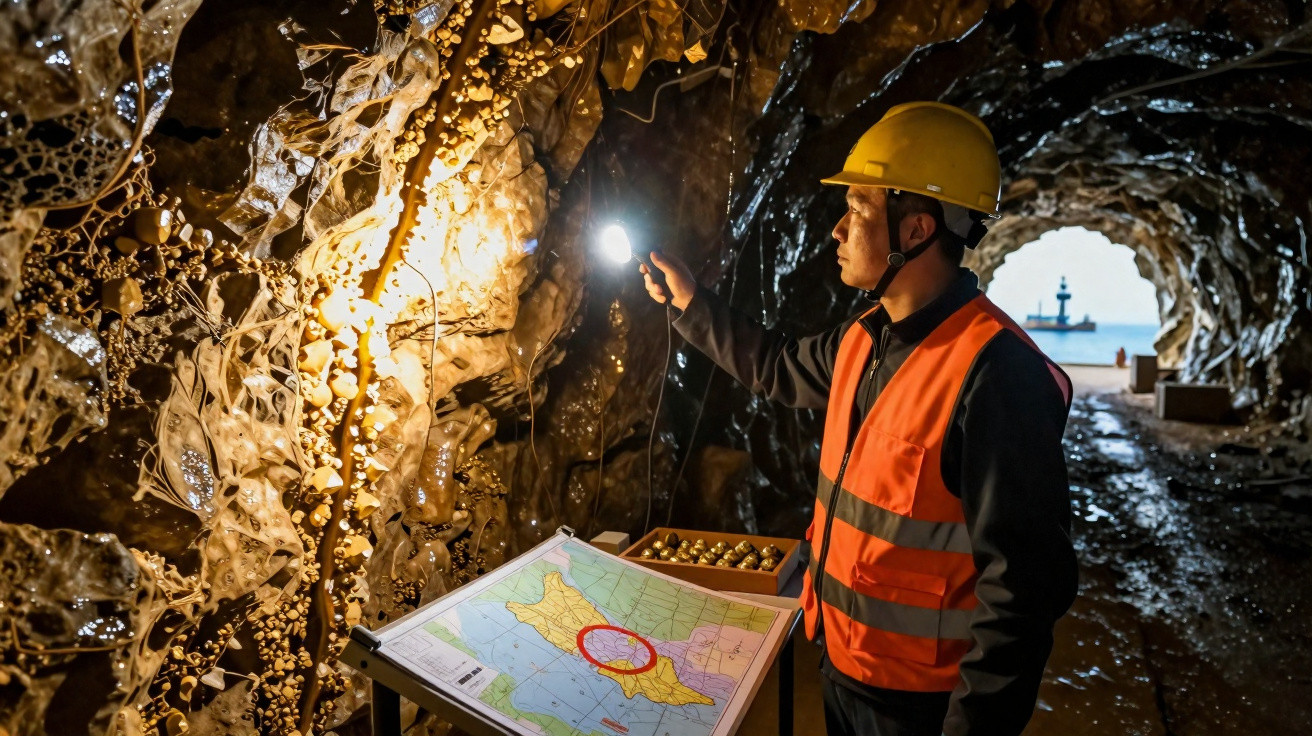
Only in the past few years have details gradually emerged publicly: geologists have identified an enormous gold deposit deep beneath the surface of eastern China. The discovery sits in a region already regarded as the country’s foremost gold-producing area - but its scale is far beyond that of conventional deposits.
China, the world’s quiet gold giant
China has topped the ranking of gold-producing nations for years. No other country extracts as much of the precious metal from the ground each year. Official figures typically put annual output at around 350 to 400 tonnes. By comparison, global mine production usually stands at a little over 3,000 tonnes.
Much of this output comes from Shandong province in the east of the country, particularly the Jiaodong Peninsula. Some of Asia’s richest deposits are concentrated there in close proximity, linked by a geological system that has been studied for decades.
Shandong is considered the centrepiece of Chinese gold production - and the new deep discovery could elevate that status considerably.
The Laizhou–Zhaoyuan gold zone: China’s “gold capital”
At the heart of the region is the Laizhou–Zhaoyuan gold belt. Chinese industry circles have long used the nickname “gold capital”, because a substantial share of national production comes from this very strip of land. New deposits have been proven there repeatedly over many decades, mainly in quartz veins and complex ore formations.
Even before the latest mega-discovery, one point was clear: discussions of Chinese gold primarily meant Shandong. Numerous state mining companies have developed vast underground operations there, extending across several levels hundreds of metres below ground.
Spectacular: gold mining beneath the sea
The Sanshandao mine is among the best-known operations. It stands out for another reason: sections of its tunnels run beneath the seabed of the Bohai Sea. To stop seawater entering, the operators had to devise entirely new safety and dewatering systems.
- Deep-level extraction under high pressure
- Complex ventilation and rescue systems
- Specialist equipment for drilling near the seabed
Such pioneering projects have greatly expanded geological knowledge of the area - and this expertise is now also being applied to exploration of the newly identified super-deposit.
The 2015 mega-discovery: more than 1,000 tonnes of gold
In 2015, Chinese geologists announced the discovery of an especially deep gold deposit in Shandong. Initial estimates indicated that it contained more than 1,000 tonnes of gold resources. Depending on the definition used and the basis of comparison, this would rank among the largest contiguous deposits ever documented.
For context, many established large mines in Africa or Australia each hold several hundred tonnes of recoverable reserves. A single block containing well over 1,000 tonnes within an already active gold-mining region is therefore an exceptional occurrence.
A single deposit containing more than 1,000 tonnes of gold cannot transform the global market, but it reinforces China’s role as the dominant mining power.
Why this discovery is so significant
The new deep-level discovery has several distinctive features:
- Deep location: The deposit lies substantially deeper than many traditional gold mines. This makes extraction more difficult, yet it offers the prospect of stable output over the long term.
- Position within existing infrastructure: The area already has roads, ports, power supplies and experienced workers.
- State control: As the gold sector is predominantly state-owned, mining plans can be closely linked to monetary and industrial policy.
For China, this means that gold supply is secured for an even longer period. The People’s Republic can strengthen its position as both a production power and a source of demand, without having to rely as heavily on imports.
How China’s gold market is organised
Unlike in many Western countries, the Chinese public had only limited access to physical gold for a long time. For much of the country’s history, private owners were scarcely allowed to hold or trade the metal freely. State mines and banks determined what happened to the gold extracted.
The picture began to change markedly with reforms in the early 2000s. The Shanghai Gold Exchange began trading in 2003. Since then, banks, companies and, later, private investors have been able to buy and sell gold in standardised forms.
This liberalisation sparked a boom. Jewellery manufacturers, investment firms and small private investors made use of the new flexibility. At the same time, the state retained considerable influence over the supply and movement of the metal through major mining groups and financial institutions.
Gold as jewellery, savings and reserves
Gold serves several purposes in China:
- Jewellery: Sales rise noticeably, especially around weddings and New Year celebrations.
- Investment bars and coins: Many households regard gold as protection against currency fluctuations.
- Central bank reserves: China’s central bank has increased its official gold holdings in stages for years.
This makes China not only one of the leading producing countries, but also one of the biggest markets for demand for the precious metal.
China’s appetite for gold reaches far beyond its borders
The major deep discovery in Shandong does not mean China is limiting itself to domestic deposits. On the contrary, Chinese mining companies have spent years acquiring stakes in projects in Africa, Central Asia and South America. These investments are intended to provide additional supply security and expand the country’s influence over the global commodities sector.
These overseas ventures attract criticism in some regions, where residents fear environmental consequences and unequal contract terms. At the same time, many countries urgently need investment in their resource industries and accept Chinese partners in order to get mines operating at all.
What “one of the largest deposits in history” really means
When specialists describe a find as one of the largest gold discoveries, they are not referring only to the volume of metal. Several considerations matter:
- Total resources in the ground
- Reserves that can be extracted economically
- Production costs per gram of gold
- Political stability in the producing country
- Technical feasibility at the relevant depth
A very large but extremely inaccessible deposit may have less market impact than several medium-sized, easily accessible deposits. In Shandong’s case, however, substantial resources, existing infrastructure and a powerful state apparatus come together - a combination that gives the project particular force.
Opportunities, risks and implications for investors
For international investors in gold or gold-mining companies, the Chinese super-discovery has two sides. A stable, predictable source of production can curb price spikes and make the market easier to forecast. At the same time, a heavy concentration of output in one country increases geopolitical dependence.
Anyone investing in physical gold or related financial products should keep several points in mind:
- Gold prices respond strongly to interest-rate decisions and crises, not solely to mining announcements.
- Major discoveries often reach the market only gradually over decades.
- Political decisions in China can influence export flows.
For private investors in Europe, the Shandong discovery changes little in the short term about the basic principles: gold remains more of an insurance policy against extreme scenarios than a conventional source of returns. Over the longer term, however, China’s influence on pricing and supply chains is likely to continue growing.
How does a gold belt such as Shandong’s form?
Gold deposits such as those in the Laizhou–Zhaoyuan belt result from lengthy geological processes. Over millions of years, hot fluids circulate through the Earth’s crust, dissolve metals from rock and deposit them again in cracks and fissures. Where conditions are right, dense zones of ore veins form that are worthwhile for mining.
Several factors converge in Shandong: ancient mountain structures, active faults and a complex system of igneous rocks. Geologists map these structures layer by layer, take drill cores, measure magnetic anomalies and use the results to create a 3D picture of the subsurface. This makes it possible to identify potential ore blocks that remain undiscovered deep beneath the surface.
It was precisely such methods that led to the indication in 2015 of the vast deep block that has now given China one of the largest gold discoveries in history - and is reshaping the global commodities map.






Comments
No comments yet. Be the first to comment!
Leave a Comment