
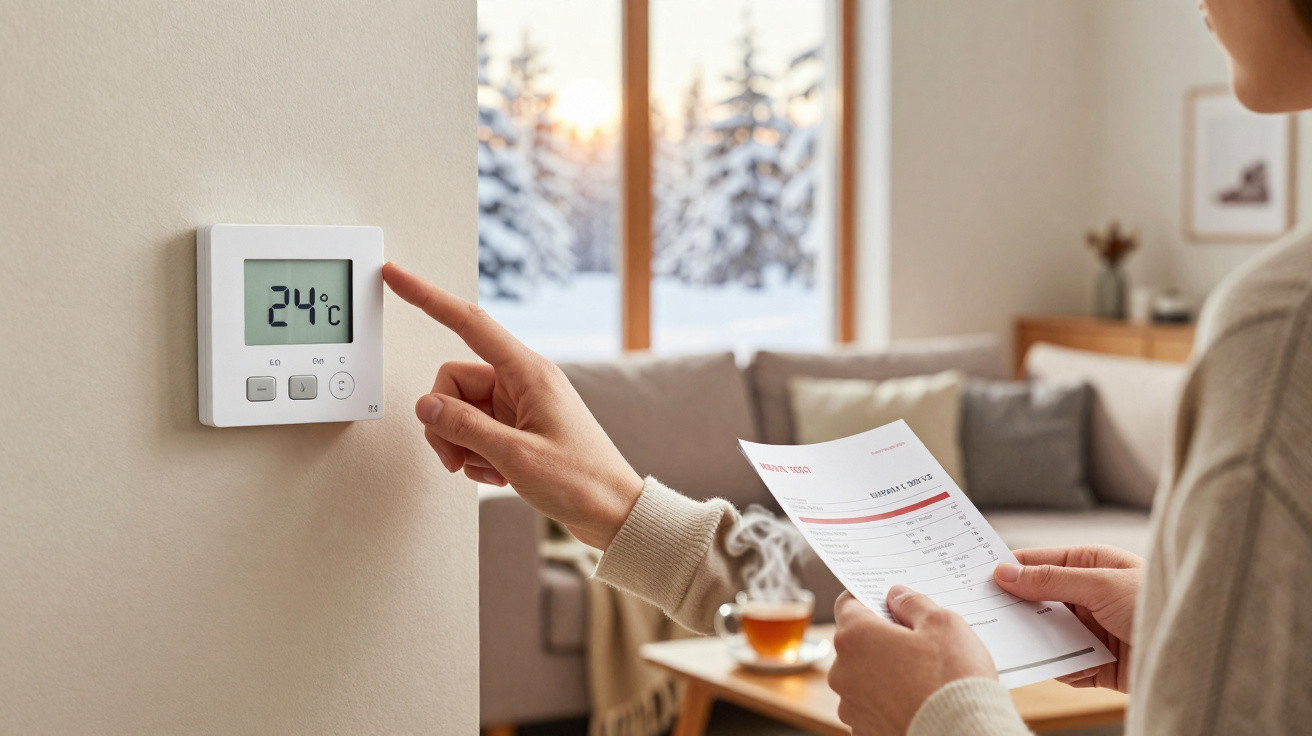
Outside, the sky is grey and the wind cuts through scarves, but the flat feels close and almost drowsy indoors. Bare feet, a T-shirt, Netflix in the background. It is wonderfully cosy. It is also costly.
A gas bill sits on the coffee table. Meanwhile, a social-media post is spreading everywhere: energy specialists now recommend heating homes to no more than 19 or 20 °C. Go beyond that, they argue, and it is no longer simply about comfort - it is wasted energy. “Comfort is a luxury,” says a viral line being shared by indignant renters and self-satisfied minimalists alike.
A once-private preference - the warmth you want in your living room - has become both a financial and moral battleground. Are people who choose 24 °C selfish energy guzzlers, or exhausted people simply trying to survive winter? The truth is more complicated than a thermostat reading.
Why 24 °C is suddenly seen as “too much”
On a freezing January night in Manchester, 32-year-old Laura comes through the door of her rented flat and follows her usual routine: tap-tap, thermostat to 24 °C. She was raised in a home where you could see your breath in the kitchen, so to her, warmth means security. Within ten minutes, the radiators are hissing, the windows have steamed up and heat washes across the room.
This time, however, there is a complication. Laura has read that each degree above 19–20 °C may raise heating costs by roughly 7 %. The comfortable warmth now feels rather more oppressive. She is not merely warming her feet; she is imagining her money evaporating into the air.
Across Europe, energy analysts have increasingly repeated one recommendation: keep living areas at 19–20 °C and bedrooms at 16–18 °C. Once the temperature passes 22 °C, they say, you enter the “comfort is a luxury” territory. It is neither unlawful nor immoral, merely expensive - in money and in emissions. Heating accounts for a substantial share of domestic energy consumption, and the impact of those additional degrees grows quickly when millions of households make the same choice.
In theory, the case is straightforward: lower temperatures mean smaller bills and a lower carbon footprint. Real lives, though, are not straightforward. Many people work from home all day. Babies crawl across cold floors. Some renters occupy draughty older properties where a thermostat set to 20 °C delivers only 17 °C in the sofa corner. The online argument has become harsh: one camp sees 24 °C as needless waste, while the other sees it as one small source of comfort in a difficult year.
Research bodies continue to highlight the figures. The International Energy Agency and national regulators routinely tell households that reducing temperatures from 22–24 °C to about 19–20 °C can cut bills by 10–20 % in many climates. Leave the heating at 24 °C throughout winter and the trend reverses. But each percentage has a personal story behind it: childhood spent in cold rooms, a badly insulated rental, or simply wanting to return home without sitting on the sofa in three layers.
Staying warm without setting your home to 24 °C
Lowering the thermostat does not have to mean living in discomfort. It means taking a different approach. The first solution is not extraordinary self-denial but simple physics: heat leaves through walls, windows and floors, as well as through tiny gaps that go unnoticed until the bill suddenly doubles.
For renters, the fastest improvements are often inexpensive and removable. Close heavy curtains as soon as darkness falls. Put draught excluders beneath doors. Apply bubble wrap or thermal film to single-glazed windows. Lay rugs over uncovered floors. These measures may not look glamorous, but their impact can be significant: a room at 20 °C can feel like 22 °C when cold air is no longer creeping around your ankles.
Then there is zoning. Heating an entire flat to 24 °C just so the hallway feels pleasant for 90 seconds each day is needless loss. Use thermostatic radiator valves or programmable controls to leave bedrooms cooler and concentrate warmth in the rooms used during the evening. Treat the flat as a series of “heat bubbles”, rather than trying to maintain one perfectly uniform temperature everywhere.
Most experts now advise a straightforward approach: choose a practical daytime range - perhaps 19–21 °C - and maintain it reasonably consistently instead of swinging between 16 and 24 °C. Sharp rises consume energy because the boiler or heat pump must work harder to meet a sudden demand. Over time, a modest stable temperature costs less than dramatic fluctuations followed by a nightly “heat blast” after work.
There is plenty of guilt circulating online. Some people post a photograph of a thermostat reading 24 °C and are lectured by strangers. Others boast about their 17 °C, “just put on a jumper” way of life. The reality in many rented properties is tougher: ageing windows, no control over insulation and outdated radiators. Let us be honest: nobody truly does this every day, measuring every kilowatt-hour like an energy monk.
We have all had the experience of turning up the heating after an awful commute and thinking, “I’ll deal with the bill later.” That does not make anyone a villain. The real issue is when that response becomes a routine repeated every evening between October and March. The key is to identify your “comfort baseline” - the temperature at which you are generally fine while wearing a jumper - and make those 24 °C spells an intentional indulgence rather than the standard setting.
Experts also flag several familiar errors: warming vacant rooms “just in case”, covering radiators with sofas or clothes airers, leaving small windows tilted open all day while the heating is on, and neglecting maintenance in a rented flat because the boiler does not belong to you. These are the hidden losses that drain a budget while everyone debates a difference of two thermostat degrees.
“Comfort isn’t binary,” says UK building physicist Sarah Price. “It’s not freezing or sauna. It’s a bundle of small choices: clothes, humidity, air movement, habits. The thermostat is only one part of the story - we’ve just turned it into a symbol.”
That symbol creates a divide. For some, it is about dignity: why should a person be told that 24 °C is “too nice” for a modest rented flat? For others, it concerns shared responsibility during an energy and climate crisis. Both reactions are valid. In small, poorly insulated rentals, tenants are caught between them - facing high bills for mediocre warmth while being instructed to “heat less” in homes that leak like sieves.
- Remember that warmth comes as much from layers, routines and stopping draughts as from the temperature itself.
- Treat the figures as guidance, not as moral verdicts on your lifestyle.
- If you cannot alter the building, address the edges of the room: windows, doors, floors and fabrics.
Is 24 °C always “wrong”?
There is a quiet reality that many specialists acknowledge away from the cameras: not everyone can comfortably function at 19 °C. Older people, young children and people with certain long-term health conditions may need higher temperatures for comfort and health. To them, the phrase “comfort is a luxury” can sound like a threat rather than advice. It can feel like being told to choose between cold and guilt.
Equally, energy costs and climate targets are real. Making 24 °C the standard temperature in millions of flats for the entire winter does result in higher bills and greater emissions. No single campaign or viral infographic will remove that tension. It lies where intensely personal experiences - cold hands and warm feet - meet public concerns such as gas, grids and policy.
The question therefore changes. Rather than asking whether 24 °C is evil, ask when 24 °C is worthwhile and who has the right to decide. Some renters have virtually no choice: their landlord controls the heating system, or the property wastes heat so severely that bills remain punishing even at 20 °C. Others have some flexibility to try 21 °C with slippers rather than 24 °C with a T-shirt, without turning daily life into an endurance challenge.
Perhaps the real division is not between those who prefer 19 °C and those who prefer 24 °C. It is between people able to alter their homes - by insulating, upgrading or investing - and those forced to make small adjustments within systems built decades ago. The thermostat number has become a stand-in for that wider inequality.
The next time you raise the control on a cold evening, you may recall the chart claiming 7 % per degree, or the expert who said “comfort is a luxury”. After a punishing day, you may still choose 24 °C for a few hours. Or you may stop at 20 °C, put on thicker socks and feel unexpectedly pleased with yourself. Either way, the choice will no longer seem neutral. For better or worse, that is the new climate in our living rooms.
| Key point | Details | Why it matters to readers |
|---|---|---|
| Every extra degree costs roughly 7 % more | European energy regulators often quote an average rule of thumb: raising the temperature from 20 °C to 21 °C can increase heating energy use by about 7 %. Operating a home at 24 °C rather than 20 °C may mean roughly 30 % more consumption across an entire season. | It offers a tangible picture of how “only a couple of degrees” can become a double-digit rise in your bill by winter’s end. |
| Insulation beats brute-force heating | Straightforward steps - sealing draughts, fitting heavy curtains and placing rugs on cold floors - can make a 20 °C room feel as comfortable as a 22–23 °C room with bare windows and floors. Renters can generally make these changes without landlord permission. | It helps you achieve the warmth you want without paying for a higher thermostat setting that largely escapes from the building. |
| Zoning your flat saves money | Keeping living rooms at 19–21 °C and bedrooms cooler, while reducing radiators in rarely occupied rooms, can reduce unnecessary heating by 10–15 % according to many housing energy audits. | It allows you to direct comfort towards the spaces you actually use instead of silently paying to warm corridors and unused spare rooms. |
FAQ
- Is 24 °C at home really “wrong” from an energy point of view? Not necessarily, but it is costly. In a well-insulated home, keeping 24 °C all winter may be a deliberate luxury choice. In a draughty rental, it generally means using substantial energy simply to combat cold surfaces and draughts.
- What temperature do experts actually recommend for tenants? Most health and energy organisations recommend approximately 19–21 °C for living areas and 16–18 °C for bedrooms, with somewhat warmer targets for older people, babies and those with certain health conditions.
- My flat is freezing at 20 °C. Does that mean I’m “wasting” energy? Probably not - it may indicate poor insulation. Cold walls, single glazing and draughts can make 20 °C feel harsh. In that situation, practical improvements and textiles matter as much as the thermostat setting.
- Is it cheaper to turn the heating off when I’m out, or keep it low all day? In many homes, allowing the temperature to fall slightly while you are out and reheating on a schedule costs less than heating continuously. Very large swings can remove that benefit, however, so a programmer with modest setbacks usually works best.
- What can I realistically do if my landlord won’t improve insulation? Concentrate on what you can control: draught excluders, thermal curtains, window film, thoughtful furniture placement away from cold walls and radiator zoning. Record high bills and cold areas; in some countries, this evidence can support requests for improvements or rent negotiations.





Comments
No comments yet. Be the first to comment!
Leave a Comment