
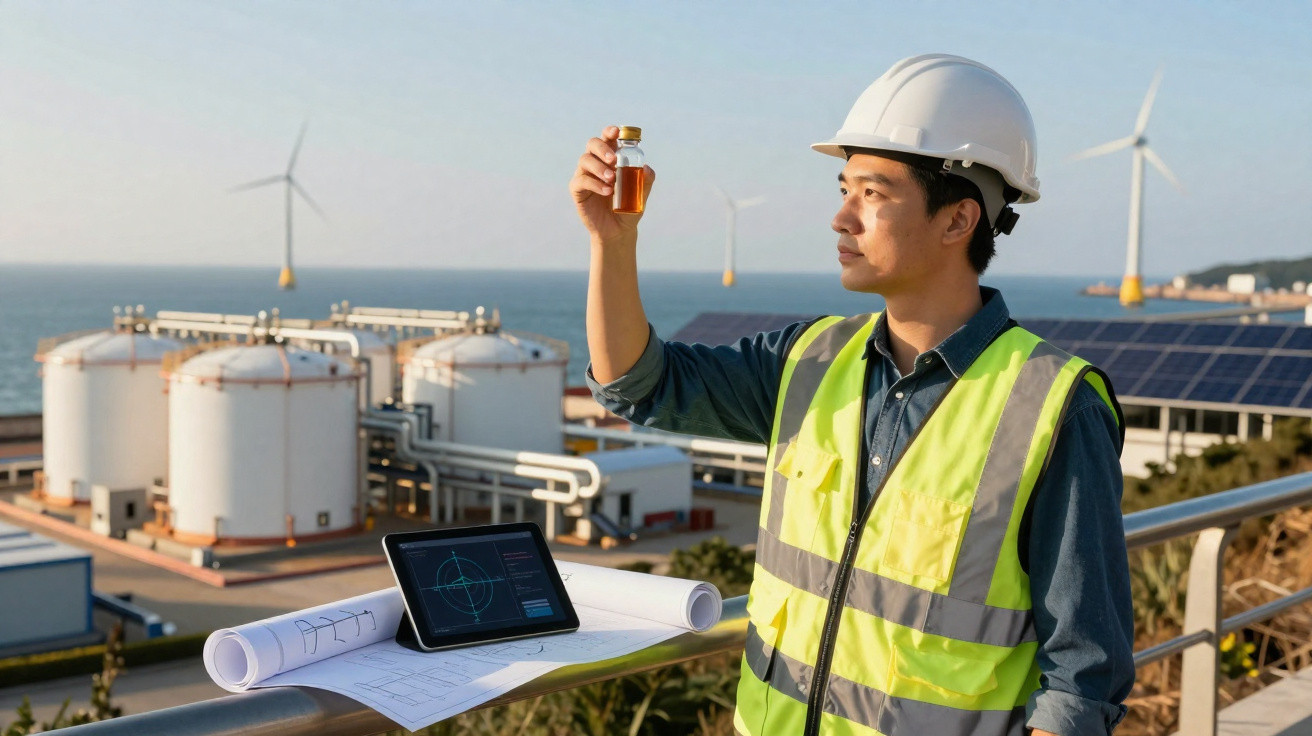
Portugal could become a producer of synthetic fuels, as it brings together several favourable conditions to do so.
The possibility was raised by Pedro Marques, a researcher at INEGI, during Auto Talks, Razão Automóvel’s new editorial format, which debuted at the ECAR Show.
In the researcher’s view, the potential is there, but it now needs to be turned into investment and concrete action.
What are synthetic fuels?
Also referred to as e-fuels, synthetic fuels are made by combining green hydrogen with carbon dioxide (CO₂) captured from the atmosphere. They could replace fossil fuels but, unlike them, are virtually carbon-neutral: because CO₂ is required to produce them, releasing it after combustion does not add extra CO₂ to the atmosphere.
“Indeed, it is possible to make synthetic fuel that makes current fuels virtually neutral in terms of CO₂ emissions. It is 100% compatible with the vehicles currently on the road, and it can also make use of all the existing distribution infrastructure,” the researcher explained.
Portugal has favourable conditions for synthetic fuels
Pedro Marques says Portugal is well placed to invest in this energy sector, primarily due to its existing and future renewable electricity generation capacity, which is essential for producing green hydrogen and capturing CO₂.
“Studies assessing the viability of this type of solution point precisely to southern Europe, of which Portugal is a part. From that perspective, we can enter this discussion,” he said.
He added: “I do not have any specific data, but looking at the current landscape and what is being said about the potential of the regions, I would say that we may eventually start producing synthetic fuels here.”
As well as southern Europe, South America, Iceland, North Africa and the Middle East are regions with the potential to become major producers of synthetic fuels. The reason is the same as in Portugal: their ability to generate large amounts of electricity from solar and wind power, or geothermal energy in Iceland’s case.
What needs to happen?
For this to become a reality, Pedro Marques says a decision is needed from the relevant authorities.
“There needs to be willingness from regulatory bodies to move forward. The issue of synthetic fuels is still very much linked to the wishes of the European Union”
- Pedro Marques, researcher at INEGI
“What is missing is investment and somebody willing to do it. It is also necessary to know whether these synthetic fuels will have any significance in the medium or short term,” he concluded.
In 2023, Germany and the European Union reached an agreement allowing the continued sale of new cars with internal combustion engines after 2035, provided they use carbon-neutral fuels such as synthetic fuels.
However, the EU’s commitment to synthetic fuels and other renewable fuels - whether carbon-neutral or low-carbon - has focused on the maritime and aviation sectors, where electrification is not viable.
Although road transport emits far more CO₂ than maritime and air transport in Europe, the European Union has been reluctant to invest in synthetic fuels.
Pedro Marques believes this reluctance may stem from the inefficiency of the synthetic fuel production process, which requires vast quantities of energy.
“To produce synthetic fuel, we need surplus electricity generation. The energy overcapacity required to produce road fuel for all existing vehicles could be so great that it makes it unviable.”
- Pedro Marques, researcher at INEGI
He concluded that it is easier to accept inefficiency when addressing a small part of the problem - the maritime and aviation sectors, where there are currently no other viable solutions - than when tackling the larger part of it, as with road transport.




Comments
No comments yet. Be the first to comment!
Leave a Comment