
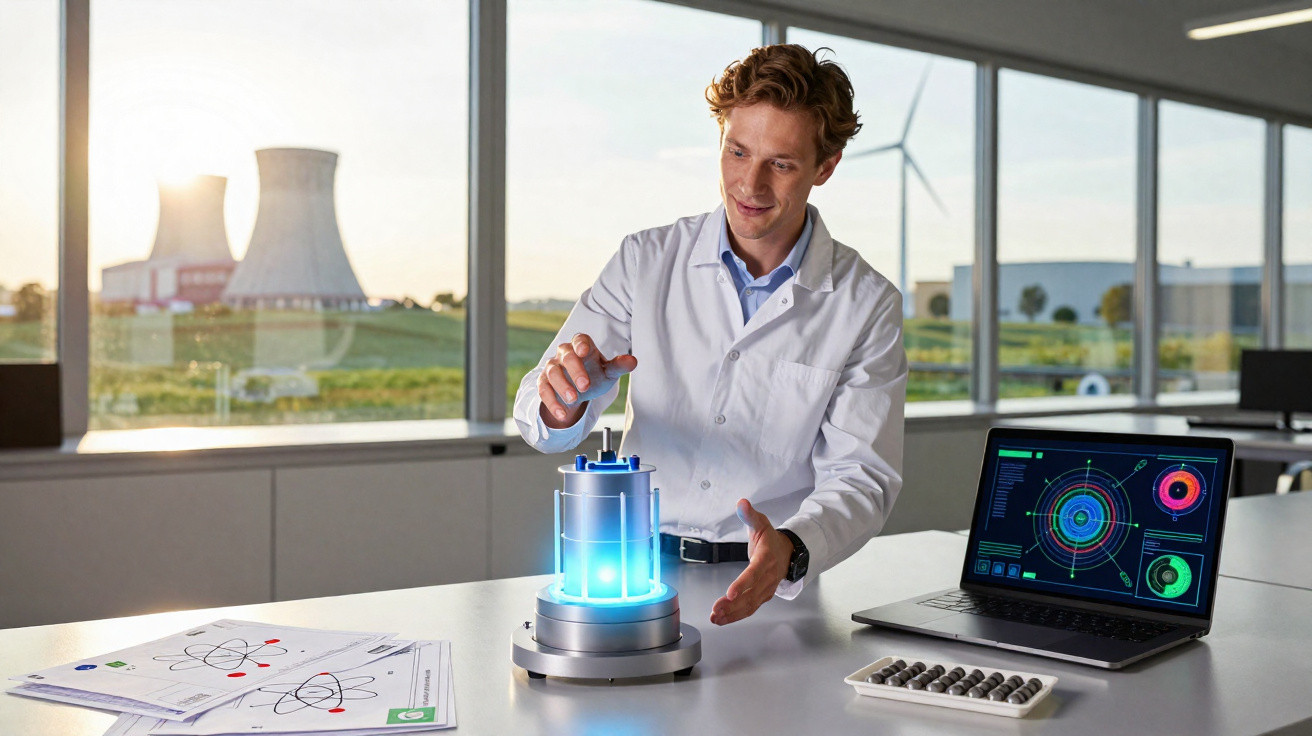
France is discreetly laying the groundwork for its next nuclear advance, committing billions of euros and drawing on decades of expertise to develop a radically different reactor design.
A renewed nuclear policy is emerging across government departments, start-ups and state-supported industrial groups. It centres on Generation IV technology, private investment and the prospect of cleaner, more adaptable electricity for an increasingly strained grid.
A fresh phase in France’s nuclear ambitions
France already generates roughly 70% of its electricity from nuclear power stations, with most of those facilities constructed during the 1980s. Many are now nearing the end of their original operating lives. Meanwhile, electricity consumption is forecast to rise as transport, heating and sections of industry move away from fossil fuels.
Against this backdrop, a new Generation IV reactor scheme has secured €645 million over only five years. Its funding combines French and European investment, public money and backing from industrial partners. In an industry traditionally defined by public expenditure and vast construction programmes, this degree of early private-sector support is notable.
This €645 million war chest signals that nuclear innovation is no longer only a matter for government budgets and mega-utilities.
The scheme is intended to produce a smaller, safer and more efficient reactor that can potentially be rolled out faster than conventional large-scale plants. It is central to France’s efforts to remain a major nuclear power as countries compete to reduce carbon emissions.
What Generation IV reactors mean in practice
Generation IV is an umbrella term covering several advanced reactor concepts under development internationally. The French programme concentrates on designs expected to offer three key improvements: more effective fuel use, less waste and wider safety margins.
- Greater fuel efficiency: obtaining more energy from the same quantity of uranium.
- Reduced waste: lowering both its volume and its long-term radiotoxicity.
- Improved safety: creating systems that can shut down more readily if faults occur.
Current French reactors use water both to cool the system and moderate reactions. Generation IV concepts frequently use alternative coolants, including liquid metal or gas, enabling higher temperatures and different operating conditions. This change can make fuel use more versatile and may enable additional industrial applications, including low-carbon factory heat and hydrogen production.
Generation IV is less about building “bigger reactors” and more about using nuclear fuel in a smarter, cleaner and safer way.
How the €645 million will be used
The funds obtained to date are not intended to finance an entire commercial reactor fleet. Instead, they are designed to move the scheme from research into a first-of-a-kind demonstrator. This involves several costly phases: design work, simulations, licensing and, ultimately, construction of a prototype reactor.
| Spending area | Main purpose |
|---|---|
| Core design and modelling | Confirm reactor physics, fuel behaviour and thermal performance |
| Safety studies | Comply with French and European nuclear safety requirements |
| Prototype systems | Construct and test crucial equipment, including pumps, heat exchangers and control systems |
| First demonstrator site | Ready the site works, grid connection and regulatory permissions |
Some of the funding is also allocated to partnerships with universities and research centres. Their work includes developing materials that can tolerate high temperatures and radiation, fuel cycles that reduce waste, and digital systems for real-time reactor monitoring.
Generation IV reactors in France’s wider energy strategy
Paris aims to cut reliance on imported fossil fuels while maintaining relatively stable electricity prices. In parallel with large solar and wind developments, the government has announced programmes for new large reactors and small modular reactors (SMRs), led by EDF and other organisations.
The Generation IV project currently being developed is somewhat separate from these more mainstream programmes. It occupies the leading edge of the sector, where the risks are greater but so is the longer-term potential. Should it succeed, it may shape the reactors France chooses to build after the forthcoming generation of more conventional facilities.
It also delivers a signal to Brussels. Through the promotion of advanced nuclear technology, France intends to strengthen its position in EU discussions over which energy sources qualify as sustainable and can access green finance.
For French policymakers, advanced reactors are a way to argue that nuclear can be both low‑carbon and aligned with future EU green finance rules.
The promises of lower waste and greater flexibility
Long-lived waste remains one of nuclear power’s main political difficulties. Generation IV designs seek to tackle this issue directly. Certain advanced reactors could use some spent fuel from current plants, reducing the volume that would otherwise require storage for tens of thousands of years.
They are also intended to create waste with a shorter lifespan. Rather than remaining hazardous over geological timescales, some such waste would require secure storage for hundreds to a few thousand years. That remains a lengthy period, but it is less challenging socially and politically.
Flexibility is a further advantage put forward by supporters. Future electricity networks will need to manage substantial variations in wind and solar generation. Advanced reactors, which are designed to increase and reduce output faster than older stations, could assist with frequency stability and support the grid at periods of peak demand.
Economic and industrial effects
The case extends beyond climate policy to industrial capability. The project supports the retention of French nuclear engineering expertise at a point when many skilled workers are nearing retirement. It provides opportunities for metalworking companies, digital specialists and component producers.
Advocates say exports of next-generation nuclear reactors could become an important part of French trade during the 2030s and 2040s. Nations with limited land availability or poor wind and solar resources may look for compact, low-carbon baseload power options. If France can supply proven Generation IV systems, it may win long-term agreements for fuel services, maintenance and training.
Risks and criticism surrounding the new reactor
Despite the momentum in funding, the scheme attracts scepticism. Critics cite previous cost overruns involving major French reactors and question why public funds should finance another high-technology risk.
Timing is another concern. Even with €645 million in place, a Generation IV demonstrator is unlikely to generate electricity before the 2030s at the earliest. Meeting 2030 climate objectives will depend largely on renewable power, energy efficiency and extending the lives of existing nuclear stations.
Safety remains a core issue. Although advanced designs are expected to reduce the likelihood of serious accident scenarios, regulators must still assess every possible failure mode, from coolant leaks to cyberattacks. This results in lengthy licensing procedures that can increase costs and cause delays.
The real test is not just technological success, but whether the reactor can prove affordable, licensable and socially acceptable at scale.
Key concepts explained
Two technical concepts are regularly raised in discussions of Generation IV reactors: the fuel cycle and fast neutrons.
The fuel cycle covers the mining and enrichment of uranium, its use within a reactor and the subsequent management of spent fuel. Generation IV systems pursue what are known as “closed” cycles, in which a larger share of material is recycled and used again. This lowers demand for newly mined uranium and limits long-term waste.
Fast neutrons are neutrons that retain much of their energy instead of being slowed by water. Reactors that use fast neutrons can split a wider selection of isotopes, including some present in spent fuel. This capability underpins the prospect of using existing waste and obtaining more energy from every tonne of uranium.
What it may mean for daily life in France
Consumers will not notice an immediate effect. Energy bills will continue to be driven primarily by existing reactors, renewable generation and gas prices. However, if the demonstrator is successful, it could provide another means of keeping electricity more affordable and predictable over the longer term.
Advanced reactors may also serve developing applications, such as city-scale heat pumps, electric factory kilns and low-carbon hydrogen production for steel and fertiliser. Rather than merely supplying electricity to the grid, nuclear stations could provide both power and high-temperature heat, cutting emissions in several sectors simultaneously.
Fictional but realistic scenarios employed by French planners envisage a 2045 energy system in which a small number of Generation IV units operate alongside older reactors, offshore wind farms, rooftop solar installations and battery storage. Within those models, advanced nuclear supplies a steady foundation when solar and wind production falls sharply, limiting the need for gas-fired backup power stations.
The central uncertainty is the speed at which these reactors can progress from prototypes to reproducible products. Raising €645 million is a substantial beginning, but complete commercial validation will require several times that sum as well as patience from investors and the public.



Comments
No comments yet. Be the first to comment!
Leave a Comment