
Italy has concluded that solar panels by themselves will be insufficient if people are to live permanently on the Moon. With a new national programme, Rome is promoting lunar nuclear power and seeking to establish itself as an essential partner for NASA and Europe during the next phase of human spaceflight.
Italy’s nuclear wager on the Moon
In early December, the Italian Space Agency (ASI) formally introduced Selene, an acronym for “Sistema Energetico Lunare con l’Energia Nucleare”. Its objective is to develop and test small fission reactors capable of supplying permanent Moon bases.
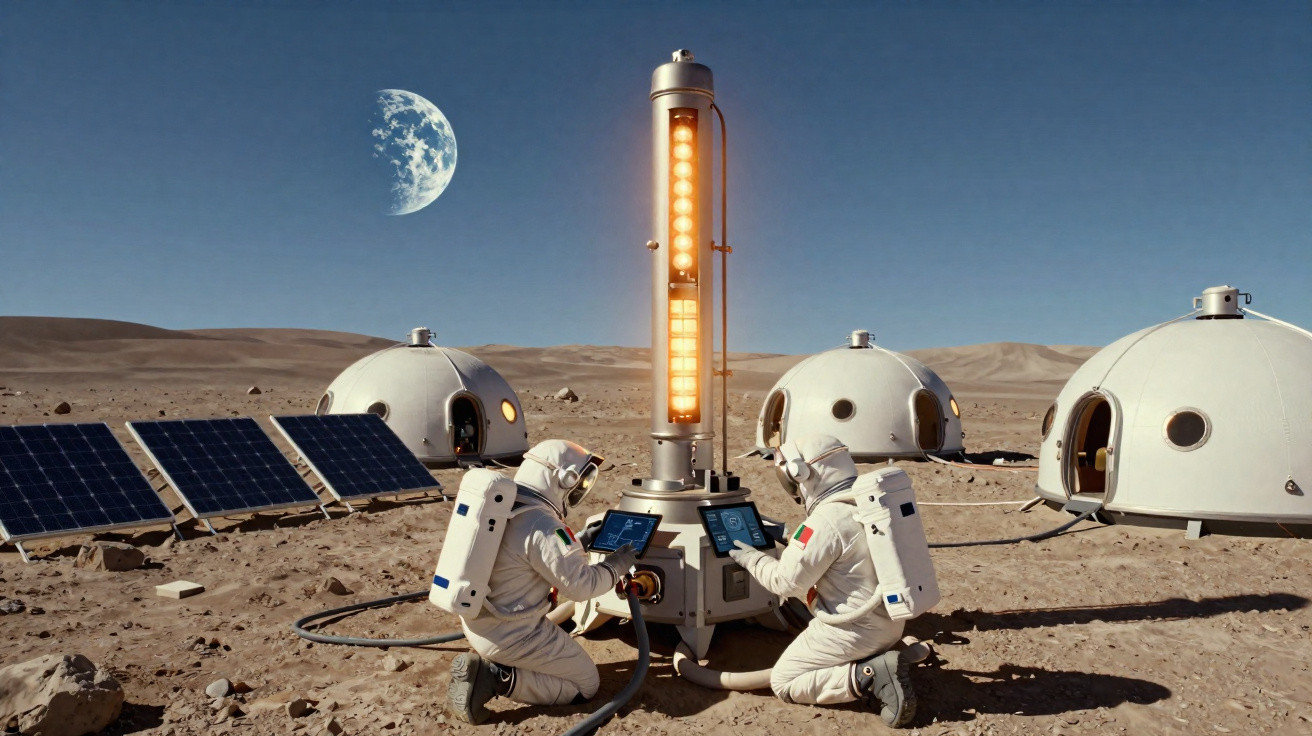
Selene aims to create a “Moon Energy Hub” delivering constant, controllable power to surface habitats, vehicles and scientific stations.
The idea is straightforward in principle but challenging to deliver. Rather than relying predominantly on solar arrays, Selene would use surface nuclear reactors (SNRs). These compact systems would be placed on the lunar surface, turn heat from nuclear fission into electricity, and supply a local network serving multiple facilities.
For Italy, the programme is more than a technical undertaking. It is a strategic move in the international return to the Moon. Russia, China and India have already indicated their intention to build a joint nuclear power plant through the ILRS (International Lunar Research Station) initiative. By offering its own design, Italy is aiming to participate in every significant debate on powering and running future lunar settlements.
Why solar power alone cannot sustain lunar colonies
Solar energy functions effectively on Earth because nights are brief and electricity grids are connected. Conditions on the Moon are much more demanding: at most locations, around 14 days of daylight are followed by 14 days of darkness.
That extended “lunar night” presents a severe obstacle for bases powered solely by solar energy. Batteries would need to be exceptionally large and heavy. High-demand functions, including life support, communications and industrial processing, cannot simply stop for two weeks each month.
Nuclear reactors offer what solar arrays on the Moon cannot: steady power, day and night, at almost any latitude.
NASA has arrived at the same assessment for its Artemis programme and is financing its own fission surface power proposals. Selene represents Italy’s domestic response, intended to fit within that framework and assist European and American crews on the surface.
Project Selene and the “Moon Energy Hub”
Selene is planned as a three-year technology programme. Its main deliverable is the Moon Energy Hub (MEnH), a central facility containing the surface nuclear reactors and coordinating power distribution across a base.
Alongside the reactors, the project addresses a number of demanding supporting systems:
- advanced sensors for tracking radiation, temperature and mechanical stress
- highly autonomous control software, since crews and Earth-based teams cannot oversee the system 24/7
- wireless transmission of power to remote users, cutting the need for heavy electrical cables
- thermal-management equipment capable of releasing surplus heat in a near-vacuum
- energy storage to manage abrupt shifts in demand or short interruptions
Removing heat is among the most sensitive challenges. Reactors produce considerably more heat than electricity, while space offers no air or water to remove that heat. Selene therefore includes an experimental test focused specifically on cooling, a capability that will be crucial in practical operation.
Designing for faults, not only normal operation
Engineers are deliberately developing the system for high-pressure circumstances. Terrestrial power networks often experience rapid increases or decreases in demand. A lunar grid would face similar events, but with more serious consequences: an unforeseen failure could endanger air supplies, water and communications.
The MEnH concept includes storage and flexible routing so that a local fault does not black out an entire base.
In the present concept, the hub sends high-power supplies to major consumers, such as habitats, laboratories and resource-extraction facilities. Meanwhile, lower-demand operations could use mobile receivers connected to wireless transmissions. This could include small rovers, temporary scientific outposts or construction robots working tens of kilometres from the principal base.
Italy’s broader lunar ambitions
Selene has not emerged in isolation. For years, Italy has worked to become a key provider of equipment for Artemis and the developing lunar economy.
The Multi-Purpose Habitation (MPH) module is a clear illustration. Under a 2022 agreement, NASA authorised ASI to lead the development of this pressurised lunar habitat. It is intended to be a flexible “home on the Moon”, accommodating crews for short- and medium-duration stays while connecting with rovers, power systems and other modules.
The MPH is intended to serve not only as accommodation, but also as an emergency refuge. An astronaut facing difficulty should be able to use it in an emergency, regardless of nationality. Combining such a safe haven with a dependable nuclear-powered grid strengthens the appeal of Italy’s proposals to international partners.
Key Italian contributions to orbital infrastructure
Italy also has a substantial role in the NASA-led Gateway, the small space station planned to orbit the Moon. Italian industry, particularly Thales Alenia Space, is building or jointly building several modules:
| Module / element | Role |
|---|---|
| ESPRIT | Communications, refuelling and additional storage for Gateway |
| I-HAB | International habitation module for crew living and work space |
| HALO structure | Pressure shell and structural elements for the main US habitation module |
Together, its surface habitats, orbital modules and dedicated energy system give Italy considerable negotiating leverage with both the European Space Agency and NASA. The country can plausibly make the case for additional astronaut places, greater scientific leadership and an enduring role in lunar decision-making.
Nuclear power on the Moon: risks, safeguards and public perception
Nuclear energy in space is far from unprecedented. The United States and Russia have launched dozens of nuclear-powered satellites and deployed radioisotope heaters on Mars missions and beyond. Selene and comparable concepts differ in their scale and setting: they involve larger reactors operating near human habitats.
Risk control would depend on several protective measures. Reactors would probably be transported “cold”, with fuel inserted or activated only after landing and inspection. Locations would be chosen sufficiently far from habitats to reduce radiation exposure while remaining close enough for efficient electricity transmission. Shielding could use both regolith - the Moon’s dusty soil - and engineered barriers surrounding critical components.
One often overlooked advantage of lunar nuclear power is political: it reduces dependence on Earth shipments of fuel and batteries once a base is built.
Public opinion remains an important consideration. Even where the physics are sound and designs are cautious, the term “nuclear” continues to provoke scepticism. Italian officials and engineers will need to communicate clearly and soberly about why the technology is necessary and which safeguards will apply.
What a nuclear-powered lunar base could look like
Picture the scene a decade from now: an Artemis crew leaves a lander near the Moon’s south pole. A group of cylindrical modules makes up the central habitat. Nearby, robotic transporters pile regolith into mounds for use as both construction material and radiation shielding.
Several kilometres away, on level terrain, stands the Moon Energy Hub. Its reactors operate quietly within armoured enclosures. High radiators, formed as panels or trusses, emit a faint infrared glow as they release heat into space. Cables link the hub with the primary base, and certain rovers recharge through wireless receiving pads.
Throughout the lunar day, solar arrays would still provide power, reducing demand on the reactors and adding to reserves held in batteries or thermal-storage systems. During the two-week night, sunset would have little apparent effect on the base. Lighting would remain on, chemistry laboratories would continue operating, oxygen-extraction plants would keep processing regolith, and the habitat would retain Earth-like conditions.
Key terms and concepts behind Selene
A number of technical terms are central to this Italian programme:
- Fission reactor: equipment that splits heavy atomic nuclei, producing heat that is subsequently converted into electricity.
- Surface nuclear reactor (SNR): a compact fission system intended to work on a planetary surface instead of in orbit.
- Wireless power transmission: the delivery of energy without physical cables, such as through microwaves or lasers.
- Technology maturity: an indication of how near a technology is to genuine operational deployment rather than laboratory demonstration.
As these technologies come together, their value could extend beyond lunar projects. Approaches to automated reactor control, highly reliable sensors and thermal management could be applied to remote power stations on Earth, including in polar areas or disaster zones with vulnerable grids.
Italy’s Selene programme occupies the meeting point between space ambition and terrestrial usefulness. Should it demonstrate a workable, safe Moon Energy Hub, a nuclear-powered settlement could move from a science-fiction scenario to a serious option considered by space agencies around the world.



Comments
No comments yet. Be the first to comment!
Leave a Comment