
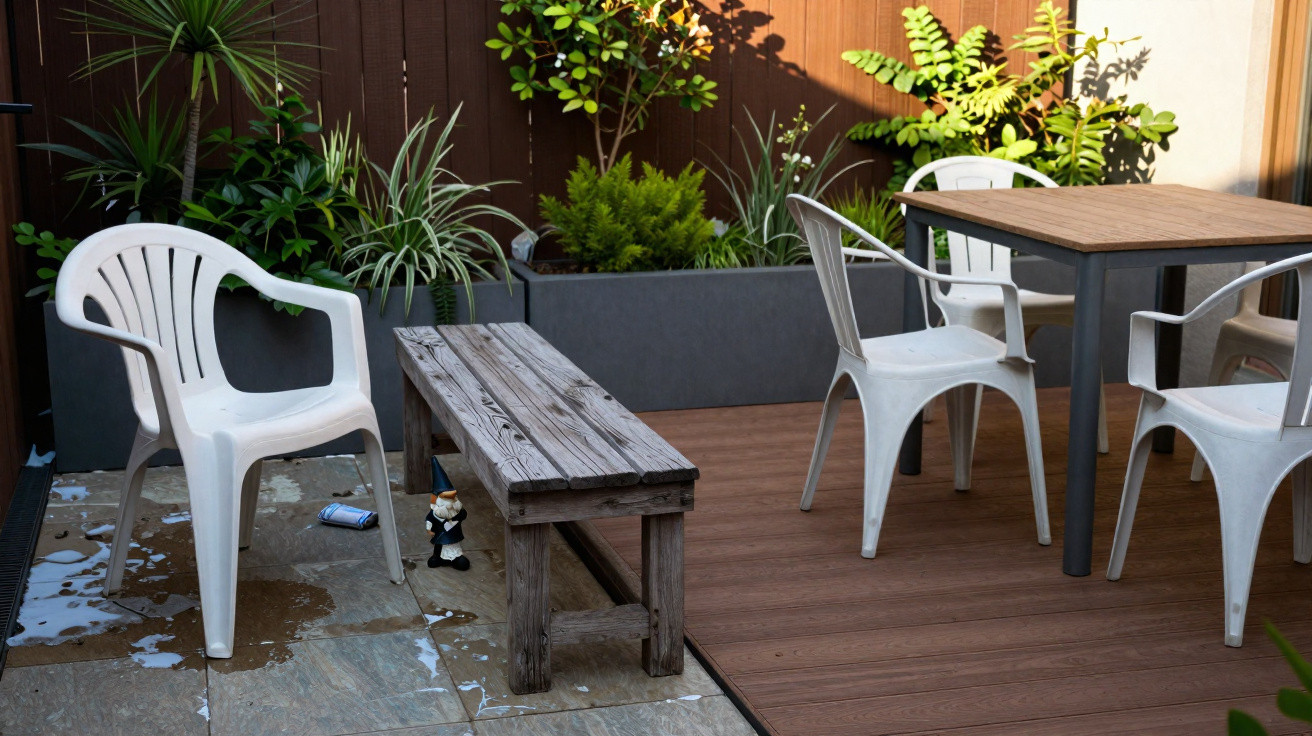
You imagine drinking coffee on the terrace in March, only to be greeted by a split bench, unsteady chairs and stains you certainly did not ask for. There is one straightforward reason behind this disheartening view: certain outdoor materials cannot withstand proper weather, ultimately costing much more than their value.
When a single winter can ruin your garden furniture
Across the UK, northern Europe and large parts of North America, outdoor furniture faces much more than occasional drizzle. It endures months of rain, frost, icy mornings, short-lived thaws and then another freeze. That repeated pattern is unforgiving.
Water works its way into minute pores and gaps within the material. As the temperature falls, the trapped water freezes and expands. With every cycle, pressure builds inside these tiny cracks, gradually breaking apart finishes, joints and even whole panels.
It’s not the cold you feel on your skin that does the worst damage, but the invisible freeze–thaw beating your furniture takes all winter.
Paint and varnish can begin lifting away in large flakes. Timber expands before drying out again, losing both its form and structural strength. Screws work loose, joints separate and furniture that looked sound in the shop quickly becomes unstable and unsafe to use.
When moisture has penetrated deeply into a material's core, the harm is seldom reversible. Wood may rot internally, particle-based boards can disintegrate, and UV-weakened plastics become brittle enough to break. The “bargain” brought home last spring can become cumbersome rubbish before a second summer arrives.
Cheap softwood and standard plastic: the outdoor money pit
Why untreated wood is effectively a sponge
Lower-priced garden furniture sets commonly use light-coloured softwoods such as spruce, fir and untreated pine. Initially, they appear clean, fresh and natural. However, these woods perform much like a sponge left outdoors on the patio.
Unless it receives deep industrial treatment, this timber repeatedly absorbs rainwater. Persistent dampness creates ideal conditions for fungi and wood-boring insects. After one particularly wet winter, that “light Scandi look” may become dark, soft and structurally unreliable.
Untreated softwood might last indoors, but outdoors it’s like leaving cardboard in the rain and hoping for the best.
Oils, stains and light varnishes applied at home provide limited help, but their protection is largely superficial. Once cracks appear or a season of upkeep is missed, water enters the timber and its gradual deterioration starts.
Standard plastics and bargain resin: damaged by cold and sunshine
Cheap plastic is another common pitfall: stackable white chairs, bright resin armchairs and inexpensive loungers filling supermarket aisles each spring. They offer low prices and promise “no maintenance”, but the reality is harsher.
Summer sunshine attacks the plastic first. UV radiation degrades its structure, leaving it brittle. Winter then arrives, and cold conditions stiffen the already weakened material. A small impact, or simply somebody sitting down too abruptly, may split the seat or break an armrest.
- UV light leaves poor-quality plastic chalky and delicate.
- Low temperatures make it more rigid and less flexible.
- Together, these effects transform a flexible chair into one that can shatter like glass.
Such items are frequently too large for ordinary household waste and difficult to recycle because they combine plastics with metal inserts. As a result, they become inconvenient clutter in garages and sheds or, worse, are taken to the tip after only a few seasons.
Aluminium and composites: the materials professionals actually choose
Aluminium: lightweight, rust-free and unaffected by winter
Landscape designers and outdoor hospitality businesses generally make highly practical choices: they select materials that last. Aluminium is near the top of that list. It does not rust like steel, nor does it require regular repainting merely to remain usable, as iron does.
Contemporary aluminium garden furniture is commonly powder-coated, with the colour baked on at high temperature. This substantial coating withstands rain, frost and UV exposure far better than ordinary brush-applied paint.
Good aluminium furniture can stay outside all year, need a quick wash in spring, and still look respectable a decade later.
Aluminium is light as well, making it simple to reposition when reclaiming a sunny spot or moving furniture away from a storm. On balconies and roof terraces, this reduced weight is as important as its durability.
Composite materials: the timber appearance without timber's problems
For anyone who does not like a streamlined metal look, composites provide a persuasive alternative. These engineered materials combine wood fibres with high-performance plastics. They create boards and slats that resemble timber while performing more like a weatherproof outer layer.
Good-quality composite:
- does not rot or attract wood-eating insects
- resists cracking and splintering under frost
- fades slowly and evenly instead of streaking or patching
- can be washed down rather than sanded and recoated
This makes composite particularly suitable for decking, benches and table tops that remain exposed throughout the year. On a terrace in Glasgow or Minneapolis, where winter seems to continue indefinitely, that dependable performance matters much more than a “natural” claim on a price label.
Pressure-treated timber: retaining the warmth of real wood
Some people simply prefer the touch and scent of genuine timber outdoors. That does not require accepting materials that deteriorate rapidly. Pressure-treated timber, often pine, belongs in a completely different category from untreated softwood.
In the treatment process, protective agents are forced deep into the timber under pressure. This limits water absorption and makes the wood considerably less attractive to insects and fungi. Used properly, this type of timber can remain structurally sound outside for a decade or longer.
Weathered grey on the surface doesn’t always mean rotten wood; with pressure-treated timber it’s often just a cosmetic patina.
That is why pressure-treated boards are frequently used for public benches, decks and play areas. They still benefit from some maintenance and thoughtful installation that prevents standing water, but they cope with a typical British or northern US winter far better than basic pine garden furniture sets.
From disposable to durable: changing how you buy for the garden
Choosing the lowest-priced set in the spring sales can feel like a smart decision at the till. That satisfaction disappears when broken chairs must be hauled to the recycling centre two years later. Replacing complete garden sets every few seasons brings both a financial burden and an obvious environmental cost.
Choosing materials with a longer life changes the whole pattern of outdoor living. Aluminium frames, quality composites and high-grade pressure-treated timber reduce waste while avoiding annual maintenance jobs that never quite get completed.
| Material | Typical lifespan outdoors | Maintenance level | Winter risk |
|---|---|---|---|
| Untreated softwood | 1–3 years | High (regular staining, repairs) | Rot, warping, splitting |
| Low-grade plastic | 2–5 years | Low, until it fails | Brittle cracks, UV damage |
| Aluminium (powder-coated) | 10+ years | Low (wash when needed) | Colour fading if very low quality |
| Wood–plastic composite | 10–20 years | Low (cleaning only) | Some fading, dirt build-up |
| Pressure-treated timber | 10–15 years | Moderate (occasional protection) | Localised rot if poorly installed |
Over ten years, repeatedly purchasing inexpensive plastic or untreated timber can prove more expensive than buying one carefully selected aluminium or composite set. It also avoids the yearly irritation of discovering chairs that are stained, misshapen or inexplicably cracked following one severe frost.
Key terms and real-life scenarios
Several technical terms occur regularly in conversations about outdoor materials:
- Freeze–thaw cycle: the continual freezing and thawing of water inside materials, enlarging cracks and weakening their structure.
- Powder coating: dry paint electrostatically applied to metal and then baked on, creating a tougher, more hard-wearing finish than liquid paint.
- Pressure treatment: an industrial method that drives preservatives deep into timber cells, improving resistance to moisture and biological attack.
Picture two neighbours on an ordinary British street. Whenever the sun appears, one buys a fashionable untreated timber set from a supermarket. The other pays more at the outset for a simple aluminium table and composite chairs. Five years later, the first neighbour has spent money several times, filled skips with damaged furniture and still rushes to cover every item at the first hint of rain. The second runs a hose over the furniture in spring, wipes it clean and carries on planting tomatoes.
Compromise remains possible. Many homes combine materials, such as an aluminium table with pressure-treated wooden planters, or composite decking alongside a few carefully selected wooden accent pieces placed under shelter. The important point is knowing which materials withstand winter with ease, and which deteriorate badly and become costly long after the receipt has faded in your pocket.

Comments
No comments yet. Be the first to comment!
Leave a Comment