
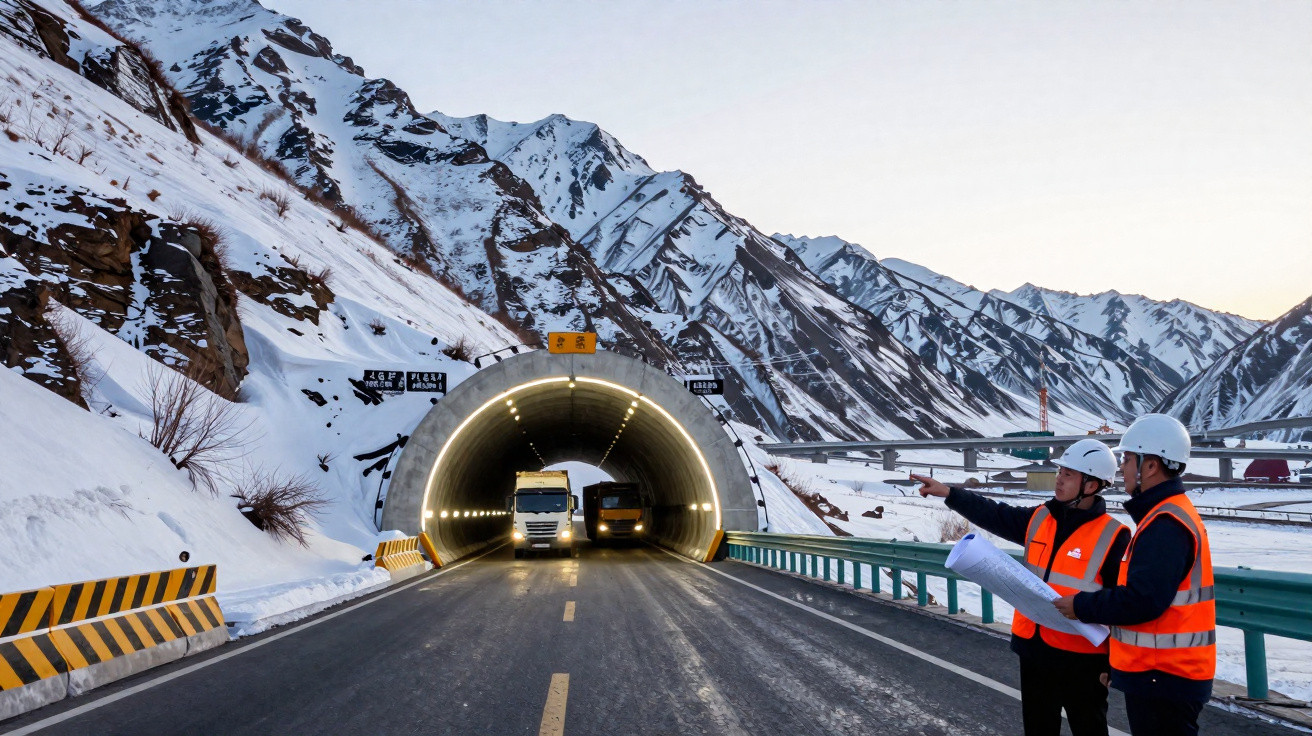
High in Central Asia’s icy mountains, a new structure of concrete and steel is quietly redrawing the map of mainland China.
Located far from Beijing and Shanghai, the scheme lies in an area that has long remained at the country’s edge. Yet this tunnel through Xinjiang’s Tian Shan range could alter trade routes, reduce time spent travelling and signal Beijing’s ambitions well beyond its frontiers.
The Tianshan Shengli tunnel, a record beneath the mountains
China’s Tianshan Shengli tunnel extends for 22.13 km beneath the Tian Shan, a formidable mountain chain widely considered one of Asia’s most challenging construction environments. As the focal point of the Ürümqi–Yuli expressway in Xinjiang, it connects the region’s north and south in about 20 minutes, replacing journeys that previously lasted for hours.
Construction teams encountered rock formations that move under intense pressure, sub-zero winter conditions and erratic groundwater. Engineers tackled these challenges using powerful tunnel-boring machines, intensive rock monitoring and multiple layers of digital supervision.
The tunnel runs in two separate tubes, each carrying two lanes, with continuous monitoring, automated emergency exits and controlled ventilation designed for heavy traffic in a hostile environment.
China describes the route as the world’s longest highway tunnel currently in operation, surpassing existing European and Japanese routes while remaining shorter than projects still being built.
Engineering under extreme conditions
Building through the Tian Shan is markedly different from excavating softer, lower mountains in coastal areas. Temperatures vary dramatically with the seasons, while snow and ice can limit access to construction sites. At depth, rock layers are under severe stress, creating the potential for abrupt collapses.
To protect both construction workers and future motorists, the project’s managers installed an extensive network of sensors across the tunnel. They monitor rock displacement, humidity, temperature and air quality. Information is relayed to a central control room staffed 24 hours a day, enabling operators to alter ventilation, lighting and traffic restrictions within seconds.
Key safety measures include:
- Two separate parallel tubes, each containing two lanes, to reduce the risk of collisions
- Cross-passages at regular intervals to allow evacuation during emergencies
- Jet fans and air-quality sensors for controlling exhaust fumes and smoke
- Automatic fire detection and firefighting equipment configured for long tunnels
- Live video monitoring and speed control
The work also trialled new methods of ground treatment. In unstable areas, crews injected grout into cracks before excavating. In sections with heavy water flow, they installed drainage galleries and waterproof linings so leaks would not emerge onto the carriageway years later.
The technical goal went beyond “breaking through” the mountain; engineers aimed for infrastructure that can run safely for decades under high traffic loads and harsh weather.
Rewiring Xinjiang, from isolation to connection
From distant frontier to inland crossroads
For many decades, Xinjiang was remote from China’s rapidly expanding coastal centres, both geographically and in everyday life. Travelling between northern cities such as Ürümqi and settlements further south often involved winding mountain passes or lengthy diversions around them. Severe weather could shut roads for days at a time.
The Tianshan Shengli tunnel transforms that calculation. Crossing the mountain barrier by road now takes around 20 minutes rather than several hours. Freight operators can plan narrower delivery slots, while bus operators can introduce direct services that were once impractical.
Residents will have quicker access to major hospitals, universities and government services in Ürümqi. Businesses involved in logistics, e-commerce and energy can organise supply chains around northern and southern Xinjiang as one market instead of two separate areas.
There is also a political message behind the engineering. Beijing presents the expressway as part of a “balanced development” policy intended to encourage inland growth and tie remote regions more closely to the national centre.
Economic corridors and the Belt and Road effect
The Ürümqi–Yuli expressway is one element of the wider overland network developed through China’s Belt and Road Initiative. Xinjiang is positioned where Chinese roads and railways run west towards Kazakhstan, Uzbekistan and, via an interconnected set of routes, Europe.
By reinforcing a domestic main route feeding into international corridors, the tunnel supports that objective. Improved internal connections allow trains and lorries to travel from Chinese factories or inland distribution centres to Central Asian border crossings with fewer disruptions and more predictable costs.
By smoothing the flow of people and goods inside Xinjiang, the tunnel adds another brick to an emerging Eurasian land bridge, partly bypassing sea lanes controlled by rival naval powers.
For European importers, this may eventually provide extra rail and road choices for some products, including electronics, textiles, machine components and time-sensitive consignments that fall between air freight and sea shipping in price and delivery speed.
China’s long list of headline projects
A pattern of building in difficult places
The Tianshan Shengli tunnel becomes part of a collection of Chinese megaprojects intended to stretch technical capabilities in demanding settings. Chinese officials frequently point to examples including:
- The Hong Kong–Zhuhai–Macao Bridge, which crosses the Pearl River estuary through long-span bridges and an immersed tunnel
- High-speed railway lines built across permafrost, earthquake-prone areas and high plateaux
- Deep railway tunnels in Tibet, where altitude and geology make conventional approaches difficult
- Offshore energy platforms in the South China Sea
One notable earlier example was Xiamen North railway station, which engineers shifted sideways by around 300 metres using hydraulic jacks rather than demolishing and reconstructing it. Chinese state media portrayed the operation as evidence of a new level of engineering confidence.
The Tian Shan project aligns with that story. Officials describe it as evidence that China can handle complex landscapes domestically and undertake comparable schemes overseas, from South-East Asia to the Middle East and Eastern Europe, often through Belt and Road contracts.
Global tunnel rankings: where Tianshan Shengli stands
Tunnels have long served as a test of national engineering ambition. Norway, Switzerland and Austria have each built major mountain links to connect isolated regions and maintain trade during winter storms. By length, the new Chinese tunnel now ranks among the leading projects of this type.
| Tunnel | Country | Length | Type | In service |
|---|---|---|---|---|
| Tianshan Shengli | China | 22.13 km | Highway (2×2 lanes) | 2025 |
| Rogfast (under construction) | Norway | 26.7 km | Highway (2×2 lanes) | 2033 (planned) |
| Ryfylke | Norway | 14.4 km | Highway | 2019 |
| Gotthard Road Tunnel | Switzerland | 16.9 km | Highway | 1980 |
| Arlberg Road Tunnel | Austria | 13.9 km | Highway | 1978 |
The ranking will change when Norway’s Rogfast, expected to measure 26.7 km, opens in the next decade. Until then, China has gained another entry on the global infrastructure scoreboard.
Safety, risk and what long tunnels mean for drivers
Record-breaking infrastructure naturally prompts questions about safety. At a length of more than 20 km, a road tunnel is a system in its own right rather than simply an opening through rock. Air quality, lighting, driver behaviour and emergency response interact in complicated ways.
Tianshan Shengli’s designers had to account for several situations:
- Vehicle fires and the spread of smoke in an enclosed space
- Breakdowns or crashes a long distance from exits to daylight
- Driver tiredness and monotony along extended, uniform stretches
- Power or communications failures far below ground
To limit these risks, the tunnel has bright, even lighting to prevent abrupt changes that could distract motorists at its portals. Lane markings and gradual bends are intended to sustain concentration. Emergency lay-bys and telephones are installed at short intervals, while regular exercises prepare staff to direct evacuations through the passages connecting the two tubes.
For motorists, the main behavioural change is often preparation. Keeping a reasonably full fuel tank, checking ventilation settings and paying attention to signs can have a significant effect in long tunnels, especially in areas where mobile reception may be weaker underground.
Beyond Xinjiang: what this means for future projects
Experience from the Tian Shan will inform a second generation of exceptionally long tunnels around the world. Data from millions of vehicle trips will reveal where congestion develops, how drivers react to information and which safety measures achieve the quickest response times.
Countries developing their own megaprojects, from undersea links in Scandinavia to transalpine routes in Europe, will follow the project closely. Chinese contractors can meanwhile use Tianshan Shengli as a reference project in overseas tenders, arguing that they have already managed comparable distances and hazards in difficult mountain conditions.
For infrastructure students, the tunnel provides a practical illustration of ideas including rock stress, redundancy and network effects. A modest reduction in travel time across a single mountain range can affect entire trade routes, alter warehouse locations and even shape where new towns expand. That sequence of effects often begins with decisions made years earlier by surveyors, geologists and engineers examining a remote ridge in winter conditions.






Comments
No comments yet. Be the first to comment!
Leave a Comment