
During a recent Arctic research voyage, an international team identified the planet’s deepest known gas hydrate emissions, over three and a half kilometres below the ocean surface. The discovery is prompting scientists to reconsider both prospective energy strategies and the climate hazards contained within the seabed.
A concealed hotspot on the Molloy Ridge
The discovery was made during the Ocean Census Arctic Deep – EXTREME24 expedition, which investigated the Molloy Ridge, a deep tectonic ridge in the Greenland Sea between Svalbard and Greenland. As the team mapped the seabed, their instruments detected two immense columns of gas rising from the depths.
Composed of methane bubbles, these plumes rise to remarkable heights: one extends roughly 1,770 metres above the seabed, while the other reaches about 3,355 metres. Both originate at a depth of around 3,640 metres, within an area now called the Freya Hydrate Mounds.
At around 3,640 metres below sea level, the Freya Hydrate Mounds host the deepest known methane hydrate emissions so far recorded on Earth.
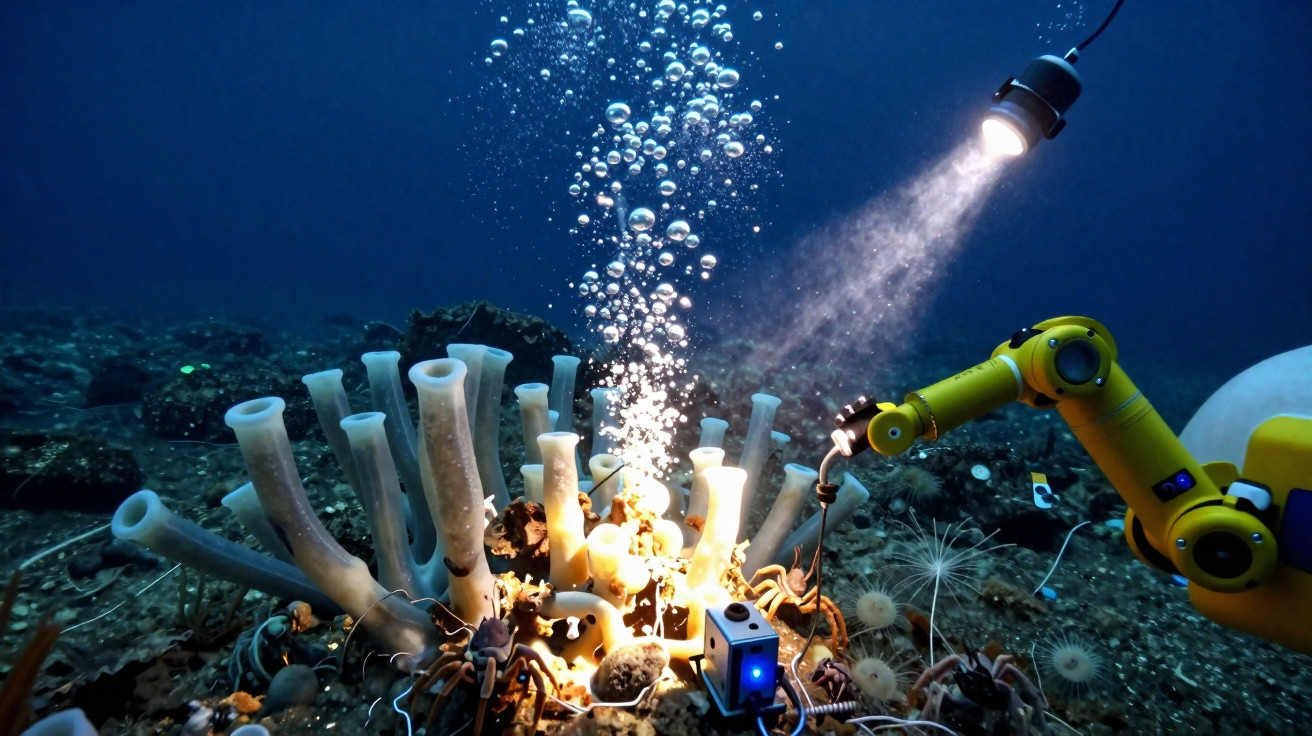
To investigate conditions on the seabed, the researchers sent down a remotely operated vehicle (ROV). Its cameras and sensors identified cone-shaped mounds of gas hydrates: solid, ice-like crystals in which water molecules enclose gas, chiefly methane, within their structure.
The mounds occupy what researchers describe as a “cold seep” zone. In these locations, cold fluids rich in hydrocarbons gradually leak from the seabed through fractures, supporting chemical reactions and distinctive ecosystems.
An extreme ecosystem that exists against expectations
Cold seeps at such great depths are uncommon. Previously, methane seeps and hydrate deposits had mainly been recorded on continental slopes, generally at depths of less than 2,000 metres. The Freya site is nearly twice as deep and lies on an oceanic ridge, well away from the usual continental margins.
Despite this setting, the area supports abundant life adapted to complete darkness. Its energy source is not photosynthesis, but chemiosynthesis, in which microbes turn inorganic compounds into food.
Organisms documented on the Freya Hydrate Mounds include:
- tubeworms gathered in dense clusters across the seabed
- bivalves, including clams and mussels that contain symbiotic bacteria
- gastropods, including specialised deep-sea snails
- crustaceans feeding as scavengers around the hydrate mounds
The animal life is notably similar to that found at Arctic hydrothermal vents, where hot fluids emerge from volcanic chimneys. Freya, however, is a cold system powered by methane and other hydrocarbons rather than superheated water.
The Freya Hydrate Mounds support a chemosynthetic community comparable to Arctic hydrothermal vent fields, but rooted in cold methane seepage instead of volcanic heat.
Crucially, these hydrate deposits are not static. Images of the seabed indicate that the mounds develop, become unstable and collapse. This cycle is influenced by tectonic movement, heat flowing from the Earth’s interior and shifting environmental conditions.
What gas hydrates are
Gas hydrates are frequently known as “flammable ice”. Where temperatures are low and pressure is high enough, water molecules form crystalline cages that hold gas molecules, including methane.
Most marine hydrates develop within sediment pores along continental slopes. There, organic material buried beneath the seabed gradually decomposes and produces methane. Cold water, the pressure of the water above and plentiful carbon together create a stable hydrate zone.
| Key conditions for methane hydrate formation | Role |
|---|---|
| Low temperature | Helps water form solid cages around gas molecules |
| High pressure | Pushes gas into the crystalline structure and keeps it stable |
| Organic-rich sediments | Provide the source of methane during decomposition |
This fragile arrangement breaks down if temperatures increase or pressure decreases. The hydrate melts, allowing methane to escape as bubbles that enlarge and expand as they move upwards through the water column.
A huge energy store with difficult drawbacks
Scientists estimate that seafloor sediments and land-based permafrost could contain more than 100,000 trillion cubic metres of methane in gas hydrate form. This quantity matches, and may surpass, known reserves of conventional gas.
Gas hydrates likely represent the planet’s largest single store of natural gas, yet they remain one of the least accessible and riskiest to tap.
When burned, methane produces less carbon dioxide for each unit of energy than coal or oil. This makes it appealing as a possible “bridge fuel” during energy transitions. In theory, hydrate deposits including Freya could appear to be future extraction prospects.
However, major barriers remain:
- Existing technology cannot consistently recover methane from hydrates without making the seabed unstable.
- Thawing hydrates could trigger abrupt methane emissions, creating environmental and safety hazards.
- Isolated deep-sea sites are costly and logistically challenging to access.
- Exceptional ecosystems may be damaged before they have been thoroughly studied.
Methane is also a powerful greenhouse gas. Across a 20-year timeframe, each molecule retains much more heat than carbon dioxide. Should substantial quantities enter the atmosphere, they would intensify warming.
A climate feedback beneath the waves
The Freya Hydrate Mounds focus renewed concern on a potentially troubling feedback cycle. Rising ocean temperatures could gradually warm even deep polar waters, reducing the stability of methane hydrates.
As hydrates begin to melt, methane bubbles ascend. Part of that methane dissolves in seawater and may be consumed by microbes. Nevertheless, some could still reach the atmosphere, especially in shallower waters or areas of strong upwelling.
Warming seas threaten to destabilise methane hydrates, release additional greenhouse gas and sharpen the very warming that triggered the process.
Scientists are now considering whether deep Arctic locations such as Freya are already undergoing subtle changes, or whether they are still largely unaffected. Long-term monitoring could establish how much methane is emitted, how much is consumed in the water and whether any ultimately reaches the air.
Reconciling energy ambitions and deep-sea protection
The Freya discovery also strengthens discussion around what activities should be permitted in the deep ocean. Gas hydrates may represent an enormous energy resource for nations seeking reliable supplies. Conversely, undisturbed mounds such as these support specialised species and genetic resources with potential medical or biotechnological value.
Any future attempt to extract hydrates would need to account for:
- the threat of seabed landslides caused by hydrate destabilisation
- the potential for sudden methane leaks that are difficult to control
- the destruction of slow-growing deep-sea communities
- uncertainty over how local disruption could affect broader ocean systems
Key terms for understanding the discovery
Several technical concepts are central to this finding. A “cold seep” is a site where methane-rich and other hydrocarbon-rich fluids emerge from the seabed at, or close to, the surrounding seawater temperature, rather than being heated as they are at hydrothermal vents.
“Chemosynthesis” is the process through which microbes use chemical energy from these fluids to produce organic matter. In dark environments, it forms the foundation of a food web, in much the same way that photosynthesis by plants sustains most ecosystems at the surface.
“Gas hydrates” do not refer to one mineral, but to a group of structures. Their stable zone is highly dependent on temperature, pressure and gas composition. A small change in any one of these factors can move a deposit from a stable to an unstable state.
What future research could involve
Researchers are already outlining further work at the Freya Hydrate Mounds. Later expeditions may combine repeated ROV surveys with seabed observatories and chemical sensors placed near the vents, measuring bubble flux, sediment temperature and minor changes in the mounds.
Computer models could test a range of possibilities, including ocean warming of a fraction of a degree, heightened tectonic activity or human disruption caused by prospective drilling. Each model can help determine how rapidly a site like this could alter, how much methane might be released and which ecosystem components face the greatest risk.
For the moment, Freya serves both as a natural laboratory and a warning. It demonstrates the scale of the energy frozen beneath the seabed, and how closely that energy is connected to fragile life forms and a climate system already under pressure.





Comments
No comments yet. Be the first to comment!
Leave a Comment