
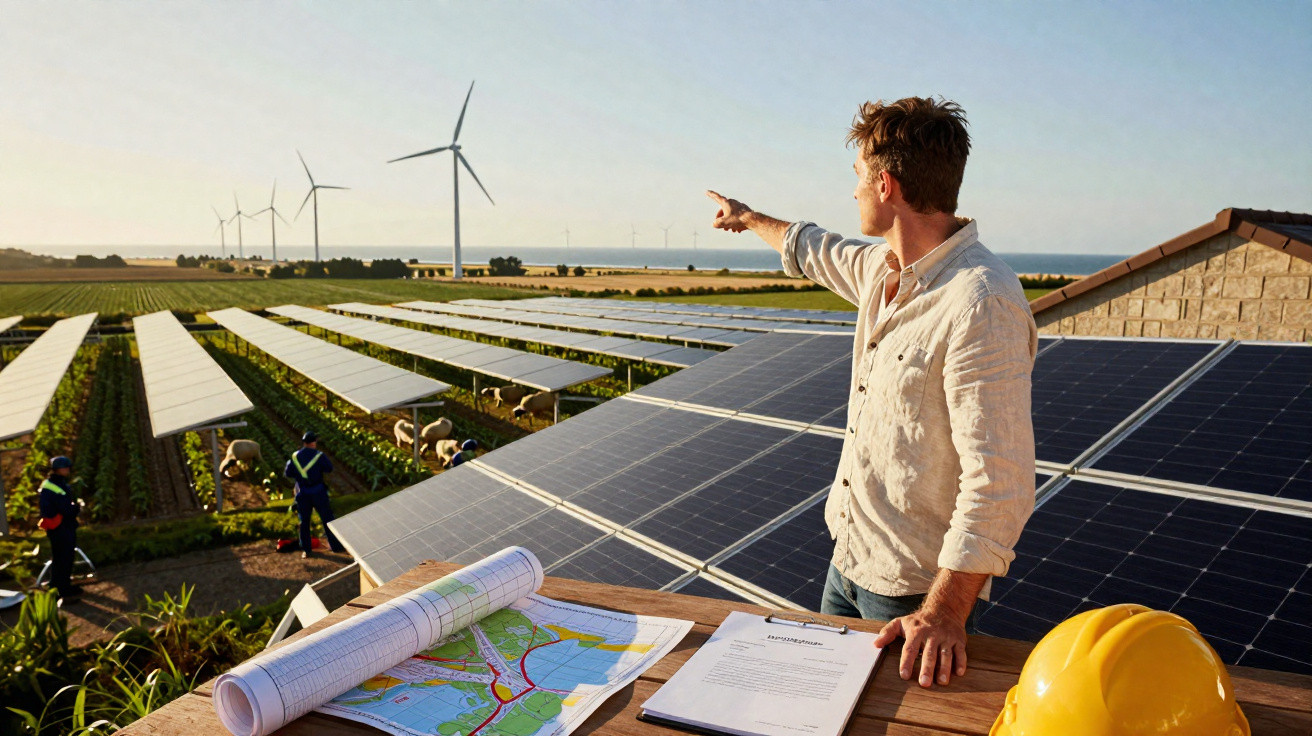
By 2035, France’s skyline and coastlines could look markedly different as solar panels and wind turbines steadily reshape the electricity grid.
In private discussions in Paris and Brussels, energy planners are revising maps and regulations while accelerating tenders, as France readies itself to move sharply beyond its historic dependence on nuclear power alone.
France steps up its renewable energy expansion
Fresh forecasts by consultancy GlobalData indicate that France’s installed renewable electricity capacity may rise from 59.1 GW in 2024 to 163.1 GW in 2035. This would almost triple green generation capacity over eleven years, representing average annual growth of close to 10 percent.
By 2035, nearly three‑quarters of France’s installed electricity capacity could come from renewable sources, led by solar and wind.
This transition would not remove nuclear from the electricity system. Rather, nuclear would serve as a foundation technology, while renewables meet much of the additional demand, flexibility requirements and climate obligations established under EU law.
Solar leads France’s changing power mix
The most significant development is unfolding on roofs, farmland and car parks. France’s solar capacity is forecast to climb from 30.5 GW in 2024 to approximately 111.2 GW in 2035. Such growth would make solar the country’s largest single source of new electricity capacity.
From roofs to agrivoltaics: scaling up solar power
Public policy underpins much of this growth. The French government is now promoting three primary photovoltaic routes:
- Large solar farms, particularly across the south and south-west
- Canopies installed above car parks and logistics centres
- Agrivoltaics and rooftop self-consumption at farms, homes and warehouses
Agrivoltaic installations, in which panels occupy land alongside crops or grazing livestock, have an important role. They provide farmers with an extra source of income while shielding vulnerable crops from heat and hail. In a warming climate, this combination of electricity generation and resilience appeals to landowners and policymakers alike.
Large car-park canopies at hypermarkets, stadiums and business parks provide similarly rapid opportunities. These locations are already grid-connected, reduce land-use conflicts and frequently support local air-quality and heat-reduction objectives.
Solar would leap from a secondary player behind nuclear and hydro to a central pillar of French power, reshaping how and where electricity is produced.
Wind power: gradual progress onshore, rapid growth offshore
As solar advances quickly, wind power continues to strengthen its role in France’s generation mix. Onshore wind expands at a slower rate, growing from 22.9 GW today to roughly 36 GW in 2035, whereas offshore wind records the greatest proportional increase.
Onshore wind: repowering instead of greenfield megaprojects
Proposed onshore wind farms continue to encounter significant local opposition, including concerns over visual effects, biodiversity and military radar. Planning approval remains slow, while prime windy locations have already been heavily developed in some regions.
Consequently, a substantial share of expansion comes through “repowering” existing wind farms. Developers remove ageing, smaller turbines and install fewer, higher-capacity machines in their place. The approach produces more electricity from the same or a smaller area, and can be easier to agree with communities already accustomed to nearby turbines.
Hauts-de-France, Grand Est and Occitanie remain vital to this programme because of their strong wind conditions and established grid links, although local resistance continues to influence both project design and delivery schedules.
Offshore wind: Brittany and Normandy move out to sea
Offshore wind is set for the most ambitious growth. From a relatively small 1.5 GW today, capacity could reach around 10.7 GW by 2035 as major wind farms begin operating along the Atlantic and Channel coastlines.
The French government now relies on contracts for difference (CfDs) to provide offshore developers with more stable income. This arrangement sets a strike price for power, reducing exposure to fluctuations in wholesale prices and making long-term developments financially viable.
Key projects off Brittany and Normandy form the basis of this expansion. They pair reliable marine winds with deep-water ports and an increasingly developed domestic supply chain for foundations, cables and substations.
Floating offshore wind, still in its early phase, could follow fixed‑bottom projects and open deeper waters to turbines in the 2030s.
Nuclear remains stable as the grid changes
A broadly stable nuclear fleet
GlobalData forecasts only a small increase in French nuclear capacity, from 61.4 GW in 2024 to around 63 GW in 2035. This is scarcely growth, largely reflecting life extensions and replacements rather than a substantial new fleet of reactors.
Launched a decade ago, the Grand Carénage programme seeks to extend the operation of many current reactors to 50 or even 60 years, subject to safety reviews. France has also pledged to construct six new EPR2 reactors, although their schedule remains uncertain after previous delays and cost overruns in the nuclear industry.
Nuclear is likely to remain the main source of actual electricity output due to its high capacity factor. However, its proportion of installed capacity will decline as solar and wind are deployed throughout the country.
From a single pillar to a multi-pillar system
Historically, France depended on one principal pillar: nuclear power. Its developing system is more like a tripod. Nuclear supplies baseload generation and stability; renewables provide low-cost, low-carbon kilowatt-hours; and flexible assets - storage, demand response, interconnectors and hydropower - manage peaks and weather-related fluctuations.
Rather than choosing between nuclear and renewables, France is trying to orchestrate both technologies in one wider, more flexible power system.
A more defined strategy, but persistent constraints
Policy alignment closes the investment gap
France’s latest National Energy and Climate Plan (NECP 2024), together with revised multi-year energy programming, offers investors a clearer path forward. Support schemes are moving away from fixed feed-in tariffs towards competitive auctions using CfDs, more closely matching systems already used in Germany, the UK and Spain.
A €7 billion hydrogen plan backs electrolysers using low-carbon power, while grid operator RTE is investing extensively in high-voltage lines, digital management and interconnectors. The purpose of these investments is to accommodate variable renewable generation while preserving security of supply.
Permits, legal challenges and curtailment delay deployment
Even so, structural barriers persist. The permitting process remains lengthy, particularly for onshore wind, where schemes can spend years in court because of local objections or environmental issues.
Grid connections are also falling behind in several high-activity areas, including Occitanie and Nouvelle-Aquitaine. Solar and wind projects in these regions often await upgraded substations or additional transmission lines. Where generation grows faster than infrastructure, operators begin curtailing output, losing available wind and solar power because the network cannot carry it away.
Rising curtailment signals a paradox: renewable projects move faster than the cables and substations meant to carry their electricity.
How France compares with European neighbours
France aims to rank among Europe’s strongest renewable energy performers, but the competition is considerable. A number of EU nations began their transition earlier and have progressed more rapidly.
Projected renewable capacity in 2035 (selected countries)
| Country | Renewables in 2024 (GW) | Renewables in 2035 (GW) | Main sources |
|---|---|---|---|
| France | 59.1 | 163.1 | Solar, wind, hydro |
| Germany | 147 | 215 | Solar, onshore wind |
| Spain | 73 | 160 | Solar, wind, storage |
| Italy | 63 | 130 | Solar, wind, bioenergy |
| Netherlands | 37 | 70 | Offshore wind, solar |
| Denmark | 12 | 35 | Onshore and offshore wind |
Germany remains ahead in total installed capacity and is planning substantial additions of both solar and onshore wind. Spain is also moving quickly, particularly with utility-scale solar combined with battery storage. Although smaller, the Netherlands and Denmark have outsized offshore strength, supported by capable maritime industries and strong public acceptance of offshore turbines.
France is pursuing a different approach: using its nuclear legacy while catching up in solar and wind, and continuing to rely on hydropower as a stabilising resource. Should these projections prove accurate, the country would rise from the middle of the field into the group of leading nations for total renewable capacity, even if it does not take first place.
What this means for bills, jobs and industry
Effects on consumers and local economies
A larger renewable sector changes not just the generation mix, but also the people who benefit from it. Households and businesses installing rooftop solar, or taking part in energy communities, receive some insulation from volatile market prices. Farmers hosting agrivoltaic schemes gain an additional income stream that may steady earnings in years of weak harvests.
At a regional scale, ports including Le Havre, Saint-Nazaire and Brest seek to secure offshore wind manufacturing, assembly and maintenance activity. This means new industrial employment, training schemes and opportunities to repurpose former fossil-fuel locations around low-carbon technologies.
Risks and unanswered questions
This rapid expansion nevertheless involves risks. Supply chains for turbines, panels, transformers and grid equipment remain constrained, while extensive reliance on Asian imports leaves Europe vulnerable to trade tensions. Resistance to large developments may grow if local communities feel left out of decisions or do not receive a share of the financial gains.
Managing such a high proportion of variable wind and solar generation will demand more storage, more intelligent demand response and strong links with neighbouring countries including Spain, Germany and the UK. Modernised hydropower and flexible biogas plants may contribute, but they cannot entirely eliminate the need for additional balancing technologies.
For the moment, the figures indicate that France is preparing for a fundamental change to its energy landscape. The coming decade will determine whether this blend of policy reform, nuclear life extension and aggressive renewable deployment can be delivered on schedule without overloading the grid or triggering political resistance.





Comments
No comments yet. Be the first to comment!
Leave a Comment