
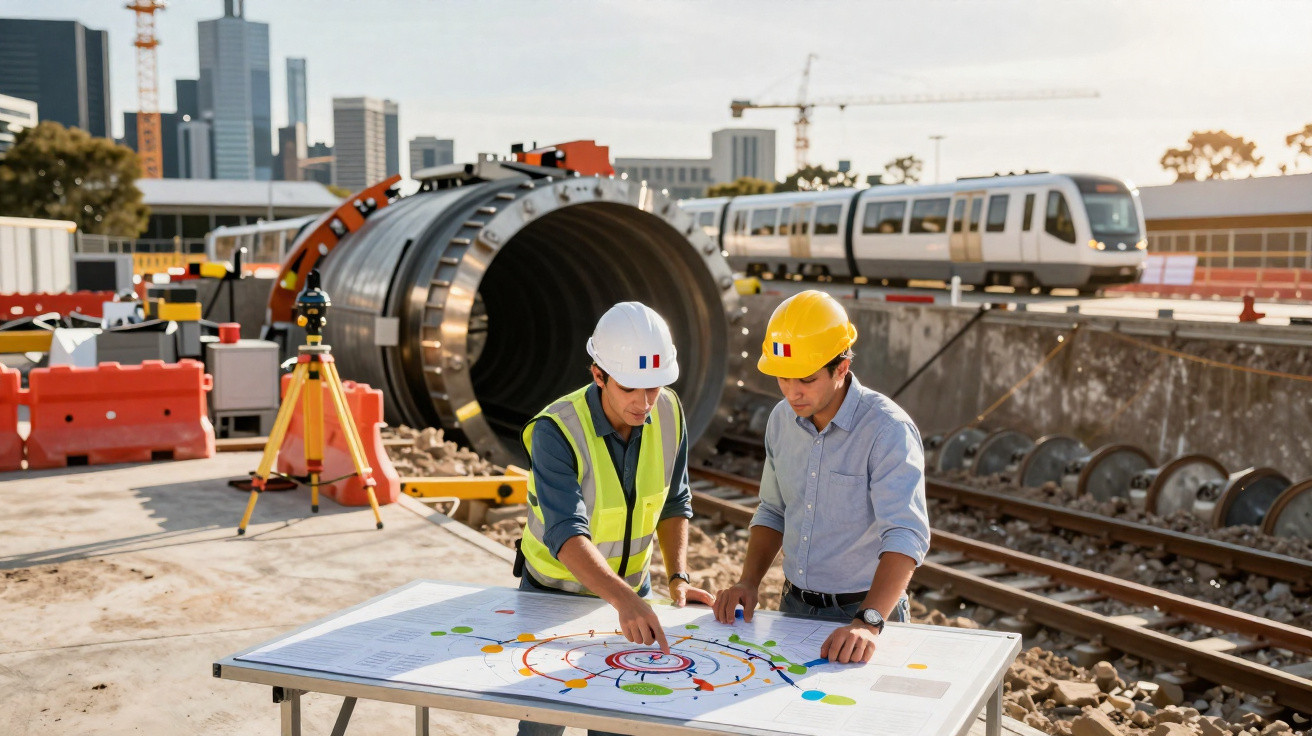
Melbourne has embarked on a rail megaproject that will run beneath its suburbs, rather than across its familiar postcard skyline. Well away from the CBD’s towers, a 90-kilometre underground loop is attracting patient investment, international suppliers and highly strategic French expertise.
What exactly is the Suburban Rail Loop?
The Suburban Rail Loop (SRL) is planned as an underground orbital railway encircling Melbourne. It moves away from the conventional hub-and-spoke arrangement, under which almost every trip is channelled through the city centre. The complete route will extend for roughly 90 kilometres, entirely below ground, linking major suburban employment, healthcare and education centres.
Expected to cost more than 125 billion Australian dollars - approximately 75 billion euros - it is Australia’s largest ever single infrastructure programme. The scheme is central to Victoria’s “Big Build” programme, which is reshaping roads, railways and tunnels for a city projected to grow to 6.5 to 7 million people in the coming decades.
Launched as part of Victoria’s “Big Build”, the Suburban Rail Loop is reshaping Melbourne’s growth model around suburban hubs rather than the CBD.
The first physical stage is SRL East, a 26-kilometre corridor from Cheltenham in the south-east to Box Hill in Melbourne’s east. This section alone will include six deep-level underground stations, twin tunnels and a fleet of fully automated metro trains.
France secures a strategic role beneath Melbourne
Alstom at the heart of the eastern section
The SRL East contract, valued at about 8.8 billion Australian dollars (around 5 billion euros), has gone to TransitLinX, an alliance comprising John Holland, KBR, WSP and several major operators. French rail group Alstom has won a portion of that work worth about 1 billion euros.
This award covers far more than the supply of trains. Alstom’s responsibilities include:
- Providing fully automated metro trains
- CBTC-based signalling
- Digital onboard and trackside equipment
- Cybersecurity and communications
- Integration of every subsystem
- Maintenance services for 15 years
This remit covers the most critical element of a metro scheme: the way it functions in daily operation. The technology must cope with fluctuating energy prices, labour shortages, peaks in passenger demand and political expectations around dependable service.
By taking responsibility for trains, signalling, cyber and integration, Alstom positions itself as the operational backbone of Melbourne’s new orbital line.
For Victoria’s government, the appointment is a way of limiting risk. Alstom already operates automated metro technology in Sydney and has extensive experience in Paris, Singapore, Dubai and other high-density networks. Using established architecture instead of developing a system from the ground up helps the project withstand technical and political disruption.
Assembly in Dandenong rather than imports from Europe
Alstom will not deliver completed trains from France. Instead, the Metropolis trainsets for SRL East will be assembled at its Dandenong manufacturing site, around 40 kilometres from central Melbourne. The facility has a long record of building rolling stock for the Australian market.
Local content is politically important. Major Australian rail schemes now face strong expectations to support domestic employment, apprenticeships and supply chains. By manufacturing in Dandenong, Alstom connects its French technology with Victorian employees and regional SMEs - a relationship often crucial when megacontracts are reviewed or extended.
The agreement also includes 15 years of maintenance under Alstom’s FlexCare Perform solution. A purpose-built depot at Heatherton will accommodate up to 36 trainsets, enabling capacity to rise as ridership increases. Incorporating operations and maintenance into the design from the outset, rather than adding them afterwards, is intended to avoid the gradual deterioration seen in some ageing rail fleets around the world.
Fully driverless, yet closely supervised
GOA4 trains and CBTC signalling
SRL East will use 13 four-car Metropolis trains, operating at Grade of Automation 4 (GOA4). There will be neither a driver’s cab nor an onboard driver: traction, braking and door functions will all be automated.
A digital control layer - the CBTC Urbalis Forward signalling system - will regulate train separation, speed profiles and station stopping in real time. It will also manage emergency braking, degraded operation and post-incident recovery. In practice, a central control room and station staff will continue to oversee the network, while algorithms make the repeated split-second decisions.
GOA4 automation allows higher frequencies, shorter headways and more predictable journeys, but pushes cybersecurity and system resilience to the foreground.
Sydney has operated a fully automated Alstom-supplied metro since 2019, featuring short headways and platform screen doors. Melbourne’s SRL applies the same approach to an orbital route that will eventually connect with suburban rail services, trams and buses, creating different travel patterns across the city’s eastern and south-eastern suburbs.
Geological challenges and political pressure
A difficult underground environment
Melbourne’s geology is far from straightforward for tunnelling. Engineers must work through a mixture of soft clay, harder rock and substantial groundwater layers. Density at the surface creates further limits: tunnel-boring machines have to travel beneath houses, roads, utility routes and existing rail infrastructure without causing flooding or ground settlement.
Such conditions increase spending on ground treatment, monitoring and construction logistics. They can also reduce excavation rates, influencing both delivery schedules and public and political perceptions of progress.
Cost escalation and long delivery timescales
The SRL is being developed amid worldwide construction inflation. The cost of steel, concrete, skilled workers and energy rose sharply during the early 2020s. In Australia’s constrained labour market, mining, infrastructure and defence are competing intensely for engineers, electricians and plant operators.
It is therefore unsurprising that estimates for the full loop have increased. Critics say the funding could instead be used to improve existing suburban railway lines, support local hospitals or bolster schools. Supporters argue that a city the size of Melbourne requires a fundamental change in how people travel, and that meaningful network effects are only possible with an orbital railway delivered at scale.
Backers of the loop argue that the payoff must be measured over 50 to 70 years, not within a single election cycle.
That conflict informs every announcement: each contract award or project milestone is both an engineering advance and a political examination.
France’s twofold presence: tunnels and operations
RATP Dev gets ready to operate the railway
French involvement extends beyond Alstom. RATP Dev, the international subsidiary of Paris’s public transport operator, has joined the SRL East Linewide Alliance with John Holland, Alstom, KBR and WSP. The Suburban Rail Loop Authority officially confirmed its involvement in December 2025.
Notably, RATP Dev is arriving long before the first passengers. For roughly ten years, it will assist with design and construction as a “future operator”, ensuring that operational requirements inform engineering decisions. Its work will cover station design, passenger-flow management, incident-response arrangements and maintenance access.
From 2035, a RATP Dev and John Holland joint venture, trading as TransitLinX, is expected to operate and maintain SRL East for 15 years. RATP Dev contributes experience from 14 GOA4 metro lines already in service worldwide, including Paris Line 14 and driverless networks in Riyadh and Sydney.
Bouygues assumes responsibility for major tunnels
Bouygues Construction has also joined the civil-engineering work, securing a contract of around 343 million euros for one of the principal northern tunnel packages. The company will use large tunnel-boring machines launched from vast work sites to progressively excavate the twin tubes for the future railway.
This arrangement - Bouygues underground, Alstom delivering systems and RATP Dev supporting operations - effectively forms a French chain running from concrete to software. The three businesses have previously collaborated on demanding metro projects overseas, reducing coordination risk compared with an arrangement involving unfamiliar partners.
Why Melbourne is backing an underground orbital railway
Moving beyond the CBD-focused model
Melbourne’s post-war rail system was designed to carry commuters into the city centre each morning and back to their homes in the evening. However, employment and universities have spread across the metropolitan area, with large campuses and job clusters in the south-east, east and north. Hospitals, research facilities and technology parks increasingly generate demand for journeys between suburbs.
The SRL is intended to connect these locations. Stations including Clayton, Monash and Box Hill are planned as major interchange hubs, bringing together metro services, existing rail, buses and new residential or commercial development. The model resembles orbital railways such as London’s Overground arc and the Grand Paris Express, which have changed where people choose to live and work.
| Aspect | Today | With Suburban Rail Loop East |
|---|---|---|
| Typical suburban trip | Bus + train via CBD | Direct orbital metro between hubs |
| Journey time between eastern hubs | Often over 1 hour with transfers | Targeted to drop significantly with direct tunnels |
| Network resilience | Disruption in CBD hurts whole system | Orbital route offers alternate pathways |
These shifts also affect property markets. Land near future SRL stations is already drawing speculative interest, while planning frameworks seek to direct growth towards denser, mixed-use neighbourhoods. This in turn prompts social debate over gentrification, housing affordability and lower-income communities’ access to new employment.
Risks, consequences and the next developments to watch
An orbital metro of this scale brings substantial risks. Delays could leave neighbourhoods affected by excavation for years, bringing noise, dust and traffic disruption. Cost overruns could lead governments to reduce later phases of the loop or defer other schemes, including regional rail improvements and hospital expansion.
Technically, full automation makes the railway more reliant on software security and cyberdefence. A compromised signalling system could bring operations to a standstill. This is why Alstom’s remit places such weight on cybersecurity, and why experienced operators such as RATP Dev are involved during design, when emergency procedures and fallback arrangements are set out in detail.
However, the potential benefits are equally far-reaching. A successful SRL East would support the proposition that Melbourne can develop as a polycentric city, with several strong suburban centres connected by fast, frequent rail. It would ease pressure on roads, lower emissions per journey and offer residents more credible alternatives to private cars.
For industry participants, the scheme is also an international reference project. Its blend of GOA4 automation, an orbital layout, difficult geology and integrated French-Australian alliances offers a model that could influence future metro projects in North America, Asia and the Middle East. Should Melbourne deliver a reliable loop despite genuine political and budgetary constraints, this underground ring will become a case study extending far beyond Australia’s borders.






Comments
No comments yet. Be the first to comment!
Leave a Comment