
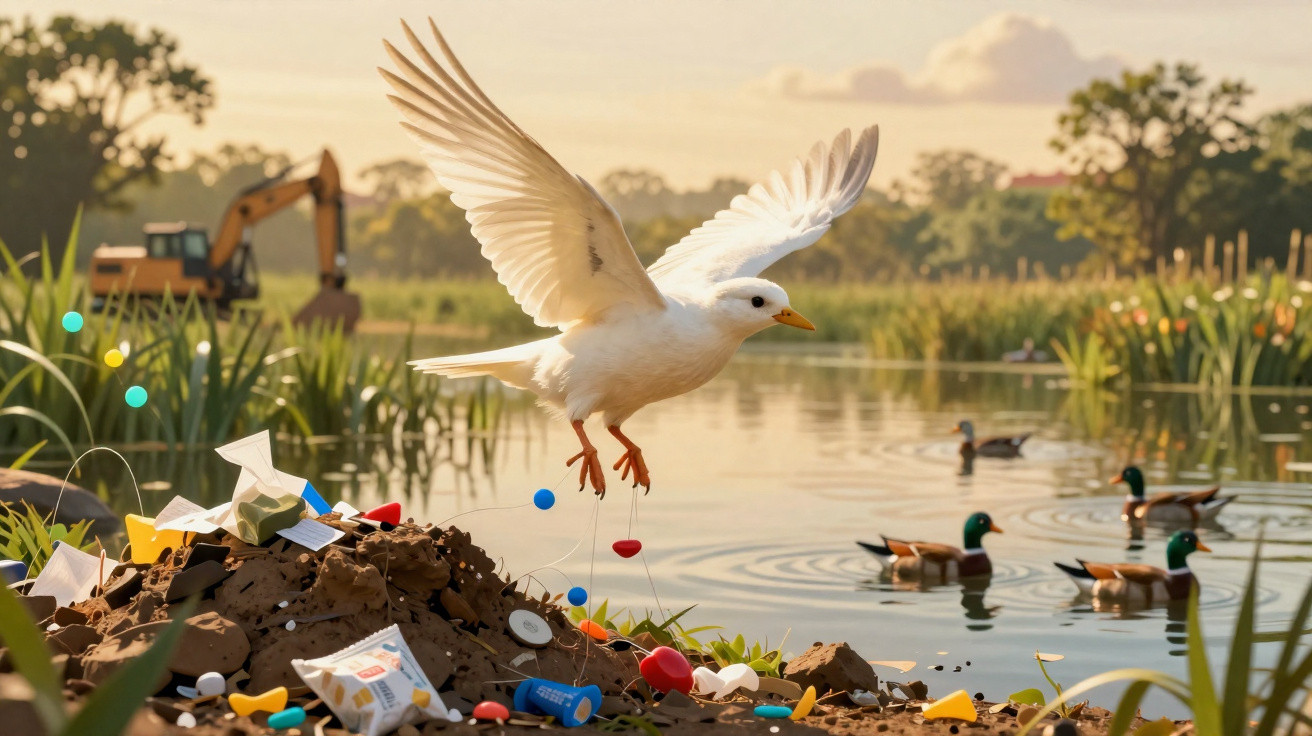
Before daybreak in southern Spain, thousands of birds leave rubbish tips and fly towards some of Europe’s most valued wetlands.
This seemingly elegant daily journey carries a disturbing cargo: packaging fragments, plastic bags and shards of silicone are transported, item by item, from human landfill sites into vulnerable lagoons and marshes intended to be protected.
Birds becoming plastic couriers
Plastic pollution travels by more than sea currents and roadside winds. In Andalusia, it also moves through the air. White storks and several gull species are unknowingly carrying hundreds of kilograms of waste each year from extensive landfill sites to Ramsar-listed wetlands and nature reserves.
Scientists at Spain’s Doñana Biological Station investigated this overlooked movement over several years. They attached GPS devices to birds, examined regurgitated pellets and droppings, and extrapolated the results to estimate the impact across entire populations.
Their conclusion: birds have become biological conveyors, linking human dump sites with habitats that, on paper, enjoy international protection.
The study examined three common scavengers at landfill sites in southern Spain:
- Yellow-legged gulls
- Lesser black-backed gulls
- White storks
Depending on their breeding cycles and migratory behaviour, all three species travel between rubbish dumps and wetlands either every day or seasonally.
From a landfill visit to a lagoon
Across much of Andalusia, the pattern is highly regular. Gulls and storks feed at landfills on discarded food, fish waste and other organic material. In doing so, they also ingest plastic fragments, films, fibres and, at times, larger pieces.
When the birds later settle in nearby wetlands, they expel material their bodies cannot digest. This happens in two principal ways.
Pellets, droppings and concealed litter
Like owls, many waterbirds regurgitate dense pellets: compact masses containing bones, shells, seeds and other substances that cannot be processed by the digestive system. The Andalusian researchers repeatedly found plastic, and even glass, in these pellets and in faeces.
Every pellet left on a shore or island can contain several plastic items, quietly adding to the contamination of the resting site.
Using the quantity of plastic detected in each bird, the frequency of landfill visits and the number of birds across a region, the researchers were able to calculate the annual amount of waste being transferred.
Hundreds of kilograms of plastic entering protected wetlands
Fuente de Piedra lagoon, in Málaga province, was one of the research’s central locations. This well-known southern Spanish wetland supports a major greater flamingo colony and has Ramsar protection.
Fuente de Piedra is an endorheic lagoon: water enters the basin but does not flow out. As a result, salts, nutrients and pollutants that arrive remain there, becoming increasingly concentrated over time.
During winter, thousands of lesser black-backed gulls breeding in northern Europe gather at the lagoon. Many make daily journeys from landfill sites in Málaga, Seville and Córdoba.
The team estimates that these gulls alone are importing roughly 400 kilograms of plastic every year into this single wetland.
The Bay of Cádiz Natural Park is another key area. It contains a patchwork of saltmarshes, mudflats and channels used extensively by resident and migratory birds. In this location, all three species studied use the same landfill sites and roosting areas.
For the bay’s marshes, the scientists estimated that gulls and storks combined transport around 530 kilograms of plastic annually. Behind that total are notable differences in each species’ behaviour.
Storks and gulls: different birds, different loads
White storks are bigger than gulls and regurgitate larger pellets, allowing an individual stork to move more plastic at once. However, they occur in lower numbers than gulls at these locations.
Once all the figures were combined, lesser black-backed gulls were identified as the principal plastic transporters in the Cádiz study area, moving roughly 285 kilograms annually. Their leading role is not due to especially careless feeding, but to their high numbers, particularly during winter.
Estimated plastic transported annually to Bay of Cádiz wetlands
| Species | Approximate role | Estimated contribution |
|---|---|---|
| Lesser black-backed gull | Abundant winter visitor | ~285 kg per year |
| Yellow-legged gull | Resident breeder | Part of remaining ~245 kg |
| White stork | Large-bodied landfill user | Part of remaining ~245 kg |
Distance is also crucial. Birds that nest or roost closer to landfills visit them more regularly and subsequently carry waste back to nearby lagoons and marshes.
Wetlands in the shadow of a dump are far more exposed than distant sites that the same species rarely reach.
Year-round pollution for certain species
The research revealed distinct spatial and seasonal trends. Yellow-legged gulls, which breed along the Andalusian coastline, were found to move plastic around their nesting colonies throughout the year.
By comparison, lesser black-backed gulls and white storks transported their greatest quantities of plastic during migration or at particular times of year when landfill food was especially important to them. Species also preferred different forms of plastic. Storks were the only birds recorded returning from landfill sites with silicone fragments, although the reason remains uncertain.
Plastic hazards extending beyond birds
The immediate risks to birds are clear. Larger plastic pieces may become tangled around their legs, wings or necks. If consumed, plastic can obstruct the digestive system, suppress appetite, cause internal damage or lead to death.
A less obvious danger comes from microplastics and chemical additives. Tiny fibres and fragments can cross the gut wall or become lodged in body tissues. Many plastics include additives that function as endocrine disruptors, affecting the hormones responsible for growth, metabolism and reproduction.
Once plastic breaks down into tiny pieces, it can move from one organism to another, climbing the food chain and concentrating at higher levels.
Within wetlands, plastic particles may be consumed by invertebrates including worms, crustaceans and insect larvae. Those invertebrates are then eaten by fish and birds, which in turn are consumed by predators. Contaminants can build up through each stage of this food chain.
Why deterring birds from landfills is complicated
The European Union landfill directive (1999/31/EC) advises landfill operators to use deterrents that prevent birds from accessing sites. Options include netting, wires installed above waste, loud sounds, falconry, and changes to the way or timing of exposed waste.
However, there is considerable disagreement about how extensively these measures should be used. Many gull and stork populations have come to depend on landfill sites as major feeding areas. Excluding them abruptly could reduce survival and breeding success, while potentially driving birds towards less regulated places, including small illegal dumps and urban streets.
Site managers face an additional practical issue. Certain deterrents merely shift birds a short distance away, potentially transferring plastic pollution to another wetland used for roosting.
The element humans can control
Researchers emphasise that the birds are not to blame; rather, they reflect a larger issue with waste. Landfills full of lightweight packaging create highly attractive feeding opportunities for adaptable species.
Cutting the amount of plastic that reaches landfill sites tackles the issue at its origin. Three everyday actions can still have a meaningful effect:
- Reduce: avoid needless packaging and single-use plastics.
- Reuse: select long-lasting containers, bags and bottles, and use them repeatedly.
- Recycle: separate waste properly so that less is deposited in landfill cells.
Improved landfill design is equally important. Promptly covering waste, intercepting wind-blown litter and separating organic material from mixed, plastic-heavy rubbish can reduce birds’ access to waste. Some facilities are trialling enclosed tipping zones or mechanical pre-treatment systems that shred and compact rubbish before birds can reach it.
What “Ramsar” and “endorheic” mean
This research uses several technical terms, two of which shape the level of concern for these wetlands.
A “Ramsar site” is a wetland designated under an international treaty signed in the Iranian city of Ramsar in 1971. Participating countries pledge to protect such areas because they are globally important for biodiversity, particularly waterbirds. Plastic carried into a Ramsar site by birds therefore makes the pollution issue international in scope.
An “endorheic” lagoon, such as Fuente de Piedra, has no natural outlet. Water can leave only through evaporation or by seeping into the ground. Dissolved salts, nutrients and pollutants carried in by streams or animals therefore tend to remain and accumulate. In a basin of this kind, every kilogram of arriving plastic remains for a long time.
How changing landfill practices could affect wetlands
Possible future outcomes are straightforward to envisage. If Spain strengthens landfill regulations so organic waste is largely removed and plastic is more effectively contained, these sites would be less appealing to birds. Gulls and storks could return to more natural feeding habits in fields, estuaries and coastal waters, while the quantity of plastic carried into wetlands would probably decline.
Conversely, if plastic production increases while waste management fails to keep pace, landfill sites could become even stronger attractions. Bird populations at these sites could increase, alongside the plastic burden reaching protected areas. Because plastic persists for so long and some lagoons are closed systems, decisions made today will influence wetland health for decades.






Comments
No comments yet. Be the first to comment!
Leave a Comment