
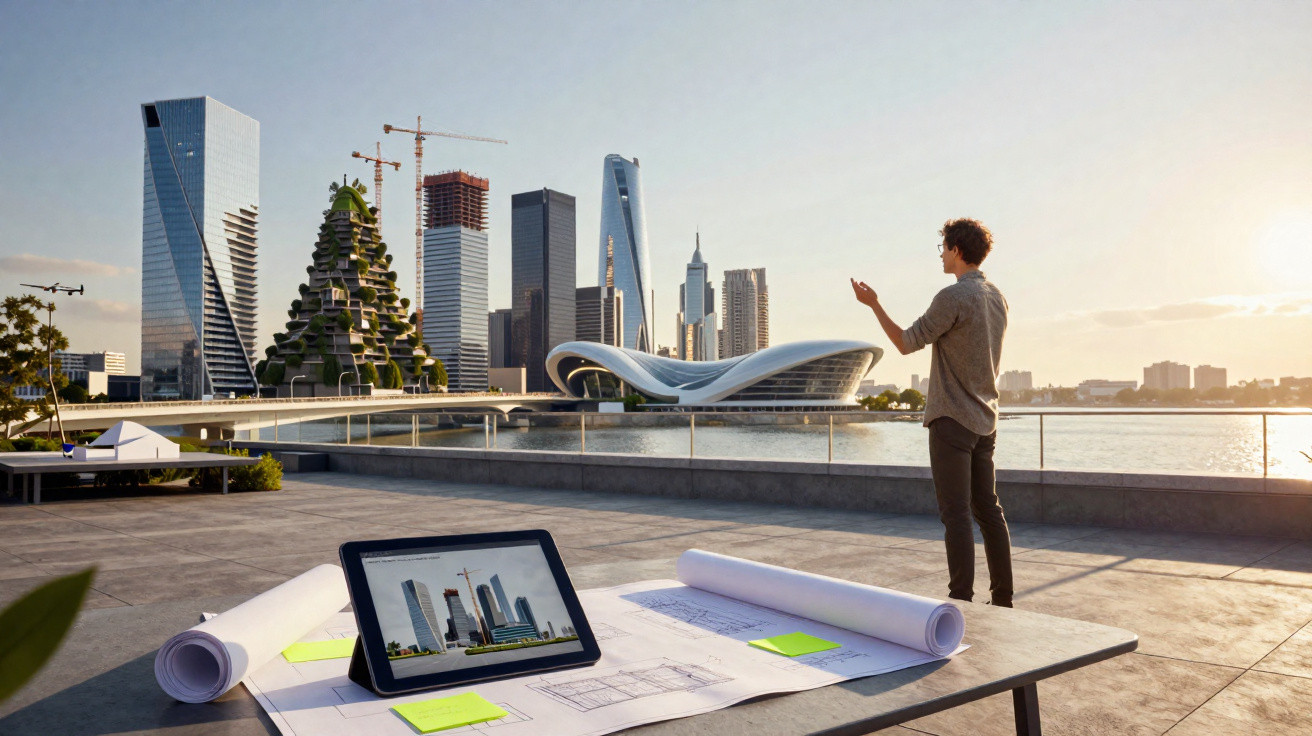
A group of teenagers stand below, pressing their faces to a dusty hoarding with phones held aloft, recording a future skyline from the pavement. Two streets away, a café owner laughs that the construction site has become his strongest promotional asset: “People come for the noise and stay for the coffee.” Cities once expanded discreetly, one brick at a time. Now, every major development becomes a worldwide event, analysed on social media before its first concrete pour has even set.
Around the globe, five unfinished giants are already defining how people imagine 2026, well before they alter the skyline. They are more than buildings: they are declarations.
The year cities begin acting like ambitious start-ups
Spend time in any major international hub today and the shift is unmistakable: cities no longer want to play it safe. Mayors speak in the language of venture capital, architects resemble film directors, and urban strategies read like manifestos. The most eagerly awaited schemes of 2026 take this attitude to its limits. They are higher, greener and more unusual. Some pledge zero emissions, while others envisage complete communities rising into the sky. They will not all fulfil every pledge. Even so, the ambition spreads.
On social platforms, visualisations of 2026 buildings travel faster than celebrity rumours. The proposed Vertical Forest 2.0 in Shenzhen, featuring layered gardens and mist-cooled terraces, already has fan accounts counting down to its opening. In Riyadh, the proposed cube-shaped Mukaab has inspired endless memes as well as serious discussion about density and spectacle. Across Europe, commuters exchange rumours about the eventual appearance of the Grand Paris Express hubs as though they were awaiting a new technology product launch. One viral TikTok asked: “Which 2026 building would you actually want to live in?” and attracted millions of votes.
There is a clear reason this resonates so strongly. Architecture is no longer a slow-moving backdrop; it has become a form of public interface. Major 2026 developments reveal the direction of money, power and climate anxiety. A carbon-neutral cultural quarter in Copenhagen communicates something very different from a desert mega-mall. As these proposals shift from CGI fantasy into physical concrete, they become a live experiment: can architecture bear sustainability, social inclusion and spectacle simultaneously? Or are we merely creating more attractive shells for the same longstanding problems?
Inside the five 2026 projects everyone will discuss
The most widely discussed projects of 2026 have one shared aim: pairing spectacle with a degree of responsibility. Consider the proposed Copenhagen Sustainable Harbor District 2026 phase, a collection of mid-rise timber towers around former industrial docks. Its approach is almost surgical. Existing warehouses are retained, lightweight wooden frames connect new buildings to them, and the waterfront is recast as a vast public living room rather than an inaccessible luxury marina. Each day, cranes position prefabricated timber sections much like pieces in a city-sized Lego set.
At the opposite end of the climate spectrum, Saudi Arabia's anticipated NEOM “The Line” early segments continue to attract attention precisely because they appear implausible. The plan is for a 170-kilometre mirrored strip across the desert, offering walkable living within a linear city only 200 metres wide. Engineers describe high-speed transit capsules beneath its spine, rooftop solar bands and climate-controlled canyons between two enormous walls. Residents express mixed reactions: interest in employment and technology, concern about displacement, and one straightforward question seldom included in glossy brochures: “Will it feel like a place, or like an airport that never ends?”
Asia is revising the narrative more quietly. In Tokyo, the Torch Tower complex, whose key components are expected around 2026, promotes a different idea: public space in the vertical dimension. It is a high-rise with terraces accessible to all, viewing decks that also function as parks, and a base integrated directly with railway and underground lines. In Africa, meanwhile, the New Administrative Capital’s Green Spine in Egypt seeks to demonstrate that extensive green corridors are not solely European privileges. Picture broad shaded walkways, solar-covered pergolas and a sequence of public squares designed to make walking practical in a hot climate. These schemes are both experiments and gambles. Their true measure will be the feel of an ordinary Tuesday afternoon, long after the ribbon-cutting ceremonies have finished.
How to “read” these mega-projects like an insider
One straightforward practice distinguishes casual onlookers from those who genuinely understand what is approaching: look past the hero image. Every flagship 2026 project comes with a polished visualisation - a sunset, cheerful couples and a dog that somehow never barks. The key is to enlarge it in your mind. Where are the ramps, service lanes and bus stops? How will delivery vehicles enter? When a tower calls itself green, where are the maintenance routes for its celebrated trees? This modest exercise soon shows which schemes have been properly considered and which are largely PR haze.
When a new 2026 building appears in your feed, avoid responding only with “wow” or “ugh”. Ask two simple questions instead. First: “What would it feel like to arrive here, tired and late?” Second: “What happens here when it rains for three days straight?” They are mundane everyday situations, but they cut directly through the hype. Everyone knows a glossy square feels different when you are carrying shopping while looking after a child. Let us be honest: nobody truly tests a neighbourhood plan by making a buggy-and-shopping-bags journey through 3D renderings.
Architects aware of this can be strikingly frank in private. One European designer working on a 2026 transit hub told me:
“We fought harder for bench locations and shade than for the fancy façade. That’s what decides if people actually love the place.”
When press releases make claims about being “smart” and “sustainable”, hold a discreet checklist in your mind:
- Can people walk across it without feeling disoriented or unsafe?
- Is there genuine shade, rather than merely symbolic trees in pots?
- Does it accommodate people of different ages and incomes, or just one kind of user?
These are untidy, human questions. They are also what converts anticipation into meaningful long-term value, rather than another skyline trophy.
The aftershocks these buildings will create
The most unusual aspect of the major 2026 schemes is that their strongest effect may occur far from their actual locations. If one city successfully delivers a carbon-neutral transport hub or an immensely popular vertical park, it subtly changes what mayors elsewhere believe they can demand. All at once, “too ambitious” begins to sound like an excuse rather than a constraint. Ideas that would have been dismissed ten years ago are now entering early design because, somewhere, someone has already laid the first foundation for something larger.
Most of us have experienced a new building changing how we use part of our own city without seeking our approval. Perhaps a museum café became your unofficial workplace. Perhaps a new bridge made a neglected park part of your everyday mental map. The projects expected in 2026 are large enough to generate thousands of these small shifts at the same time. Some will be welcome; others will feel awkward or exclusionary. This is why today's public debate - in council chambers, comment sections and even on pavement-side hoardings marked with a Sharpie - matters much more than it may seem.
What lies ahead is not a tidy, carefully curated future in which every skyscraper carries trees and every station resembles a spa. Daily life is more complicated than that. Yet, as 2026 draws nearer, a quiet baseline is shifting: more cities are demanding energy performance, more residents are questioning shade and access, and more investors are recognising that unattractive, unloved buildings make poor business. The five most anticipated projects of 2026 will not solve everything. They may, however, redefine our idea of what is possible - and what we will no longer tolerate - in the brick-and-mortar stories we inhabit.
| Key point | Detail | Why it matters to the reader |
|---|---|---|
| 2026 projects as laboratories | Major construction schemes test density, ecology and new urban uses on a large scale | Understand how these experiments could influence your own city tomorrow |
| Looking beyond CGI images | Examine access, shade and real movement patterns rather than spectacular renderings | Develop a critical eye for interpreting the projects everyone is discussing |
| Impact on everyday life | Hubs, parks and towers reshape mobility, rents and social habits | Anticipate practical changes to your journeys, leisure time and neighbourhood |
FAQ:
- Which 2026 architectural project is getting the most global attention? The early segments of Saudi Arabia’s NEOM “The Line” currently dominate headlines and social media, mainly because of their radical linear form and bold sustainability claims.
- Are these futuristic projects really sustainable or just marketing? It varies widely. Some, like timber-based districts and transit-oriented hubs, have solid technical backing. Others lean heavily on buzzwords while key details on energy, water and social access remain vague.
- Why should I care about buildings in cities I’ll never visit? Major projects set benchmarks. They influence building codes, investor expectations and design culture, which eventually filter into more ordinary developments closer to home.
- Can public opinion still change a big project due for 2026? Yes. Facades, public spaces, accessibility features and even ground-floor uses are often adjusted late in the process in response to community pressure and political debate.
- How can I follow the progress of these 2026 projects? Look for a mix of sources: local news in the city concerned, satellite or drone updates, urbanism blogs, and official planning portals where revised drawings and reports are published.




Comments
No comments yet. Be the first to comment!
Leave a Comment