
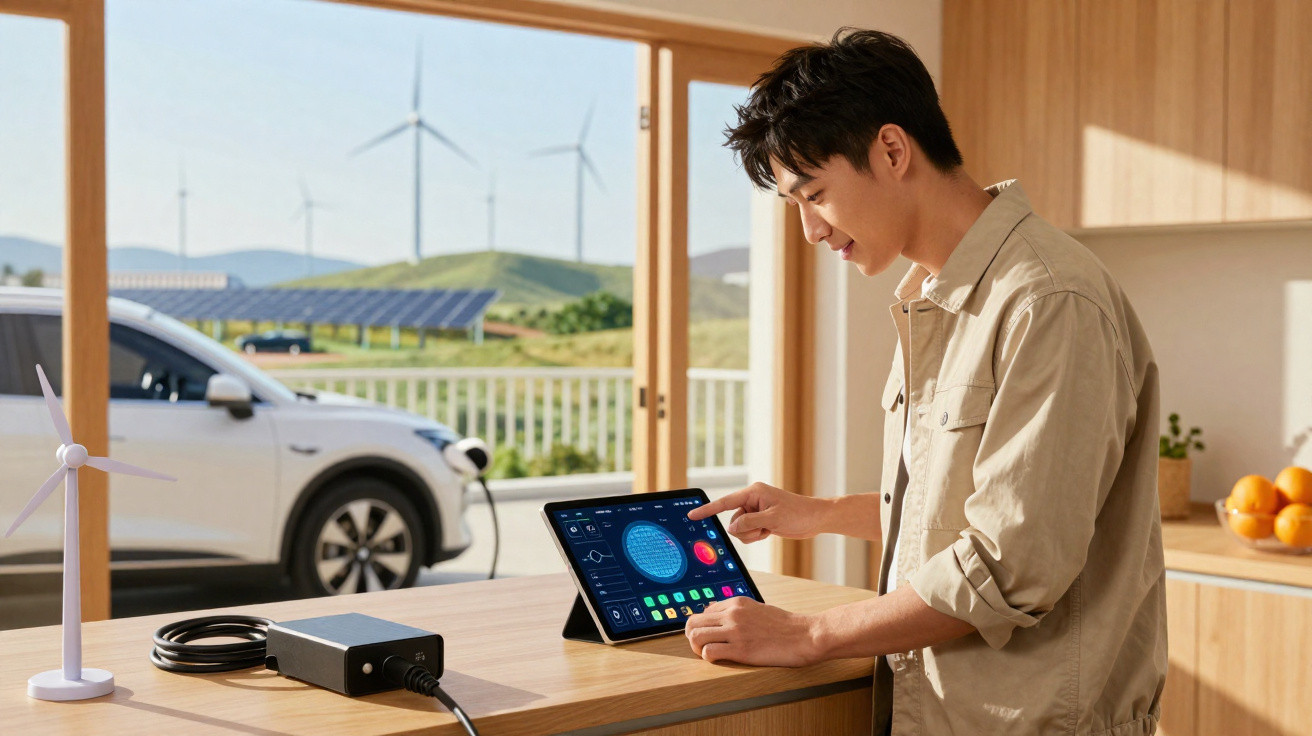
While European governments wrestle with climate targets and debate nuclear power and carbon taxes, another player has advanced much more quickly. China now leads the world in new renewable capacity and continues to widen that advantage every year.
China quietly takes the global lead
When asked which country generates the most renewable electricity, many people would suggest Norway, Iceland or Sweden: nations with plentiful hydropower, low populations and a long-established clean-energy profile. The answer is more surprising: China.
China produces more renewable electricity than the whole European Union. Its output includes wind, solar, hydroelectricity and an increasingly large contribution from modern bioenergy. For wind and solar specifically, China installs more capacity each year than any other economy in the world.
China has become the largest renewable-power producer on the planet, adding around two-thirds of new global wind capacity in recent years.
This transformation was built over time rather than achieved overnight. Twenty years of large-scale investment, industrial strategy and state-supported finance enabled Chinese manufacturers and developers to expand at exceptional speed. The outcome has been lower-cost solar panels and wind turbines internationally, alongside a growing gap between China and Europe.
Wind and solar: where China pulls away
Across the northern plains of Inner Mongolia and Xinjiang, onshore wind turbines stretch across the landscape. Offshore, wind farms are being built along the coasts near Jiangsu and Guangdong. In both sectors, projects are delivered at a speed that European developers can only admire.
Wind energy highlights the contrast. In France, for instance, wind supplies roughly 10% of all electricity generation. Several Chinese provinces already receive a larger share from wind, while the country’s overall fleet is still growing quickly.
Solar power follows much the same pattern. Panels cover the roofs of factories, warehouses and recently constructed homes. Vast solar parks occupy desert areas in Gansu and Qinghai, with ultra-high-voltage transmission lines carrying their clean electricity towards coastal megacities.
China now adds more solar capacity each year than the next several countries combined, pushing global panel prices sharply down.
These projects are supported by a supply chain that China mostly commands, covering everything from polysilicon and wafers to completed modules and inverters. This manufacturing strength allows projects to be deployed more cheaply and rapidly than in many Western markets.
Europe and the US: still big players, but slowing
The United States and the European Union remain in second and third place globally for renewable electricity generation. Both have highly advanced technologies and ambitious climate policies. However, their growth rates are less steep than China’s.
Why Europe is losing ground
Europe was an early mover, supported by strong feed-in tariffs in Germany and Spain, as well as substantial offshore wind subsidies in the North Sea. Today, though, a combination of complex regulation, local resistance and increasing project costs is holding back new development.
- Long permitting procedures can postpone wind and solar schemes by several years.
- Grid connections are struggling to match the rise of intermittent renewable electricity.
- More expensive finance increases the cost of capital-intensive developments.
- Protests against onshore turbines and new transmission lines halt or reduce certain proposals.
In the US, low-cost gas and shifts in federal politics make long-term planning harder. Certain states are moving rapidly ahead with renewable portfolios, whereas others remain dependent on coal and gas. Offshore wind ambitions are also challenged by inflation, supply-chain difficulties and legal disputes.
The numbers behind the green shift
Global energy agencies emphasise one notable reality: renewables account for almost every new unit of electricity capacity added around the world in recent years, and China supplies a very large portion of it.
| Region | Main renewable sources | Current trend |
|---|---|---|
| China | Solar, wind, hydro | Rapid expansion, record annual additions |
| United States | Wind, solar | Steady growth, big state-by-state differences |
| European Union | Wind, solar, hydro | Growth continues, but investment momentum softens |
National policy decisions underpin these overall patterns. China views renewables both as a climate measure and as a strategically important industry. State-owned banks provide enormous credit lines, while central planning establishes clear long-term goals for transmission, storage and grid expansion.
European governments, by contrast, must balance market liberalisation, local democracy and climate objectives. That approach brings innovation and accountability, but it can also produce delays. Investors need dependable policy direction, yet this can change after elections or public opposition.
Why China is betting big on clean power
China’s leaders have several motivations for accelerating green energy. A decade ago, air pollution in major cities generated public anger, making reduced smog a central political objective. China also seeks to lessen its reliance on imported coal, oil and gas, all of which present energy-security and foreign-policy risks.
Renewable energy supports both aims by reducing dirty air and limiting exposure to unpredictable international fuel prices. It additionally offers a route towards export leadership in emerging technologies, including batteries, electric vehicles and grid equipment.
By scaling up renewables, China aims to clean its air, secure its energy supply and dominate the next generation of industrial value chains.
There are compromises involved in this approach. Fast construction can put pressure on local ecosystems. Major hydroelectric dams inundate valleys and force communities to relocate, while solar installations reshape delicate desert environments. Even so, the rate of deployment is changing the global emissions outlook more quickly than many analysts anticipated ten years ago.
What this means for Europe’s energy future
Europe must choose between accepting a weaker role in the clean-technology race and adapting its policies to compete. That does not automatically require replicating China’s state-led system, but it does require reducing bureaucracy and providing investors with certainty.
Quicker approvals for onshore wind, improved planning for offshore grids in the North Sea and Baltic, and shared purchasing of critical materials could all alter the direction of travel. A more robust industrial policy could also help European solar and turbine manufacturers facing pressure from cheap imports.
Europe can also build on its existing advantages: sophisticated research, high-quality engineering and integrated cross-border electricity markets. Smart grids, demand-response systems and energy storage are fields in which European companies already have a leading position.
Key concepts readers keep hearing
Two technical terms appear repeatedly in discussions of this transition: capacity and intermittency.
Installed capacity (measured in gigawatts, GW) means the maximum power a facility can generate when operating at full output. China is now the global leader in installed wind and solar capacity. Yet installed capacity does not necessarily match actual generation, since wind conditions vary and the sun goes down every night.
Intermittency describes that changing level of output. Electricity grids must continuously balance supply with demand. Countries address this by investing in storage, such as batteries and pumped hydroelectricity, flexible gas plants, and long-distance transmission lines that move power from windy areas to calm ones or from sunny afternoons to dark evenings.
China’s ultra-high-voltage transmission system is one way of responding to intermittency. Europe has chosen a different approach, placing greater emphasis on storage and cross-border trade. The US combines state-level and regional strategies, with less coordination at national level.
What could happen next
Should China continue to install renewables at its present rate, emissions from its power sector could reach their peak well before 2030. This could modestly improve global warming projections, despite coal remaining part of the energy mix. China may also strengthen its grip on clean-technology supply chains, leaving Western economies more reliant on imported equipment.
For Europe and the US, one plausible outcome is increased trade conflict over green industries, including solar panels and electric vehicles, combined with continued cooperation on climate diplomacy. Both require China’s involvement to meet global climate targets, while also seeking to reduce strategic dependency.
For businesses and households, this transition brings more variable electricity prices, wider use of rooftop solar and fresh ways to earn money by changing energy use. An electric car, household battery or smart heating system can make consumers active participants, helping to balance the grid while lowering bills.




Comments
No comments yet. Be the first to comment!
Leave a Comment