
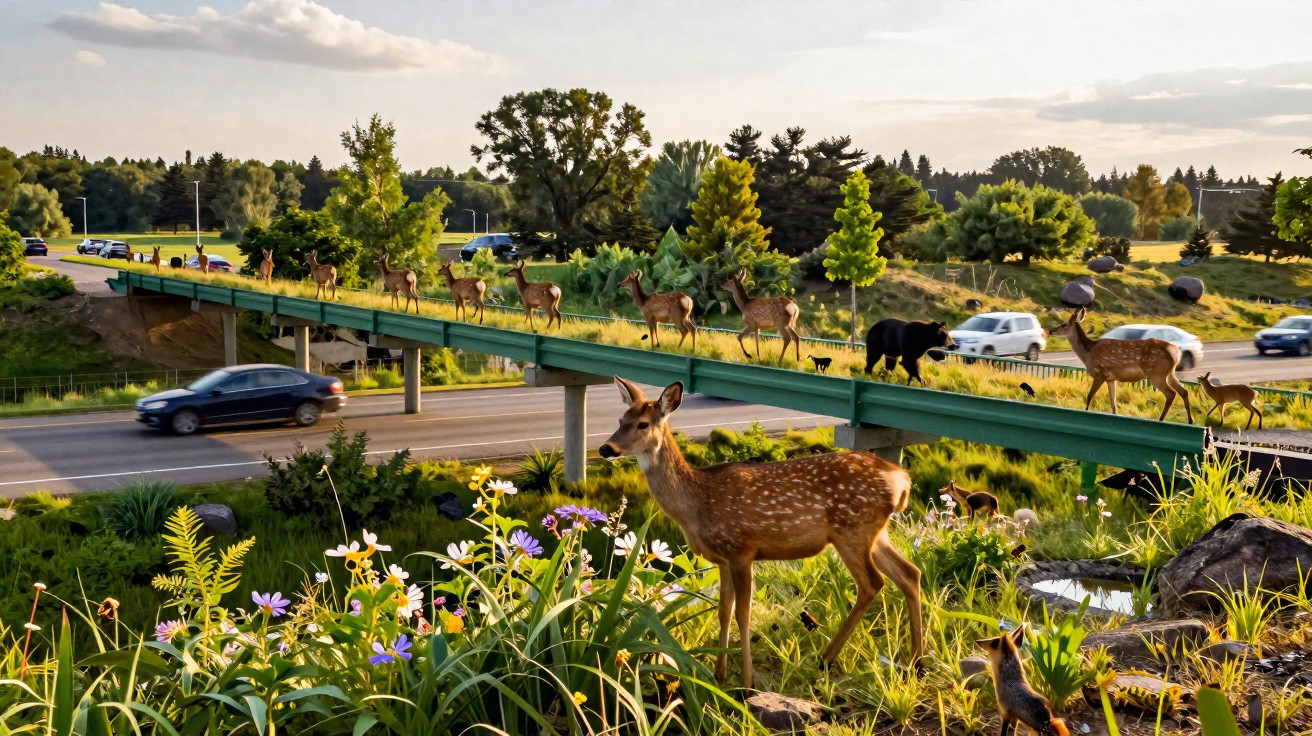
Lorries rumble by in an unbroken flow, their headlights dissolving into the soft orange sky. Yet above the traffic, a silent moment unfolds: a mule deer steps on to a grass-covered bridge spanning six lanes of tarmac. She pauses, her nose quivering, before continuing. A fawn emerges behind her, followed by another. Within minutes, an entire family is crossing a road it never truly “sees”. Below, motorists drink coffee, move between lanes and check their sat-nav. Above them, a migration route that pre-dates the car is gradually being joined back together.
Now picture this happening thousands of times, in thousands of locations, across every continent. Concrete becomes a corridor. Motorways are sewn back into habitats.
What is surprising is not that wildlife crossings work.
Highways That Animals Can Finally Cross
On a map, a motorway appears as a tidy line. At ground level, it acts more like a barrier. For elk, bears, tortoises and frogs, a four-lane road can bring a journey begun generations ago to an abrupt end. You notice it while driving after dark: eyes shining in the headlights, a sudden shape at the verge, and that unsettling lurch when you realise how narrowly a collision was avoided.
Wildlife crossings reverse that situation. They turn an impenetrable obstacle into a series of gateways: broad, planted bridges above traffic; dim tunnels below concrete; and rope “canopies” suspended over Caribbean roads for monkeys and sloths. More than 10,000 such structures now cross over or run beneath roads worldwide, restoring migration paths much as a surgeon reconnects severed nerves.
Some of the clearest proof comes from Canada’s Banff National Park. Since the 1990s, 44 crossings - combining overpasses and underpasses - have been installed along one section of the Trans-Canada Highway. Motion cameras have since recorded bear families moving carefully across, wolf packs travelling at night, and elk trotting over almost casually, as though following a well-known path. Roadkill there has fallen by around 80% for many large mammals and by more than 95% for elk.
In the Netherlands, where roads form a dense network, wildlife managers have counted over 600 crossings used by creatures ranging from frogs to badgers. One of the best known, Natuurbrug Zanderij Crailoo, extends for more than 800 metres. Deer, foxes and wild boar travel across it as they would a natural slope. To them, it is not “infrastructure”. It is simply the continuation of the woodland.
The principle is remarkably straightforward. The more an ecosystem is broken into fragments, the less robust it becomes. When animals cannot travel, their gene pools contract. Populations become less capable and more vulnerable, with a reduced ability to respond to disease, drought or climatic fluctuations. Reconnecting habitats through wildlife crossings allows genes - and behaviours - to move once more. In time, that exchange reinforces whole ecosystems rather than individual species alone. Highways cease to function as blades cutting through the natural world and begin to resemble stitched seams.
How We’re Learning To Build For Deer, Bears, Frogs And Bees
The most successful crossings are not merely concrete structures carrying a “wildlife” label. Their design reflects highly particular behaviours and fears. Deer favour broad, open, grassy bridges where approaching predators are visible. Bears tend to be more wary and often prefer additional cover. Turtles require low, damp underpasses that remain wet. Small salamanders will use tunnels only when the air carries the scent of moist soil rather than exhaust fumes.
For that reason, engineers and ecologists now spend weeks mapping animal movements before choosing a crossing site. They trace tracks in snow, inspect droppings beside fences, and study GPS data from collared elk or panthers. They identify “pinch points” where animals are still attempting - and often failing - to get across. A new bridge or tunnel is then placed precisely where these unseen animal routes already run. The strongest designs are not about making nature adapt; they are about paying close attention to it.
Most of us have experienced the shock of a deer suddenly appearing at the roadside, sending our hearts racing. Such near misses have helped spur some communities into action. In Wyoming, vehicle traffic was cutting through the vast “Path of the Pronghorn” migration. Following several fatal winters, local ranchers, tribes, transport authorities and conservationists achieved something uncommon in politics: they agreed on a shared solution.
Today, a network of overpasses and underpasses enables tens of thousands of pronghorn and mule deer to cross safely each year on vital sections of the route. Animal collision rates have declined by more than 80% along those stretches. Insurance claims dropped, while fewer people received distressing late-night calls about damaged vehicles and injured family members. The effort was not solely about “saving wildlife”. It also made a harsh road less punishing for people.
Evidence from research is mounting rapidly. Cameras at crossings reveal increasing use year after year as animals become familiar with the routes. Studies in Europe, North America and Australia have measured genetic diversity in populations before and after crossings were opened. In many instances, inbred groups that had been gradually declining begin exchanging genes again. Insects and small mammals also gain when roadside verges are planted as “micro-corridors”, connecting major structures into uninterrupted green strips.
Let’s be honest: nobody reads a government report on ecological connectivity for pleasure. What resonates is the quiet, determined belief that roads need not be the point where nature stops.
What It Takes To Turn A Deadly Road Into A Living Corridor
When planners set out to mend a fragmented landscape, the first step is unexpectedly simple: they observe. They wait near culverts where foxes pause. They inspect fences for places where deer repeatedly try to leap over. They speak with local motorists, who know exactly which bend produces the most collisions every autumn.
After that, the process resembles urban planning for non-human residents. Where do animals choose to cross? Which sightline is safest? How loud is the traffic beneath them? Designers then create crossings that feel as natural as they can. This requires enough soil to support genuine trees and shrubs, rather than a thin scattering of grass. It can mean sound barriers or earth banks to soften the thunder of lorries. It also involves fencing that guides animals gradually towards a bridge or tunnel instead of leaving them trapped at unfamiliar dead ends.
A common mistake is to assume that “one big bridge will fix everything”. Ecosystems do not operate like that. A few years after a striking overpass opens, monitoring may show that amphibians are still dying in their thousands several kilometres away, where a seasonal wetland meets an unprotected road. Smaller mammals may remain blocked by concrete barriers omitted from the original scheme. The most effective programmes therefore regard crossings as a network, rather than a showcase project.
There is also a repeated human failing: constructing an attractive crossing but overlooking the invisible details. Overly bright lighting deters nocturnal species. Poor maintenance allows rubbish to accumulate in underpasses until animals no longer use them. Some communities also bypass the slow, patient process of speaking with local residents, hunters and lorry drivers, allowing suspicion to persist long after construction is complete. In truth, restoring fragmented ecosystems depends as much on rebuilding trust as it does on laying concrete.
“Wildlife crossings are not charity projects for cute animals,” says one ecologist working along a busy Oregon highway. “They’re core infrastructure for a livable planet - for us included.”
When communities adopt that thinking, small but thoughtful measures begin to multiply:
- Planting native shrubs on bridges so that pollinators and birds, as well as large mammals, can use them.
- Scheduling construction around breeding and migration seasons to reduce stress.
- Combining new crossings with lower speed limits at recognised hotspots, giving both drivers and animals more time to react.
These measures do not attract headlines or produce polished drone footage. But, gradually and persistently, they transform hostile highways into something more like shared space.
The Quiet Revolution Above (And Below) Our Roads
A subtle change is taking place in landscapes where crossings are installed. People start to see roads differently. An overpass they once overlooked becomes a subject of conversation. Children in the back seat press their faces against the window, searching for elk tracks in snow on the bridge. Local news reports on the first occasion that cameras record a wolf using a crossing. The images circulate, and a piece of grey infrastructure suddenly seems alive.
Once that change in perspective begins, a broader question follows: if motorways can be redesigned for deer and bears, what else could be redesigned for life? Researchers are already testing “fish passages” around dams, bee highways across urban rooftops and hedgerows that serve as insect corridors between fields. Wildlife crossings over tarmac become an emblem of something more ambitious - a world in which human travel does not automatically destroy everything in its way.
Not everyone will see the vast overpass currently taking shape outside Los Angeles, intended to reconnect mountain lions divided by freeways. Most of us will never stand beneath a Dutch eco-viaduct and listen for the quiet tread of a badger above. But the principle behind these 10,000-plus structures is quietly universal: when we stop treating nature as background noise, its patterns return with remarkable speed.
We often speak of “fixing the planet” as though it requires impossible acts of heroism. Sometimes it is more like this: a bridge made of earth and trees over a busy road, a tunnel beneath a traffic lane, or a line in a government budget stating, very simply, that we are prepared to share.
| Key point | Detail | Why it matters to readers |
|---|---|---|
| Wildlife crossings work | Studies show up to 80–95% fewer animal–vehicle collisions on protected stretches | Provides evidence that these structures protect both animal and human lives |
| Design must follow animal behaviour | Shape, width, vegetation and noise all affect whether species actually use crossings | Helps readers see why “just any bridge” is insufficient |
| They restore whole ecosystems | Reconnected habitats reinstate migration routes and genetic diversity | Demonstrates how a single piece of infrastructure can strengthen entire landscapes |
FAQ:
- What exactly is a wildlife crossing? A wildlife crossing is a structure constructed above or below a road, allowing animals to move safely between habitats without entering traffic.
- Do animals really use these bridges and tunnels? Yes. Camera traps around the world have recorded thousands of crossings by deer, bears, wolves, amphibians and numerous other species once they learn the route.
- Are wildlife crossings only for big mammals? No. There are small tunnels for frogs and salamanders, rope bridges for monkeys and possums, and planted overpasses used by insects and birds.
- Who pays for wildlife crossings? Funding generally combines government transport budgets, conservation programmes and, in some cases, private or philanthropic contributions.
- Can local communities influence where crossings are built? Often, yes. Collision reports, local ecological knowledge and citizen campaigns can encourage authorities to prioritise particular hotspots.

Comments
No comments yet. Be the first to comment!
Leave a Comment