
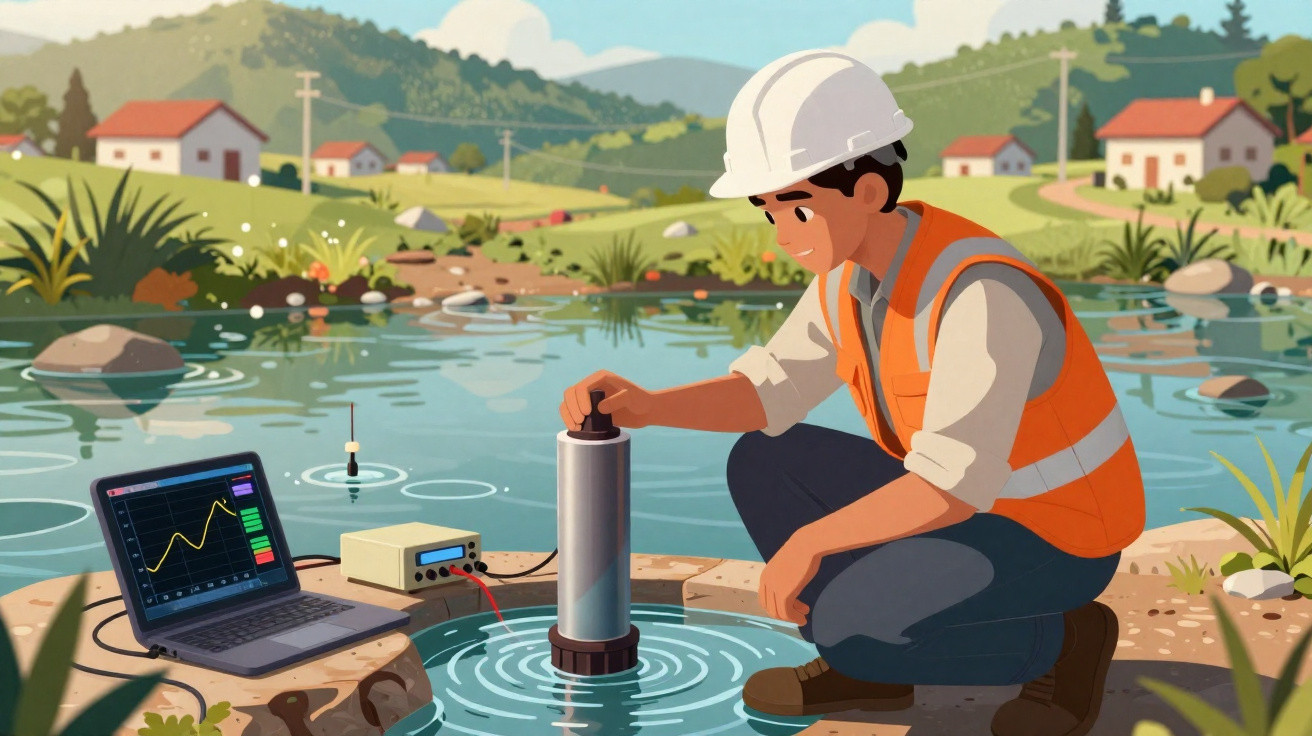
At first sight, the concept seems almost implausibly straightforward: there are no blades and no submerged gears, only a cylinder moved by flowing water. Behind this stripped-back arrangement, however, is a Spanish research project that may offer an unusual route to affordable, low-maintenance hydropower.
Turning harmful vibrations into electricity
The device was developed by a team at the Universitat Rovira i Virgili in Catalonia. Its approach is based on vortex-induced vibrations, a familiar engineering effect that is more commonly regarded as a problem.
As water passes around a cylindrical object, the flow is not completely smooth. Small spinning eddies – known as vortices – detach alternately from either side of the cylinder. These rotating structures produce changing pressure and alternating forces, repeatedly pushing and pulling the object until it begins to vibrate.
Engineers normally try to prevent this phenomenon. Vortex-induced vibrations can wear down materials, create cracks and shorten the service life of costly structures such as bridges, chimneys and offshore platforms. The Spanish researchers have instead chosen to harness those vibrations and recover their mechanical energy.
Turning a destructive fluid effect into a controllable motion, the team aims to turn structural fatigue into a steady source of electricity.
In the proposed design, a hollow cylinder hangs in the current like an underwater pendulum. Water flowing past it creates vortices in its wake, drawing the cylinder from side to side and producing regular oscillations. Rather than being lost, this movement is transferred through a shaft to equipment positioned safely above the water.
With every swing, the shaft turns by a small amount. The resulting motion is passed to a mechanical system installed either on a floating platform or on the riverbank, where a generator can turn it into electricity.
Why replace conventional underwater turbines?
Most existing marine and river-energy schemes use turbines. Much like wind turbines beneath the surface, these machines have rotating blades connected to a hub, with shafts and gearboxes linking them to a generator.
For straightforward energy capture, turbines perform fairly well. Many extract 25–35% of the kinetic energy in moving water. Their moving components, however, face harsh conditions in marine environments. Salt water attacks seals and bearings, while algae, barnacles and shellfish attach themselves to blades, altering their profile and adding drag. Reaching submerged equipment can require divers, heavy boats and extended periods of suitable weather.
Maintenance is therefore both costly and hazardous, particularly in fast rivers or isolated tidal channels. Communities located far from major ports may find routine servicing impractical.
The oscillating-cylinder approach is intended to eliminate many of these difficulties:
- No rapidly rotating blades below the waterline
- No complicated sealed gearboxes beneath the surface
- Only a straightforward, durable body exposed to debris and water
- Mechanical and electrical equipment that can be reached above water
Only the cylinder gets wet. The delicate parts stay dry, on a barge or onshore, where a standard technician can reach them with basic tools.
This design change does not automatically improve efficiency, but it could transform the economics. Some loss in output may be acceptable if the equipment is easy to install and lifetime servicing costs fall dramatically.
What the laboratory results reveal
The researchers evaluated the system in a hydraulic flume at their fluid-structure interaction laboratory. They suspended the cylinder in regulated currents and used sensors to measure its angle and oscillation frequency. An electromagnetic brake reproduced a range of electrical loads, enabling the team to assess how the device would operate while producing power.
In realistic test conditions, the system achieved a power coefficient of about 15%. Put another way, it captured roughly 15% of the kinetic energy moving through the area swept by the cylinder.
Although this result is below the performance of the leading underwater turbines, it is within the range achieved by vibration-based energy harvesters in other applications. For the team, the principal benefit is not outperforming turbines in raw efficiency, but creating a machine that is far simpler to build, deploy and maintain.
Compact oscillating cylinders for challenging sites
The cylinder-pendulum system is not intended for vast offshore installations in deep, rough seas. Its likely role is in smaller applications where dependability and simplicity are as important as megawatt-scale production.
Possible locations include:
- Secondary tidal channels with moderate yet consistent currents
- Run-of-river sites that need neither dams nor substantial civil engineering
- Harbours and estuaries, where access can vary and available space is limited
- Remote river crossings supporting sensors, telecommunications equipment or small microgrids
The design is modular. Multiple cylinders could be arranged side by side or installed at separate depths, creating something like a small submerged fence. As each unit contributes additional power, installations can be tailored to local requirements rather than relying on a standard turbine design for every location.
A row of moving cylinders could one day power navigation lights, isolated research stations, or pumps in off-grid farming projects.
Could the same principle work in air currents?
The fundamental physics applies equally to water and air. Any stable flow passing a cylinder can produce vortex-induced vibrations, provided that its speed and the cylinder dimensions are within an appropriate range.
The Spanish researchers suggest that the principle could, with redesign work, also be used in the atmosphere. A vertical or horizontal cylinder installed in a windy passage could twist and swing sufficiently to operate a small generator. Unlike conventional wind turbines, these devices would not need large rotating blades, potentially reducing both visual intrusion and risks to birds.
Output would not be the same, as air has a lower density than water. At identical flow speeds, less energy is available per square metre, although stronger winds and taller structures could offset this difference. The idea also raises a wider question: might future coastal hybrid installations use both air and water cylinders, drawing on sea breezes and tides through one basic family of technologies?
How the technology could fit real energy systems
A single cylinder would not provide electricity for a city. Its probable role is distributed generation at a small scale, such as for rural microgrids, scientific equipment moored in rivers or navigation aids in tidal estuaries. In such situations, dependable operation with minimal intervention can matter more than maximum efficiency.
The system could also complement solar panels and batteries. Photovoltaics would meet much of the demand during daylight hours, while a steady river current could help recharge batteries overnight or in cloudy weather. Combining these technologies reduces the need to oversize any individual system.
| Aspect | Traditional turbine | Oscillating cylinder |
|---|---|---|
| Main moving part | High-speed blades | Slow swinging cylinder |
| Underwater complexity | Bearings, seals, gearbox | Simple mechanical linkage |
| Typical efficiency | 25–35% of kinetic energy | Around 15% in lab tests |
| Maintenance access | Specialist vessels, divers | Most work done above water |
Risks, unanswered questions and the route to real rivers
Hydraulic flumes offer controlled, forgiving conditions; real rivers do not. The next step will be to trial these systems in muddy, debris-filled environments that change with the seasons. Floods may alter current patterns overnight, while floating branches or ice could strike cylinders with considerable force. Sediment may also accumulate around moorings.
Engineers must investigate how cylinder arrays affect one another and interact with surrounding ecosystems. Fish passage, underwater noise and effects on sediment movement will all need detailed assessment. As the device has no fast-spinning blades, it may present a lower collision risk than turbines, but field evidence is still required.
Durability is another unresolved issue. Although the concept limits the number of moving components underwater, repeated oscillation still places cyclic loads on the structure. Any commercial design promising a working life of 20 years or more will depend on material selection, fatigue resistance and intelligent damping.
Key concepts explained
“Vortex-induced vibrations” may sound technical, but the effect is familiar to many people. A flag flapping in a strong wind is a classic example. Air moves around the pole and fabric, creates vortices, and these make the fabric flutter. On certain bridges, the same mechanism can create rhythmic movement that engineers seek to control.
The Spanish team's “power coefficient” is another important measure. It indicates the proportion of energy in a moving fluid that a device can capture. A coefficient of 15% therefore means that 15% of the kinetic energy in the stream crossing the cylinder's swept area becomes useful mechanical power. Further losses occur during transmission and generation, so the final electrical output is slightly lower.
As energy systems become increasingly distributed and more responsive to local conditions, technologies such as this Spanish cylinder could occupy a place alongside larger, more conspicuous machines. Its value lies in working with the disorder of real currents and converting a longstanding engineering nuisance into a modest, reliable power source.






Comments
No comments yet. Be the first to comment!
Leave a Comment