
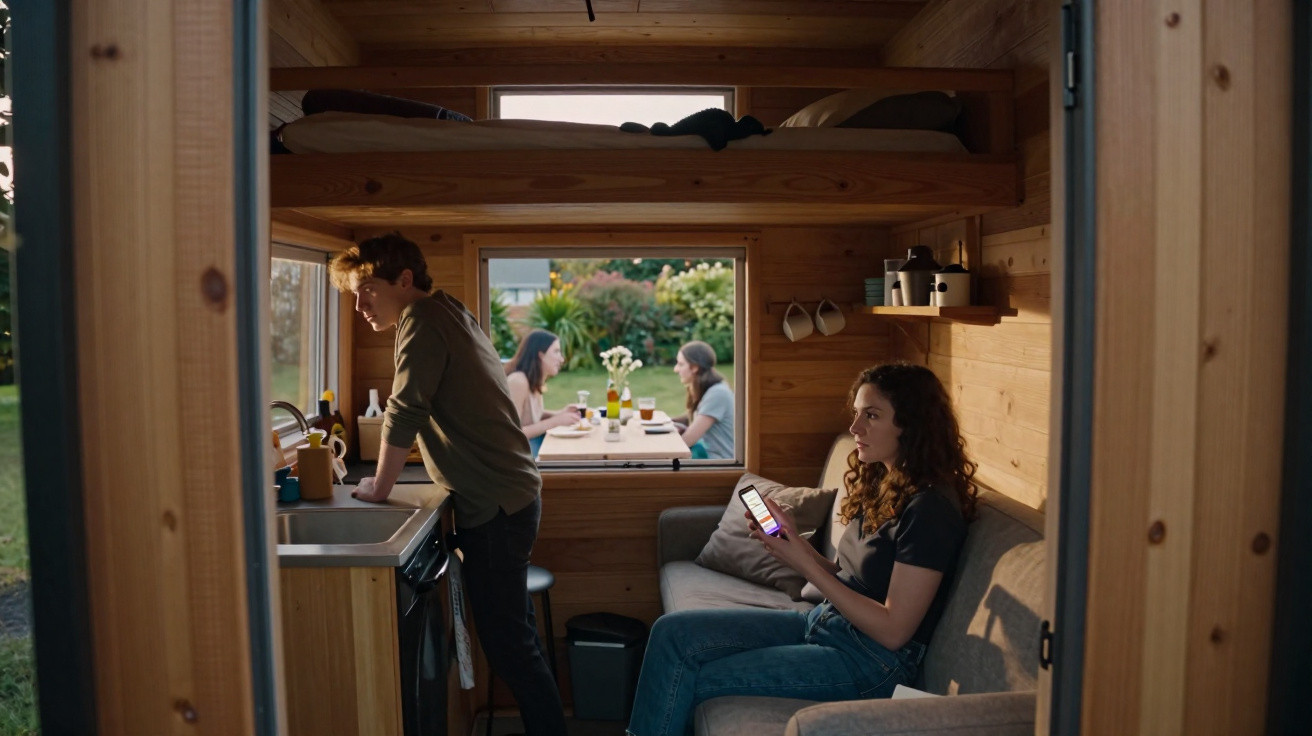
Five years later, the picture is much more complex.
For a young US couple, moving into a tiny house seemed to offer escape from rent, clutter and money worries. Yet the compact wooden property has gradually altered their friendships, family relationships and even their partnership. The financial gains are genuine, but so are the compromises they did not anticipate.
The tiny house dream meets everyday reality
Five years ago, Amber and her partner moved their tiny house onto its plot, becoming part of a movement celebrated across social media and glossy magazines: minimalist homes of under 30 square metres, frequently free of a mortgage and finished in inviting natural wood.
Their household spending fell sharply. Utility bills became lower, they no longer bought large pieces of furniture, and their wardrobes became smaller along with their regular outgoings. On paper, it appeared to be a successful choice.
What they did not factor in: how living almost permanently within arm’s reach of each other would change how they argue, relax, work and socialise.
Without proper doors, a spare room or much soundproofing, privacy became a luxury. Amber describes a home where every call can be heard, every poor mood takes over the whole room, and every disagreement lacks somewhere to cool off.
Living on top of each other in a tiny house
The pair have one open-plan living space, a small kitchen and a bed in the loft. There is no corridor where someone can shut a door, no separate workspace and nowhere to unwind alone. Headphones can lessen the other person’s presence, but cannot make it disappear.
Time once spent separately in different rooms of a conventional home now takes place alongside one another. Watching a series, replying to work emails, working out and scrolling through a phone all happen within the same shared space.
The more time they saved on commuting and cleaning, the more they spent simply being in each other’s company – wanted or not.
According to Amber, being continually close changes the emotional atmosphere over time. Habits that might seem affectionate in a bigger flat can become too much in a tiny house, whether it is how the other person cooks, works late on a laptop or makes calls. Small annoyances intensify more quickly when there is no retreat.
When love meets lack of space
Relationship specialists regularly emphasise the importance of “healthy distance”: individual hobbies, friendships and areas of the home. Tiny houses put that principle under considerable pressure.
An argument cannot be put on hold by leaving for another room. One partner cannot use the kitchen table for work while the other watches a film without discussing it first. Gaming late at night, early yoga sessions and Zoom calls with friends all need organising like a shared diary that moves around with you.
- Disagreements can escalate faster when neither person has a private place to calm down.
- Sleep and relaxation are affected when the living area and bedroom are effectively one space.
- Individual habits can seem more significant when they are constantly on display.
For Amber, the affection is still strong, but the ideal of permanently cosy companionship has been replaced by a more realistic view: emotional intimacy requires space in both a literal and figurative sense.
When your home discourages guests
The next surprise came from beyond the house. Amber and her partner expected friends and relatives to enjoy the tiny house, at least for the novelty. At first, people did come round. The compact kitchen, thoughtfully designed storage and loft bed all prompted “wow” reactions.
As time passed, however, visits became less frequent. Hosting more than one or two people comfortably is simply not possible. There is no extra chair for a neighbour, nowhere for children to play, and no way to fit an eight-person dining table, regardless of how inventive the layout may be.
The couple realised they had saved on heating and furniture but paid a different price: fewer invitations, fewer family celebrations at theirs, fewer evenings that stretch naturally late because no one needs to rush home.
Friends increasingly suggested cafés, parks or their own larger flats. Family occasions automatically took place elsewhere. When Amber now wants to spend time with people, she generally goes to them or meets them in public. Impromptu “come over for dinner” evenings have disappeared from her life.
The quiet erosion of social life
Social researchers have long connected housing conditions with social networks. Those who are able to host often stay more central to their friendship groups. They become the focal point for birthdays, board-game evenings and shared meals. People who cannot host may gradually move to the margins without recognising it.
Amber describes an increasing feeling of isolation. She feels uncomfortable repeatedly asking others to “offer the space”. Meanwhile, visitors are reluctant to squeeze into a one-room cabin already shared by two adults and all their possessions.
Over five years, this reluctance becomes visible in the diary. Invitations become rarer, and some friendships largely continue through messages. The sense of belonging to a close group fades, not because anyone has fallen out, but because the home cannot physically accommodate that closeness.
What tiny houses really cost
The original attraction remains compelling. From the US to Germany, interest in tiny homes has risen sharply since the late 2010s. Increasing rents, insecure employment markets and greater concern about environmental impact have all encouraged people to seek smaller, cheaper and supposedly greener homes.
In many markets, tiny homes offer comparatively low initial prices. A basic unit may cost roughly the same as a mid-range car, while using far less energy than a detached home. For some buyers, they provide a route to ownership that a traditional mortgage would never make possible.
| Aspect | Tiny house | Conventional small flat |
|---|---|---|
| Upfront cost | Lower purchase price, but extra fees for land, permits and utilities | No purchase if renting, deposit and monthly rent required |
| Running costs | Lower energy bills, less furniture, fewer possessions | Higher heating and cooling, more furnishing expenses |
| Legal complexity | Planning rules, zoning, permanent residency restrictions | Standard rental regulations, more predictable |
| Social potential | Harder to host, limited overnight guests | Easier to gather friends and family |
For Amber, the financial calculation remains favourable. She pays less for utilities, decorating and impulse purchases because there is nowhere to keep additional belongings. But when she compares those savings with what is missing from her life – meals shared at home, birthday celebrations and extended family staying overnight – the loss feels unmistakable.
Legal obstacles and hidden restrictions
Finances and social life are not the only considerations. The legal position of tiny houses is still unclear in many areas. Some local authorities classify them as caravans, while others regard them as permanent homes. Planning rules can prohibit all-year residential use on particular plots, and connecting water, sewage and electricity may become costly projects.
Anyone thinking about making the move needs to consider questions that rarely feature in Instagram portrayals of the trend:
- Is residential occupation throughout the year permitted on the chosen plot?
- Is the tiny house treated as a vehicle, a mobile home or a standard building?
- What regulations apply to parking, tax and insurance?
- How might the location affect access to healthcare, education or work?
Those who expect effortless mobility often discover that local rules tie them down, particularly after they install permanent utilities or add decks and extensions. What first seemed like freedom on wheels can become a fixed and regulated home in the view of the authorities.
Could tiny living work without shrinking your social world?
Experiences such as Amber’s do not prove that living in a small space cannot work. Instead, they highlight where expectations may need to change. Some tiny-house residents enjoy full and well-connected lives, but most make a serious effort to compensate for the missing square metres.
A practical trial before downsizing can be useful. Spend several weekends with your partner in a small holiday cabin. Invite two or three friends over, even when it feels crowded. Consider not only storage, but also how you deal with arguments, quiet, illness and work calls in such limited space.
It is also worth planning how social connections will be maintained:
- Allow for regular meals out, co-working spaces or community centres, so you do not always rely on your tiny home.
- Speak openly with friends and family about how get-togethers will work when you have less space.
- Seek plots near shared amenities: clubhouses, communal kitchens or gardens can make up for the lack of a large living room.
Minimalism and small-scale homes can ease financial strain and reduce environmental impact, yet they also transform everyday life in ways that extend far beyond floor area. A home does not merely contain possessions; it provides space for disagreements, laughter, late-night conversations and celebrations.
For people such as Amber, the central issue is no longer the cost per square metre, but what kind of life they want those metres to hold. For some, the exchange of lower bills for a quieter social calendar will be worthwhile; for others, it will be intolerable. Testing that balance beforehand may prevent considerable disappointment once the tiny front door shuts.




Comments
No comments yet. Be the first to comment!
Leave a Comment