
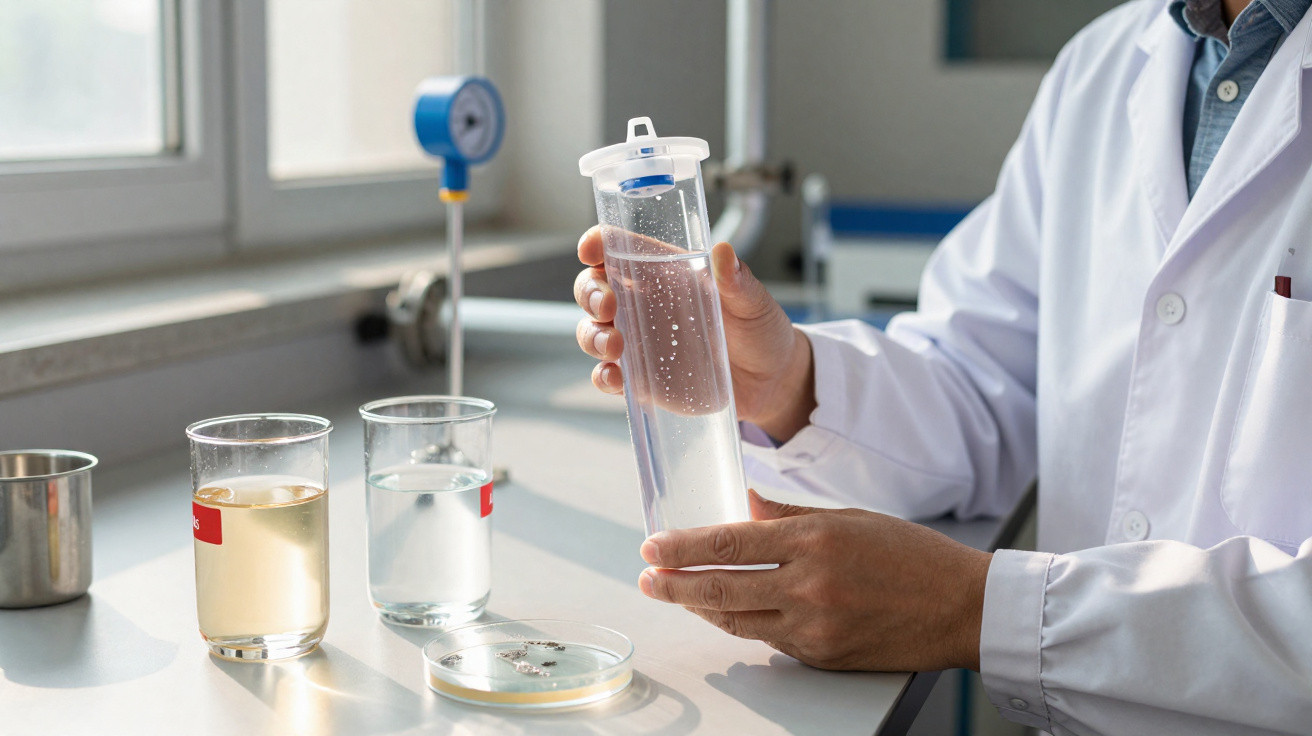
A modified carbon filter material has been shown in laboratory tests to cut arsenic in contaminated water to below the recommended safety threshold.
The finding brings a cheap, power-free solution a step nearer for homes and small communities dependent on unsafe wells.
Inside the cartridge
Within a conventional countertop cartridge, the material processed heavily contaminated water at a consistent household flow rate.
Using this arrangement, Silvia Goyanes of Argentina’s National Council for Scientific and Technical Research (CONICET) and the University of Buenos Aires (UBA) showed that the cartridge repeatedly reduced arsenic from 100 parts per billion to below ten.
The reduction remained within the recommended limit across more than 7,998 litres of treated water, without the use of added chemicals or electricity.
This controlled-test performance provides a benchmark for the filter’s required results when it encounters real wells, where competing minerals and arsenic concentrations can vary.
Why arsenic remains in water
Prolonged arsenic exposure may increase the risk of cancer and damage the heart, lungs and skin.
The element can be released from particular rocks, dissolve into groundwater and then pass unnoticed through pipes and storage tanks.
Under US regulations, the EPA sets the drinking-water threshold at 10 parts per billion, an extremely small concentration in water.
As many smaller systems cannot pay for sophisticated treatment, a cartridge capable of reaching that threshold could have a significant impact.
Activated carbon designed to target arsenic
In many filters, activated carbon - a porous form of carbon that captures chemicals - is effective at improving taste and removing certain pesticides.
To remove arsenic specifically, the researchers coated the carbon with metal salts, using an edible binder to keep the materials together.
“The modifications we make to commercially available activated carbon can be done through processes without heat and using low-cost equipment that is very common in the industry,” said Alicia Vergara, a CONICET researcher.
This type of adjustment could allow the same cartridge base to address local water issues, provided manufacturers maintain consistent quality.
The role of metal salts
Metal salts alter the carbon’s surface by creating sites that draw in dissolved arsenic rather than allowing it to pass through.
After these sites are created, adsorption - the process in which pollutants adhere to a solid surface - can retain arsenic until it can be disposed of safely.
In an earlier study, scientists produced iron-loaded activated carbon and demonstrated its ability to remove arsenic from drinking water.
Appropriate metals can also add magnetism, potentially enabling sensors that indicate when a cartridge has been exhausted.
Food-safe coating
An edible polymer - a long-chain molecule used to form gels - enclosed the carbon particles within stable granules.
As water passes through the cartridge, the coating helps prevent fine carbon dust from making the filtered water cloudy.
Since the polymer is food-safe, engineers can develop consumer cartridges without concerns about a hazardous binder coming into contact with water.
Holding the metals and carbon together also creates the possibility of later reuse, as contaminants can be removed through a controlled wash.
The reality of flow rate
At roughly 0.49 litres per minute, the test system could fill a 1-litre bottle in around two minutes.
A higher flow rate reduces contact time, giving arsenic fewer opportunities to adhere to the material’s treated surfaces.
The team said that altering the cartridge geometry could shorten the filling time while maintaining strong removal performance.
Achieving a balance between speed and safety will be important in real kitchens, where users may stop using filters they consider too slow.
Other chemicals tested
In addition to arsenic, the team passed dyed water and samples containing antibiotics through the material, with both declining sharply.
Many microbes and pesticides, including paraquat and atrazine, have not yet been tested, meaning such claims are currently based on chemistry alone.
“The results were very good, as were those for antibiotic contamination, such as tetracycline, where the material showed a high removal potential,” stated Matías Barella, a researcher at the UBA.
Until trials involving bacteria, viruses and fungi are published, buyers should regard these additional promises as objectives rather than demonstrated performance.
Reuse and clean-up
All cartridges eventually become saturated with captured arsenic, so extended use relies on identifying when the material has been exhausted.
Following a batch of water, desorption - removing trapped chemicals from the material - can renew the sites for another cycle.
“Furthermore, it offers the advantage of being reusable, since with a simple procedure the contaminant can be desorbed and the material reused,” added Vergara.
The wash liquid must be handled safely, as regeneration concentrates arsenic into a smaller volume that cannot be released outdoors.
Cost and scale
Cost is a key requirement for filters, and the CONICET and UBA team said its material performed at the level of high-end cartridges sold in Argentina.
Off-the-shelf ingredients also reduced expected costs, as the cartridge medium could be produced using retail supplies.
“This is a filler material that could be used in various commercial filter cartridges as a replacement for conventional activated carbon,” said Goyanes.
Securing an industry partner will determine whether the cartridge progresses beyond the laboratory and reaches communities that require safer wells.
Field trials to come
This tailored carbon blend illustrates how modest material changes can transform a standard cartridge into an arsenic-focused purifier.
Field testing, unambiguous replacement indicators and safe regeneration procedures will determine whether its potential is maintained beyond controlled test water.
Photo: courtesy of the researchers.






Comments
No comments yet. Be the first to comment!
Leave a Comment