
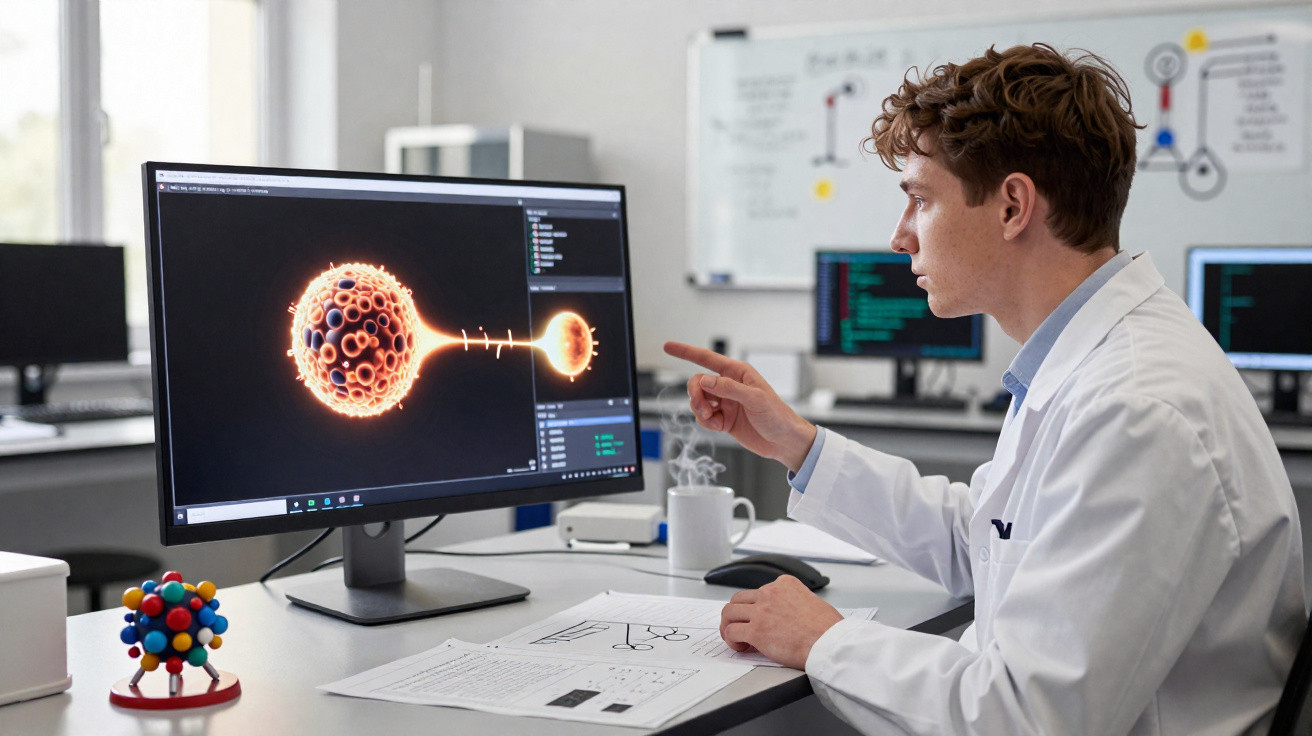
The term atom derives from the Greek word for indivisible. Its name, however, is misleading.
A simulation by theoretical physicists in the US has delivered the first completely microscopic account of the instant an atom divides in two. It offers new detail on the high-energy process that helped usher in a new era of science and technology.
In 1938, physicists Otto Hahn, Lise Meitner and Fritz Strassmann demonstrated just how inaccurate that tiny word was: uranium nuclei can split into two after being struck by neutrons.
Decades on, nuclear fission has been used in warfare, electricity generation, medicine and scientific research, yet it has been slow to reveal all its secrets.
Nuclear fission inside a quantum nucleus
Rather than being a simple cluster of protons and neutrons, like gumballs in a dispenser, the nucleus of a heavy atom is a turbulent arena of quantum activity.
It is difficult enough to understand how separate nucleons act and interact in an undisturbed atom, let alone during a major transformation.
To make the sequence more manageable, theoretical physicists at Los Alamos National Laboratory and the University of Washington (UW) divide the fission process into four stages.
The four stages of an atom splitting
Over the first 10^-14^ seconds, approximately, the arrival of a slow neutron makes the nucleus swell and reorganise at what is known as the saddle point. At this stage, the atom resembles a minute peanut shell.
Next comes the much swifter saddle-to-scission transition, during which the eventual fission fragments are formed. This phase lasts roughly 5×10^-21^ seconds.
The third stage is faster still, taking a relative instant of 10^-22^ seconds. During scission, also called neck rupture, the nucleus formally separates.
In the final stage, taking a comparatively leisurely 10^-18^ seconds, the fission fragments settle into their forms and speed apart. They release neutrons and gamma rays, and may trigger further decay processes after a short delay.
Several theories explain the exact movement of subatomic particles from peanut-shaped nucleus to separated fragments. Yet experimental findings often either challenge fundamental physical assumptions or conflict with ‘microscopic’ models of the interactions between individual protons and neutrons.
A microscopic simulation of scission
Using a framework created by lead author and UW physicist Aurel Bulgac, the quantum many-body simulation provides the most precise picture so far of what occurs at the precise point of scission. This is when the narrow bridge joining the two portions of a large atomic nucleus constricts and breaks.
Calculations involving uranium-238, plutonium-240 and californium-252, each under different initial conditions, required extensive use of the US Department of Energy’s Oak Ridge National Laboratory supercomputer.
“This is probably the most precise and most carefully obtained theoretical description of neck rupture, without any assumptions and simplification,” says Bulgac.
“We have a very specific prediction, which until now didn't exist. Previous theories were always based on, 'Let's assume that this is happening, and if it's happening, then this probably is going to be seen.' We didn't do that. We simply put in the equations of motions known for many decades in nuclear physics with high precision, plus quantum mechanics, nothing else.”
The simulation uncovered several unexpected features of the fission process. While certain models had forecast a substantial amount of quantum randomness during neck rupture, the team’s model found a distinct ‘wrinkle’ in the density of subatomic particles before the scission point emerged.
It also indicated a difference in how the two types of nucleon divide: the proton neck appeared to finish breaking before the neutron neck.
Importantly, the simulation supported disputed suggestions that highly energetic neutrons are released during scission. The model even predicted their energies, angular distribution and directions of escape.
“Most experiments look for them in the direction of the motion of the fission fragments, and they couldn't distinguish the scission neutrons there because most of them were thermal neutrons emitted by the hot fragments,” Bulgac says.
Now that these predictions are available, researchers can test whether experiments support these latest findings on how the supposedly ‘indivisible’ atom splits in two.
This research was published in Physical Review Letters.





Comments
No comments yet. Be the first to comment!
Leave a Comment