
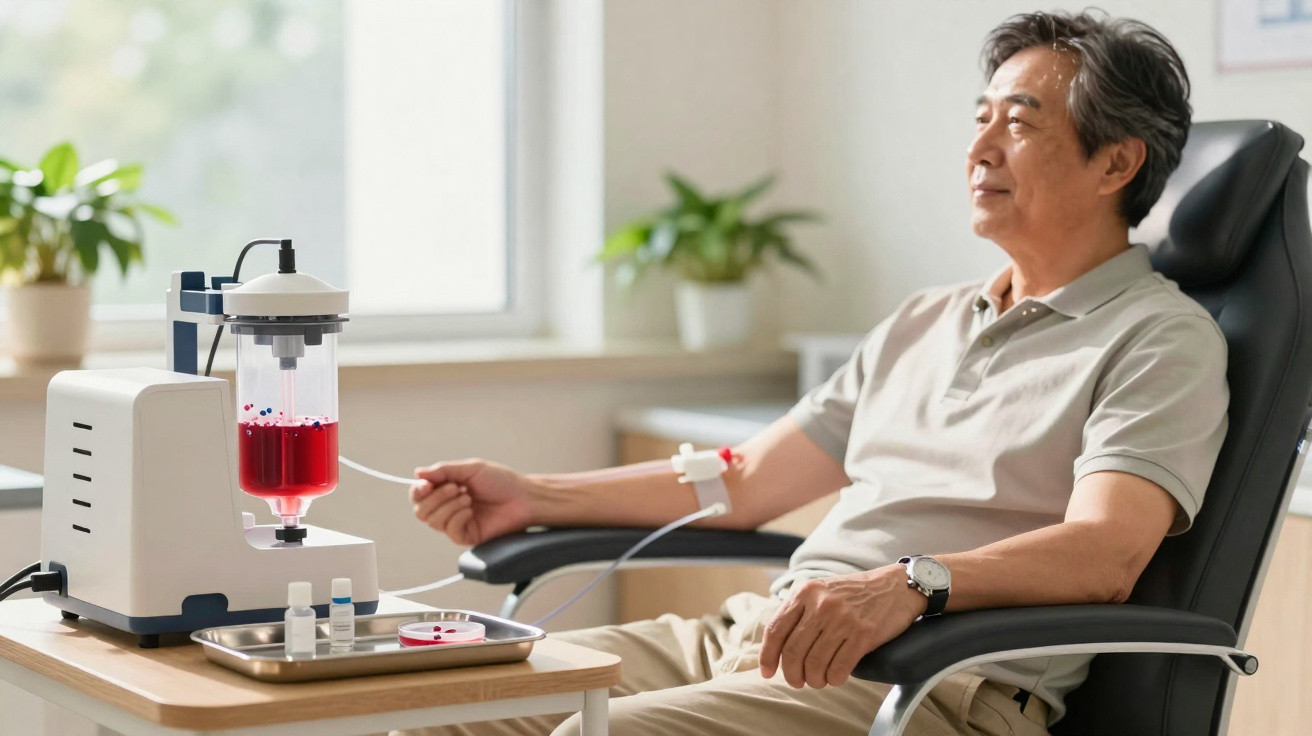
For decades, this machine has drawn blood from one arm, removed cholesterol and returned the blood to the body. The novel discovery is what it may remove alongside it: forever chemicals from the bloodstream.
Almost every person alive has forever chemicals in their body. Until now, there has been no practical means of extracting them from a living person.
Researchers at the world’s biggest apheresis centre report that its filters achieved this. The result is preliminary and based on small numbers, as the authors themselves emphasise.
PFAS and plastics travel on fats
More than 4,700 per- and polyfluoroalkyl substances, or PFAS, are either used commercially or present in the environment. Biomonitoring has detected them in the blood of over 99% of Americans.
Roughly 200 million Americans have encountered them through their drinking water. These compounds take between 4.8 and 8.5 years to halve in concentration, meaning exposure at age 30 can still be present at 40.
Plastic enters the body through a separate route. Estimates suggest people ingest 39,000 to 52,000 plastic particles annually, rising to 74,000 to 121,000 when inhaled particles are included.
Such particles have been identified in human blood, placentas, lung tissue and brains. Fat is the apparent connection between these two forms of pollution.
PFAS attach themselves to LDL and VLDL particles, which transport cholesterol through the body. They also adhere to plastic, doing so up to 250 times more easily when the plastic has been weathered outdoors.
The researchers’ next proposal is a hypothesis rather than an established fact: both pollutants may acquire a layer of plasma fats that allows them to remain in circulation. A filter designed to remove those fats might therefore remove the pollutants as well.
Blood treatment removes some PFAS
The established findings performed as anticipated. Among 34 patients assessed before and after two treatment sessions, C-reactive protein, fibrinogen, LDL cholesterol and lipoprotein(a) all dropped markedly.
The new evidence came from mass spectrometry. At a certified laboratory in Bremen, Germany, plasma samples from 14 patients showed reductions of up to 25% in four of the most prevalent forever chemicals.
A different laboratory assessed a further four patients after one session and recorded larger reductions: 48.9% for PFOS, 43.5% for PFOA, 55.0% for PFNA, and 75.8% for a longer-chain related compound, PFDoDA.
The compounds were also detected in the eluate, the portion separated by the machine and discarded. This is important because it indicates that the pollutants departed in the discarded fluid.
Stefan R. Bornstein of TU Dresden and University Hospital Carl Gustav Carus is the study’s lead author. His team started investigating after discovering that these pollutants are carried alongside lipids.
“We always assumed that in addition to lipids other factors may contribute to the surprising success of this treatment,” Bornstein told Earth.com. He says the laboratories found “a relevant and significant clearance of these toxins from human blood circulation.”
Microplastic evidence is less certain
The evidence becomes more limited here, which the authors acknowledge. Gas chromatography of blood samples from four patients found reduced polyethylene in every case and reduced polyvinyl chloride in three out of four.
Polypropylene showed the opposite pattern. It decreased in one patient, increased in two and was undetectable in the fourth. Polystyrene increased in the one patient in whom it was present, while one nylon decreased.
Two patients were additionally treated with a device that captures free genetic material in the blood. Afterwards, all detectable polystyrene and polypropylene had disappeared in one patient. In the other, the removed particles were polyethylene and PET.
With only two patients, the researchers describe the result as suggestive and set out a testable explanation. Some plastic in circulation may attach to DNA strands or cell debris, both of which this device can capture.
A third approach, conducted at Spain’s Germans Trias i Pujol Research Institute, stained particles from four patients and quantified them with flow cytometry. It found an average decline of about 70 percent.
That result requires considerable caution. It did not reach significance with a cohort of that size, while the stain labels fats generally and can therefore count particles without establishing that they are plastic.
Skin samples reveal plastic particles
Measurements in circulation tell only part of the story. Raman spectroscopy of human eyelid skin enabled the team to find polystyrene particles within tissue and map their location.
This ability could prove more significant than any individual figure in the paper. It makes it possible for a laboratory to identify and locate plastic present in a person’s tissue.
A second experiment examined whether that tissue burden causes damage. Human adrenal cells exposed to 30-nanometre polystyrene beads showed a trend towards cell death, measured through an enzyme released by dying cells.
Serum collected before a treatment session produced no change. Serum collected afterwards reduced that signal. The experiment was repeated three times, and the authors describe the finding as a trend rather than proof.
Charlotte Steenblock, the senior author, is based in the same Dresden department. She describes the change in thinking that these findings could bring about.
“For years we treated the lipoprotein as the disease,” says Steenblock. “If it proves to be a vehicle as well, the question shifts from whether we can measure these pollutants in people to what happens when we take some of them out.”
Apheresis has a long safety record
The Dresden programme itself is not experimental. Bornstein says it has treated people with inherited high cholesterol for 25 years and now carries out around 200 sessions each week.
According to his account, 70% to 80% of these patients have experienced no subsequent cardiovascular event, stroke or heart attack because the treatment so substantially removes cholesterol and lipoprotein(a).
That statistic reflects his clinical experience, rather than a finding from this paper. He describes the treatment as “far superior to all currently available medications” and says German insurers cover it as a “gold standard treatment.”
Published research generally reports mild, short-lived side effects, including low blood pressure, dizziness, tiredness, nausea and cramps caused by the anticoagulant.
“Therapeutic apheresis is an invasive treatment but has very little side effects and in more than hundred thousand treatments in our center we have rarely ever seen a major problem,” says Bornstein.
Study limitations temper the findings
The limitations section is notably frank. Sample groups are small, patient conditions and machine types differed, and the plastic tests are exploratory within a field that lacks validated methods.
Contamination is a real risk when plastic is the substance under investigation and it is also widespread in laboratories. This is not a randomised controlled trial, and no long-term outcome data are available.
As patients were not consistently matched across the datasets, the authors explicitly state that they cannot assert a single common removal mechanism.
The key qualification concerns timing. Every measurement reflects an immediate change in circulating material following the procedure, rather than the full quantity stored throughout the body.
An early reduction could be partly reversed as tissue stores release their contents. Several authors also disclose financial connections to firms producing apheresis equipment.
“We did not go looking for this,” says Bornstein. “It means the machine caught them. It does not yet mean the body is rid of them.”
Researchers plan larger follow-up studies
Standard plasma exchange replaces removed material with donor plasma, which can itself contain contaminants. The Dresden systems do not use replacement fluid, so nothing is introduced back into the blood.
Washington has taken notice. The Advanced Research Projects Agency for Health has begun a $144 million programme to measure and remove plastic particles from the body at an affordable cost.
Previous research had suggested that blood-filtering approaches might access these particles. The team now plans to expose large animals to labelled plastics and image them after treatment.
“More long-term studies will have to be implemented to show if this approach will become a specific treatment for patients with progressive cardiometabolic and neurometabolic diseases,” says Bornstein.
“None of this displaces the first priority, which remains preventing exposure,” says Bornstein. “Cleaning up afterwards is the harder and more expensive way to solve the problem.”





Comments
No comments yet. Be the first to comment!
Leave a Comment