
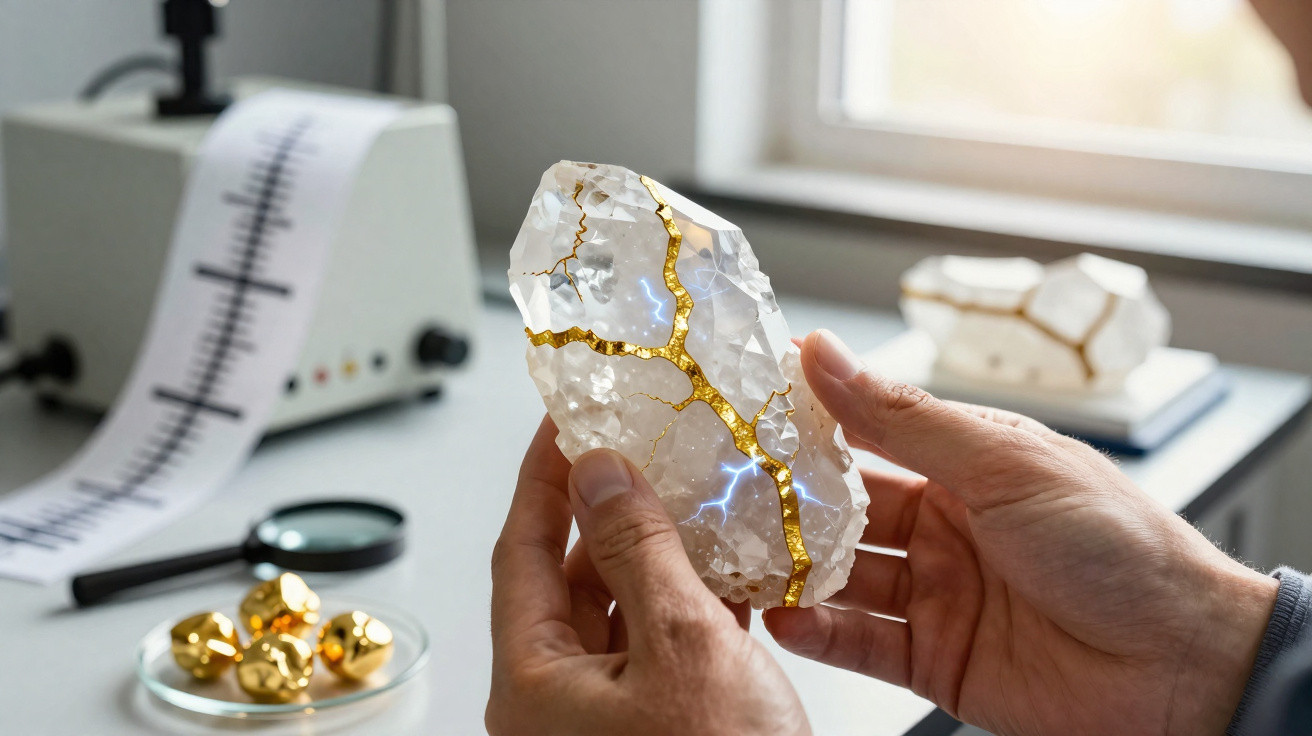
Break open a piece of white quartz from a gold mine and you may spot gleaming streaks of metal within it. For over a hundred years, geologists observing sights like this have said, “Gold got here in hot water.”
By this, they meant that extremely hot fluids travelled through fractures in the rock, transporting dissolved gold before depositing it as conditions altered.
The explanation accounts for much of what is seen, yet it presents a difficult question: these fluids normally contain only minute quantities of gold relative to the amount of water, so how can such a solution create sizeable nuggets within quartz, a mineral that reacts with very little?
Geologists are still troubled by that mystery.
Electric quartz and gold growth
Christopher Voisey, a geologist at Monash University, and colleagues from CSIRO and the Australian Centre for Neutron Scattering (ANSTO), explored a different element of the process: electricity produced by earthquakes may help gold accumulate in quartz veins.
Their work centred on quartz's piezoelectricity. When a quartz crystal is compressed, flexed or twisted, its atomic arrangement changes sufficiently to divide positive and negative charges.
This leaves one side of the crystal comparatively positive and the other comparatively negative, producing a voltage across it. Quartz watches use the same phenomenon, although in that case it is precisely managed by miniature electronic circuits.
Gold-bearing fault zones contain numerous quartz veins. Within them, rocks fracture, slide and grind against one another as tectonic plates shift. Earthquakes build and then release stress in the quartz, causing piezoelectric charges to emerge and disappear.
The researchers posed a straightforward question that could be tested: could these voltages move electrons, remove gold from solution and bind it directly to quartz surfaces?
Earthquakes, quartz and gold in the laboratory
To investigate, the researchers conducted a set of carefully controlled laboratory tests. They put quartz fragments into solutions containing dissolved gold, resembling hydrothermal fluids far below ground.
They then applied mechanical stress to the quartz to replicate an earthquake's abrupt pushing and pulling, before inspecting the crystal surfaces using high-resolution microscopes.
Metallic gold formed as bright dots, nanoparticle clusters and small pseudo-hexagonal crystals sitting on the quartz grains.
Such forms are consistent with electrochemical deposition, in which dissolved gold ions receive electrons and become solid metal on a surface.
Rather than only working with metal-free quartz, the team also used quartz already containing a small amount of gold, which better reflected a natural vein. In this arrangement, the tiny gold grains served as conductors in the system.
As stress generated an electric field in the quartz, those metal grains concentrated the field around themselves. New gold nanoparticles consequently tended to develop on and around the pre-existing grains, creating halos and dense clusters.
In these circumstances, the electrical charges could “plate” gold from the solution, with newly formed metal covering the quartz surface and increasing the thickness of the deposits.
From seed to gold nugget
Once even a minute gold “seed” is present, it becomes the favoured location for further gold plating during every stress event.
Because quartz is an electrical insulator, electrons cannot readily travel through its interior, making it difficult for nugget formation to begin from nothing.
Gold, by contrast, is a good electrical conductor. Once a small conductive grain has formed, it focuses the electric field at its surface and enables electrons to move efficiently exactly where they are required.
As these reactions proceed, the system takes on a “rich get richer” pattern, producing fewer but larger pieces of gold instead of numerous tiny ones.
In a separate experiment, the researchers placed quartz in a liquid containing gold nanoparticles.
After stressing the quartz, the particles no longer remained evenly dispersed through the fluid. Instead, they moved, accumulated and clustered into larger groups directly on the quartz surface.
“The results were stunning,” said study co-author Professor Andy Tomkins, from the Monash University School of Earth, Atmosphere and Environment.
“The stressed quartz not only electrochemically deposited gold onto its surface, but it also formed and accumulated gold nanoparticles,” Tomkins explained. “Remarkably, the gold had a tendency to deposit on existing gold grains rather than forming new ones.”
This behaviour indicates that electric fields surrounding stressed quartz can collect and concentrate mobile gold particles before they merge into a continuous grain.
Voltages in real quartz veins
In a fault zone packed with these veins and surrounded by gold-bearing fluids, every earthquake temporarily makes the system behave like an electrochemical cell.
Electrons build up on certain quartz surfaces, where dissolved gold species accept them and transform into metallic gold.
Complementary reactions take place on other surfaces, while charged ions in the fluid shift to restore charge balance.
Every “squeeze” – every earthquake – gives the quartz a small charge and causes a little gold to plate onto existing grains or new nucleation sites.
Gold from quartz and earthquakes
This electrical process does not overturn established models of gold formation. Hot fluids carrying gold must still pass through fractures under appropriate temperatures and pressures, while shifts in fluid chemistry continue to help separate the metal from solution.
The research introduces an additional stage: piezoelectric voltages generated during earthquakes direct gold growth towards selected locations in quartz, particularly where metal is already present.
Most of the world's substantial gold nuggets originate in quartz veins within orogenic gold systems, which have provided about three-quarters of all gold extracted throughout human history.
Across many such deposits, miners find large masses of metal in thick veins, rather than a light scattering of gold dust distributed throughout the rock.
“In essence, the quartz acts like a natural battery, with gold as the electrode, slowly accumulating more gold with each seismic event,” Dr. Voisey concluded.
The study indicates that seismic activity, through the repeated charging and discharging of quartz over geological time, may help account for the close association between gold and quartz, as well as the uncommon instances in which nature produces particularly large nuggets.
The complete study appeared in the journal Nature Geoscience.




Comments
No comments yet. Be the first to comment!
Leave a Comment