
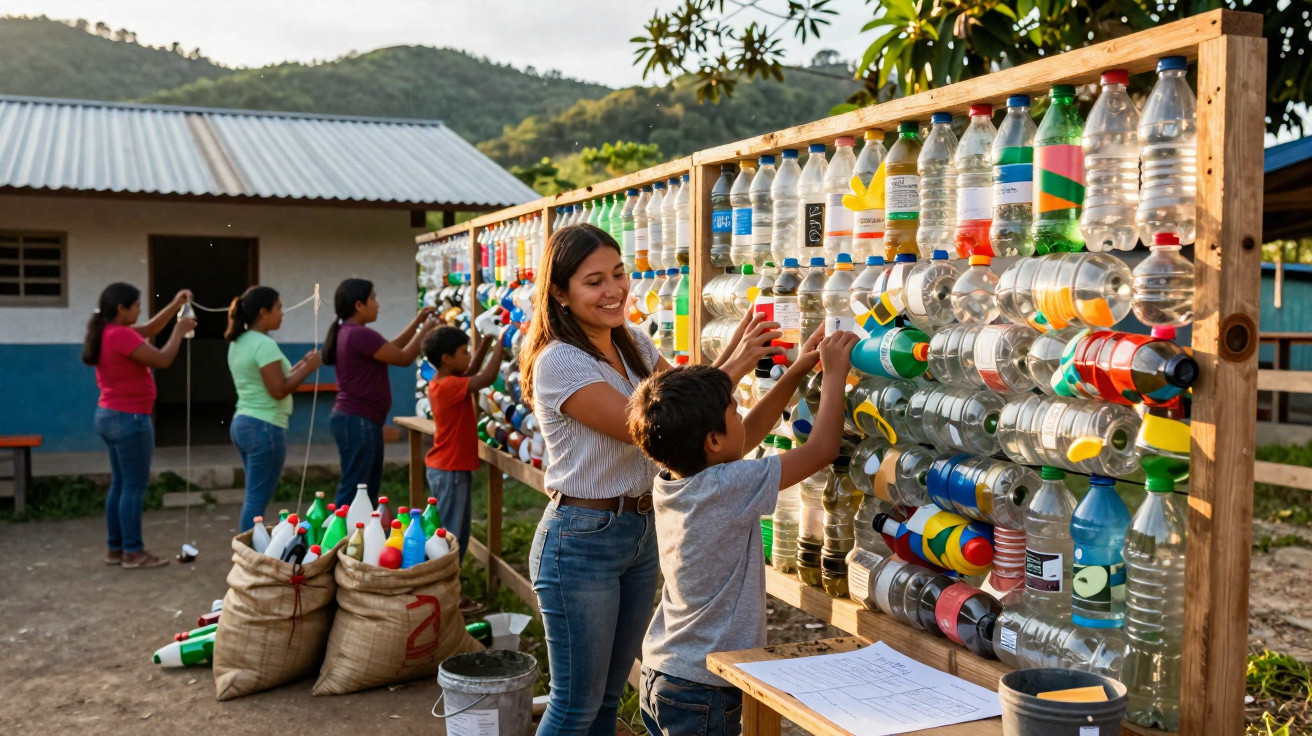
Since 2009, residents and volunteers have turned PET bottles and inorganic waste into wall infill for new classrooms in rural Guatemalan communities. Backed by the organisation Hug It Forward, the initiative has reportedly enabled 392 classrooms, bringing together education, material reuse and community-led work.
How are PET bottles made into eco-bricks?
The bottles are washed and dried before being filled with flexible inorganic materials that have no suitable local disposal route, including wrappers, carrier bags and food packets. The contents must be tightly compacted so that each bottle becomes rigid enough to be used within the walls.
- PET bottles are collected from within and around the community;
- Organic, wet or sharp waste must not be placed inside them;
- Plastic packaging is cleaned and compressed using a rod;
- Finished bottles are sorted according to size;
- Wire mesh holds the containers in place within the wall;
- Mortar covers the assembly and shields the materials from the elements.
Do PET bottle eco-bricks actually support the building?
The eco-bricks used in the classrooms are not a replacement for the building’s main structural framework. Foundations, columns and beams are made from concrete reinforced with steel bars, using the pillar-and-beam system. The bottles serve as infill between these structural components.
This difference matters because the building’s stability does not rely solely on compacted plastic. According to information published by the organisation itself, the structural method used in these projects has been approved for the earthquake conditions commonly found in Guatemala.
How do residents and children take part in construction?
Community participation begins before any building work starts. Families, pupils and teachers help gather bottles and waste, while adult residents join community work sessions alongside bricklayers and volunteers. The intention is for the school to be built with the community rather than simply handed over to it.
- Children and families collect discarded bottles;
- Waste is prepared and compressed inside the containers;
- Residents provide part of the necessary labour;
- Bricklayers manage the structural and technical stages;
- Volunteers help prepare and close the walls;
- The work encourages discussions about consumption and waste disposal.
How many bottles and how much money are required?
The number needed differs from one project to another. A single classroom may require thousands of bottles, depending on its dimensions, the shape of its walls and the sizes of bottles available. Records include one classroom built with more than 4,000 bottles, as well as projects with two or three classrooms that used between 6,500 and more than 10,000 bottles.
Costs also vary according to location, transport, labour and material prices. The organisation cites an average of roughly US$ 7,000 per classroom, while project partners have mentioned figures of around US$ 8,500. Even so, the approach may cost less than comparable buildings constructed entirely from concrete blocks.
What impact do the classrooms have on these communities?
These buildings provide places to learn in areas where pupils had faced makeshift classrooms, overcrowding or lengthy journeys. They also remove packaging from the environment that might otherwise be burned, left on streets or washed by rain into rivers and open land.
The method does not remove the need to reduce plastic consumption, nor does it eliminate the need to maintain the buildings. Just as it is important to know how to identify and control termites in wooden components, every school requires inspections for damp, cracks and deterioration. The project’s distinguishing feature is its ability to turn a local problem into environmental education, collective action and new opportunities to study.




Comments
No comments yet. Be the first to comment!
Leave a Comment