
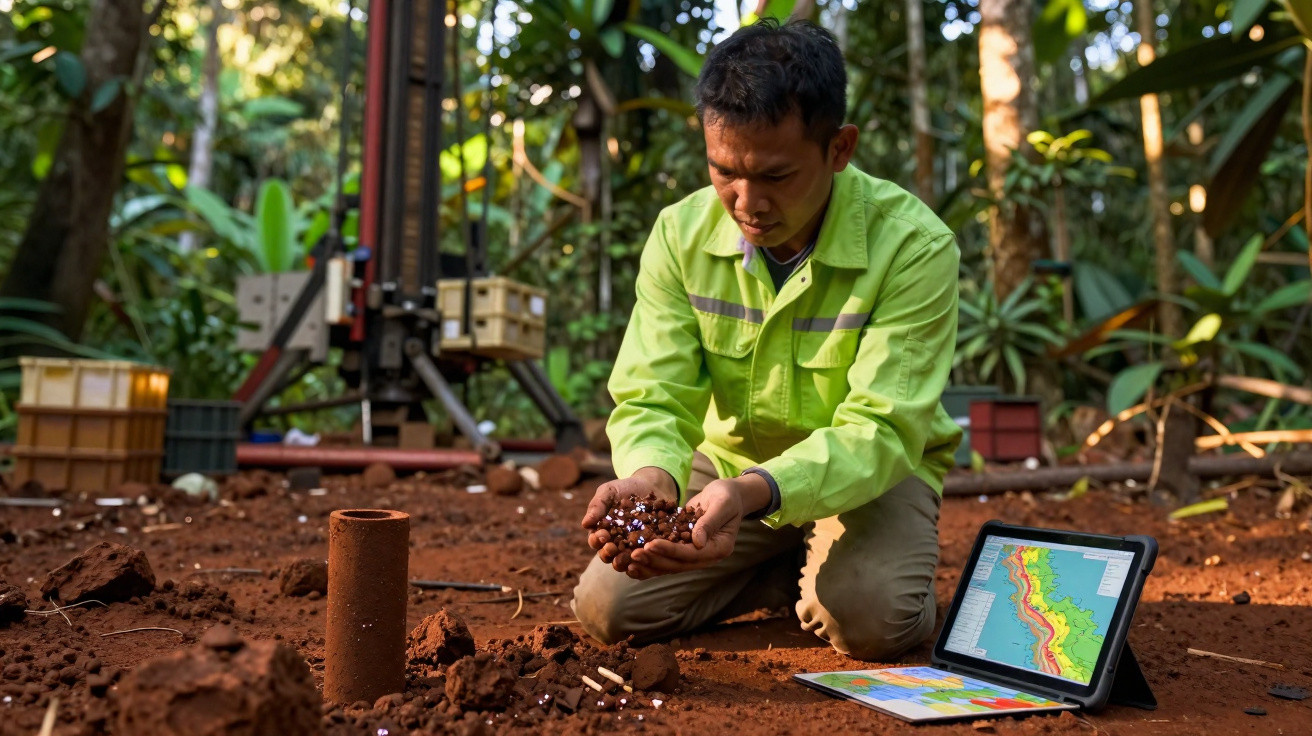
Scientists have now verified that Malaysia’s ion-adsorption clays hold substantial deposits of non-radioactive rare-earth elements.
This geological fact places valuable minerals beneath areas legally designated as permanent forest reserves.
Location of the rare-earth elements
Throughout Peninsular Malaysia, these deposits occur in weathered clay formations extending below broad tracts of wooded land.
Researchers working alongside the Ministry of Natural Resources and Environmental Sustainability (NRES) found that these clay strata contain notable rare-earth element concentrations in areas already classified as protected forest reserves.
Consequently, the nation’s most promising rare-earth resources are located in landscapes subject to stringent conservation protections.
This overlap creates a choice between immediate income and long-term environmental standing, before processing technology is even considered.
How the pilot operated
Perak’s pilot mine served as the national test case because it generated marketable material without the damage associated with open-pit mining.
The operation relied on in-situ leaching – a mining method that flushes ions from clay through an injected solution – instead of excavating ore.
Authorities tracked both surface water and groundwater throughout the work, while officials consistently said there were no significant signs of contamination.
Such outcomes increased interest in the pilot, while also intensifying calls to expand it before Malaysia has adequate midstream capacity.
Rare-earth element exports halted
Federal policy changed after leaders concluded that exporting raw materials kept Malaysia in the supply chain’s lowest-value segment.
NRES confirmed that a national moratorium – a temporary export prohibition intended to encourage domestic value addition – came into force on 1 January 2024.
Officials further stated that the moratorium would be assessed every six months, allowing it to be tightened or eased according to industrial preparedness.
Although this timetable appears adaptable on paper, miners have to work around chemistry and cash flow rather than policy schedules.
The stockpile issue
Operators say that, once injection has begun, halting work partway through can cause technical and environmental difficulties that persist for months.
Production may therefore continue to build up while exports are suspended, leaving material as stranded inventory.
These stockpiles also produce a troubling incentive, as a bag of concentrate may resemble standard mineral powder at a port.
Without a domestic Malaysian buyer, each additional tonne becomes both a financial exposure and a test of governance.
The midstream bottleneck
Malaysia’s principal limitation lies in midstream processing: the cracking and separation stages needed to produce high-purity oxides and metals.
China holds dominant large-scale capability in this area, explaining why many countries still send concentrates abroad for refining.
A recent examination of ion-adsorption clay rare-earth deposits outlines both the importance of these clays and the geopolitical impact of controlling processing.
Without more than one dependable midstream route, an export ban may seem less like a strategy than a bottleneck.
Lynas as a bottleneck
Malaysia is already home to Lynas, a significant processor outside China, making it the most obvious nearby option for policymakers.
In late 2023, Malaysia permitted Lynas to remain operational until March 2026 as the company worked on waste-related changes.
This gives Lynas value as both an industrial asset and a negotiating tool, since upstream miners need a customer able to refine their material.
However, depending heavily on one plant could simply reproduce reliance under a different flag.
Rare-earth elements within forests
Officials have recognised that the majority of mapped potential is located in forest reserves rather than readily accessible industrial sites.
That situation encourages governments to consider exemptions, pilot allocations or new methods that claim to reduce disturbance at the surface.
Even the most effective method presents enforcement challenges, since illegal miners can replicate the chemicals while avoiding safeguards.
Legal protections are in place, including Malaysia’s licensing requirement to report radioactive discoveries immediately.
Tracking and confidence
Regulators and advisers have considered traceability – supply-chain monitoring that tracks material from the ground to the customer – as a way to strengthen credibility.
It is important because overseas buyers increasingly seek evidence that production complies with environmental and labour standards.
However, traceability can also increase costs and slow processes, so it is viable only when it improves market access or pricing rather than merely adding paperwork.
Perak’s own planning papers reflected the same challenge, weighing the export moratorium against the need to maintain investor confidence.
What a hub requires
Malaysia’s long-term strategy requires more than mines, as a hub needs purchasers, refiners and manufacturers operating in a coordinated system.
Proposals for central purchasing are intended to avoid stranded stockpiles, but they also depend on transparent pricing rules and rigorous custody controls.
Skills development is equally an industrial-policy issue, because midstream operations and magnet production require engineers, chemists and process specialists in substantial numbers.
A regional hub appears possible, but only if Malaysia brings forest conservation, mining permits and midstream investment schedules into alignment.
What comes next
Malaysia has a genuine rare-earth advantage, but its greatest restriction is not its geology; it is its capacity to turn clay into high-value products.
Future progress depends on whether domestic midstream capacity is established before stockpiles, forest disputes and investor uncertainty alter the entire plan.
Information from an analysis in The Asean Frontier.





Comments
No comments yet. Be the first to comment!
Leave a Comment