
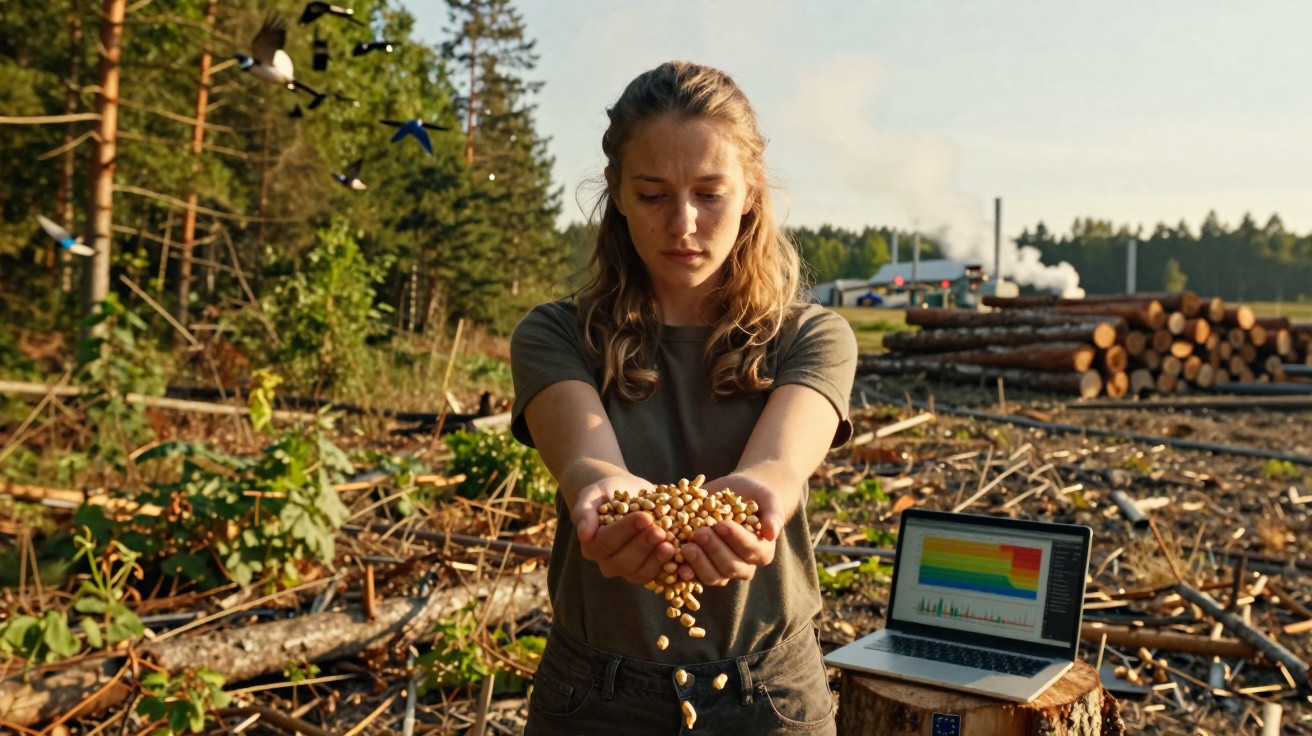
Trees absorb carbon from the atmosphere, as is taught in basic secondary-school science. When trees are burned, however, that carbon dioxide returns to the air.
Even so, the US, the UK and the European Union (EU) still classify wood-burning as a "carbon-neutral" renewable energy source, placing it alongside solar and wind power.
The carbon-neutral wood-burning debate
This so-called "emissions loophole" is considerably more complex and disputed than it first seems.
Some forest scientists maintain that emissions from burning wood can be offset by planting new trees. Others argue that the practice will worsen climate change.
Although further research and debate are clearly needed, the EU and the US are pressing ahead with an option they regard as a carbon-neutral substitute for fossil fuels.
The relatively obscure wood pellet industry is now expanding rapidly, with the EU responsible for much of the demand. In 2009, the bloc first classified forest biomass as "carbon neutral."
That ruling triggered a domino effect: electricity generated from biomass in the EU rose by 51 percent between 2009 and 2016. In 2015, the EU used 80 percent of the world’s wood pellets, chiefly to generate electricity.
The EU now relies substantially on wood-burning to achieve its Paris carbon-emissions targets. It has become the bloc’s biggest renewable energy source, ahead of both wind and solar.
US wood pellet exports to Europe
In turn, the US has become the EU’s leading wood pellet supplier, exporting almost a billion dollars’ worth to Europe each year. The south-eastern US alone produces 98 percent of all pellets exported by America.
Yet as the EU and US place their hopes in this growing industry, its environmental consequences remain contested. It is still unclear whether burning wood genuinely qualifies as "carbon neutral."
The reasoning is that, provided at least as many trees are planted as are felled, the carbon taken from and later released into the atmosphere will eventually balance out.
Supporters of the wood pellet industry say forest replanting makes it renewable. They also contend that it gives landowners an incentive to replant trees and maintain healthy forests.
Forest biomass, coal and carbon storage
Although wood-burning can be carbon neutral in certain circumstances, such as when businesses replant the same tree species, it can be more harmful than coal in others.
Transporting wood pellets from the US to Europe requires large amounts of energy and accounts for 25 percent of the total carbon emissions linked to biomass energy in Europe.
Some studies have additionally concluded that power stations fuelled by forest biomass emit 15 to 20 percent more carbon dioxide than those fuelled by coal.
Scientists and environmentalists also fear that, without strict regulation, the industry could damage biodiversity and carbon storage.
"The big problem is you're cutting old-growth forests and expecting them to regrow," said William Schlesinger, president emeritus of the Cary Institute of Ecosystem Studies and an EPA Science Advisory Board member.
"That's totally unrealistic in 20 years and not guaranteed over 100 years."
Put another way, the approach is sustainable only over a long timescale. As climate change accelerates, the world does not have an abundance of time.
Forests contain vast quantities of CO2, stored both in timber and soil. Burning the wood plainly releases greenhouse gases, while disturbing the soil does too; soil holds twice as much CO2 as trees.
While certain studies estimate that the industry could expand pine plantations, they also found this would happen at the expense of natural timberland forests. Research in turn indicates that timber plantations store less carbon than natural forests.
None of this research has changed the position of the US Environmental Protection Agency (EPA).
The agency has not completed a comprehensive assessment, but a 2012 memo found that "it is not scientifically valid to assume that all biogenic feedstocks are carbon neutral" and said any such judgement needed further analysis.
Despite the lack of further analysis, EPA administrator Scott Pruitt announced in April 2018 that the agency would classify the burning of forest biomass as carbon neutral.
Some scientists view this as another instance in which Pruitt has prioritised industry interests over environmental concerns.
"Once again," said Sami Yassa, a scientist with the Natural Resources Defense Council (NRDC), "here [Pruitt is] dismissing established science to give a free pass to his industry pals to pollute."
This week, the EU said it would continue to classify wood-burning as "carbon neutral."
The statement came despite a warning from almost 800 scientists, among them Nobel Prize winners and recipients of the US Medal of Science.
The scientists cautioned that "the expansive eligibility for forest biomass in the EU's Renewable Energy Directive would likely lead to increases in greenhouse gas emissions for decades, quite plausibly lead to an additional harvest of wood equal to all of Europe's present harvest, and seriously threaten European and global forests."





Comments
No comments yet. Be the first to comment!
Leave a Comment