
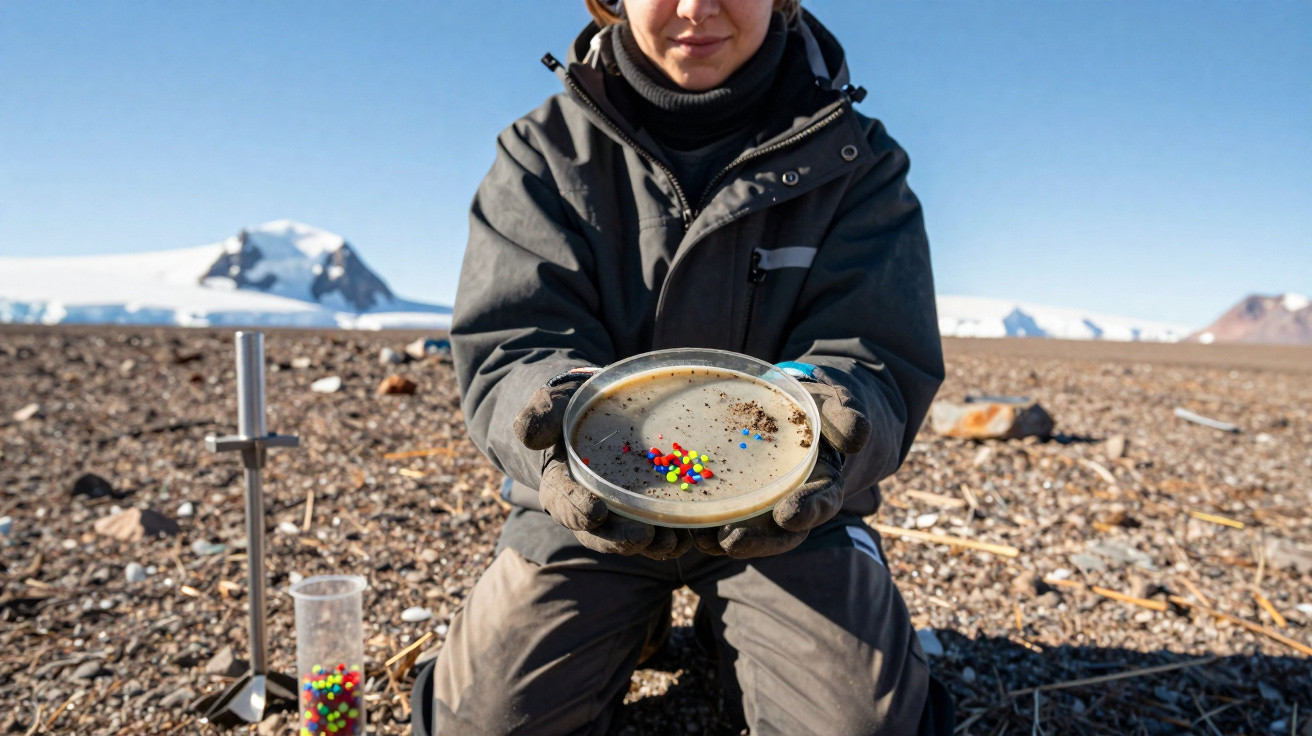
The McMurdo Dry Valleys of Antarctica rank among Earth’s most distant and unspoilt settings, yet their soils are no longer devoid of plastic.
Scientists have identified microplastics and nanoplastics in soil taken from across the Antarctic region, with some particles found below the ground’s surface.
These results demonstrate the extraordinary extent of plastic pollution, which has now reached one of the world’s most isolated landscapes.
The finding also prompts fresh questions about the consequences for vulnerable polar ecosystems.
An international research team headed by Lancaster University carried out the study.
Soil samples gathered in January 2023 contained a broad variety of plastics in the Dry Valleys.
The researchers found polypropylene, polyethylene, PET, polystyrene, polyvinyl chloride and tyre-wear particles.
Antarctica’s overlooked plastic problem
Plastic pollution has long been recognised as a worldwide issue, while larger plastic debris and microplastics had previously been detected in waters surrounding Antarctica.
Far less scrutiny, however, had been given to the land itself. Soil was largely a blind spot in the research.
As a result, there was a significant lack of understanding about how widely plastic contamination had spread across the continent’s terrain, rather than only through the adjacent ocean.
This omission was more important than it may initially appear.
Antarctic soil is among the closest examples of an environment unaffected by direct human activity.
It therefore provides a crucial test of whether plastic pollution has truly crossed every boundary, or whether any parts of the planet remain untouched.
Microplastics and nanoplastics across the McMurdo Dry Valleys
Plastic was present in topsoil from thirteen separate sampling locations, with nanoplastics in particular detected in 54 percent of those topsoil samples.
When they examined deeper layers, the team also identified nanoplastics in lower soil at half of the sites tested, albeit at lower levels than in soil nearer the surface.
Such contamination would not have been found without relatively recent advances in laboratory technology.
The scientists used a recently developed approach known as thermal desorption-proton transfer reaction-mass spectrometry.
This method can identify plastic particles so tiny that earlier detection techniques would have missed them entirely.
How plastics reached Antarctica
The precise route by which these plastics arrived remains uncertain. The researchers believe the pollution is likely to come from several sources.
Some material could originate from research stations in Antarctica, whereas other particles may have travelled vast distances through the atmosphere before being deposited in the soil.
Considerably more work will be needed to establish the contribution of each source and the potential effects on an ecosystem with almost no previous exposure to plastic.
The study’s lead author, Nhu Phan, undertook the research while completing a Ph.D. at Lancaster University.
“This evidence shows that soils in one of Earth’s most pristine environments are not exempt from plastic contamination,” said Phan.
“:These findings highlight the urgent need to study plastic fate, transport, and ecological impacts in polar regions.”
The risks for polar life
The team has serious concerns about the implications for Antarctic ecosystems.
Polar habitats could be more susceptible to plastic contamination than warmer areas. Their invertebrates generally have slower metabolisms and develop at a slower pace.
These characteristics usually leave animals less able to adapt and more susceptible to unfamiliar chemical stressors they have never previously encountered.
“Our findings raise concerns regarding the global reach of plastic contamination,” said co-author Crispin Halsall from Lancaster University.
“It is unclear whether ultrafine nanoplastic particles have arisen through direct long-range atmospheric transport from afar, or through the weathering of larger plastic debris found in marine areas along the Antarctic coastline.”
Should the plastic largely be locally sourced, improving clean-up at research stations and strengthening waste procedures on the continent could make a genuine difference.
Yet if wind is transporting it from around the world, local clean-up efforts alone cannot be sufficient.
The response would need to operate on a far larger scale, addressing plastic at every point where it originates.
Plastic pollution knows no borders
The researchers say their evidence underlines the urgent requirement for stronger international collaboration to cut plastic emissions globally.
They also urge more rigorous waste management practices within Antarctica.
This dual approach follows logically from their results. Plastic pollution discovered in this way is not confined to a single isolated Antarctic valley.
Instead, it signals how completely plastic has entered the planet’s systems, extending even to locations that most people will never visit.
The results confirm that plastic pollution can no longer be considered a local issue.
It has instead become something approaching a permanent aspect of the modern world, from which even Earth’s most remote, ice-bound places are no longer protected.



Comments
No comments yet. Be the first to comment!
Leave a Comment