
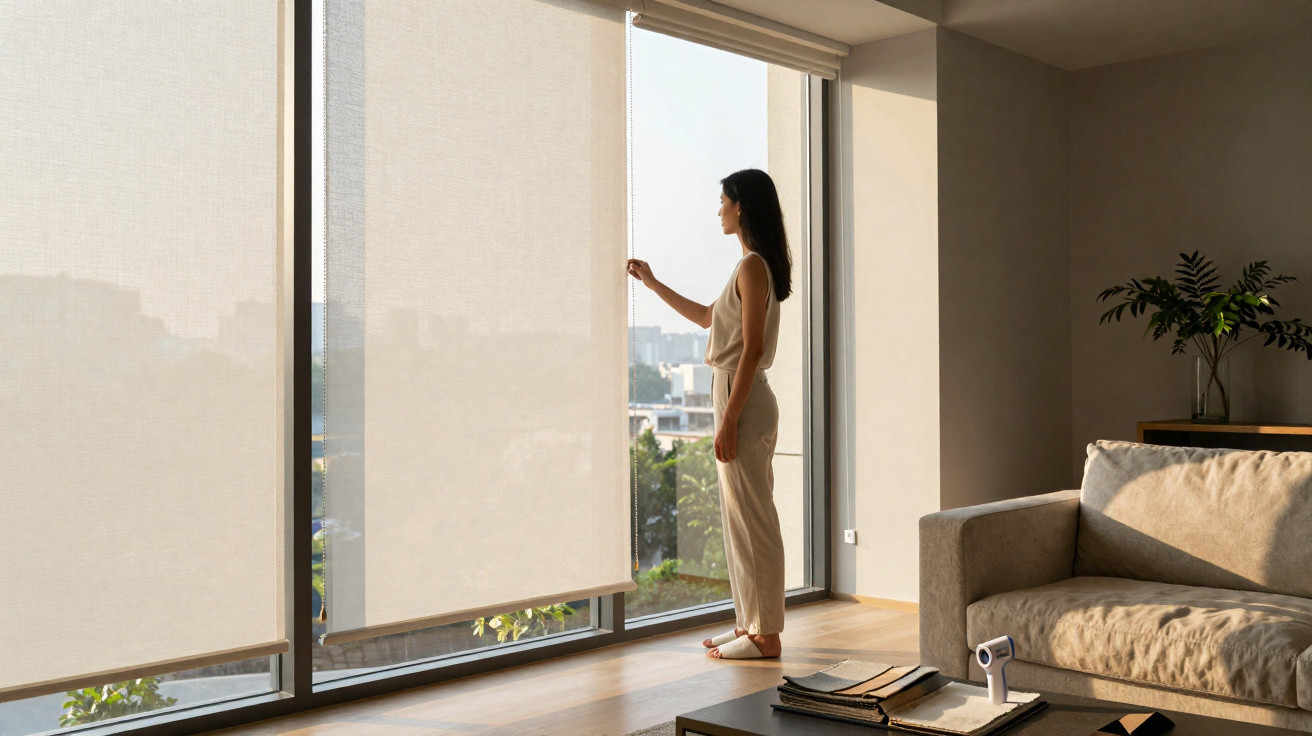
By 5 pm, the living room already feels like a greenhouse. Sunlight pounds through the patio doors, the fan merely stirs warm air, and the heavy thermal curtains, closed since morning, make the room feel even more oppressive. We all know that dilemma: live in semi-darkness or put up with the heat. Yet a solution once largely confined to upmarket hotel rooms has recently been making its way into flats: screen fabric, a technical textile fitted to a discreet blind. Less visually heavy and often more effective indoors than double curtains, it transforms the light without making the windows feel barricaded. It also has a few unexpected benefits.
Screen fabric: the discreet textile long used in hotels
In newer hotels, large heavy curtains have not vanished entirely, but they often conceal an ultra-slim roller blind installed close to the glass. Its material, known as screen fabric, is woven from fibreglass or polyester yarns, usually PVC-coated, to filter sunlight while retaining a view outside. From a distance, it can look almost like a plain sheer. Up close, however, its weave reveals technology designed to withstand UV exposure, temperature changes and repeated use.
The appeal often becomes clear after spending a first night in a well-positioned hotel room: daylight enters on waking, yet the room is not stifling. One family living in a through-flat in Lyon replaced their dark beige thermal curtains with two 3% openness screen blinds. During the July heatwave, their living-room thermometer recorded temperatures up to 3 °C lower during the hottest hours, based on their own readings. It is not magic, but in a west-facing room, that modest difference is immediately noticeable.
The main distinction lies in the way light is handled. A conventional thermal curtain can block some radiation, but when installed indoors it also traps heat between the fabric and the window. Screen fabric filters part of the sun’s radiation before it spreads through the room, while still allowing air to circulate around it. Visual comfort improves too: there is less glare on screens, fewer reflections on the table, and the welcome feeling that you are not living behind drawn curtains in broad daylight.
How to choose the right screen blind model
Before ordering, assess the orientation of each window instead of selecting the same fabric throughout the home. For south- or west-facing glazing, a low openness fabric - 1 to 3% - will block more direct sunlight and reduce visibility from outside. An openness factor of 5% or more is better suited to a cooler room where maintaining a clearer view is the priority. The blind should extend well beyond the glazing, ideally by a few centimetres on either side, as sunlight has a habit of finding its way through even the smallest gaps.
A common mistake is to confuse screen fabric with a blackout blind. The former reduces heat and glare, but will not necessarily make a bedroom completely dark. To sleep without being woken at dawn, choose blackout fabric or add a second curtain. Let us be honest: nobody raises and lowers solar shading with clockwork precision every day. A motorised, programmable or simply easy-to-operate model will be used far more frequently than a complicated system.
The right option also depends on the glazing, insulation and whether exterior shading is already in place. An indoor screen fabric can noticeably improve comfort, but it does not fully replace a roller shutter, external venetian blind or awning fitted outside, all of which stop the sun before it reaches the glass. The most effective protection is ultimately the one you are happy to look at and use every day. As installers often put it:
“We are not trying to remove the light; we are trying to stop the sun from taking over the room.”
- Choose 1 to 3% openness for highly exposed elevations;
- Favour light or metallic shades on the window-facing side to reflect light more effectively;
- Measure the full width of the frame, not just the glazed area;
- Check the blackout level before buying for a bedroom.
A change in décor that also reflects our relationship with heat
The popularity of this hotel-inspired material is not solely down to practicality. It reflects a very real weariness with longer summers, heavily glazed homes and worrying air-conditioning bills. Thermal curtains still have their place in some older houses, helping retain warmth in winter or creating a cosy atmosphere. In a modern living room, however, they can soon feel bulky, difficult to wash and poorly suited to July daylight. Screen fabric provides a lighter answer, almost invisible when raised, without making unrealistic promises.
| Key point | Detail | Added value for the reader |
|---|---|---|
| A material from the hotel sector | Screen fabric is a filtering technical textile, often used for roller blinds. | Reduce glare without having to live in darkness. |
| Effectiveness depends on orientation | Openness factors of 1 to 3% are better suited to south- and west-facing windows. | Select a protection level suited to every room. |
| A solution that may need complementing | An indoor blind does not always replace external solar shading. | Avoid exaggerated promises and genuinely improve summer comfort. |



Comments
No comments yet. Be the first to comment!
Leave a Comment