
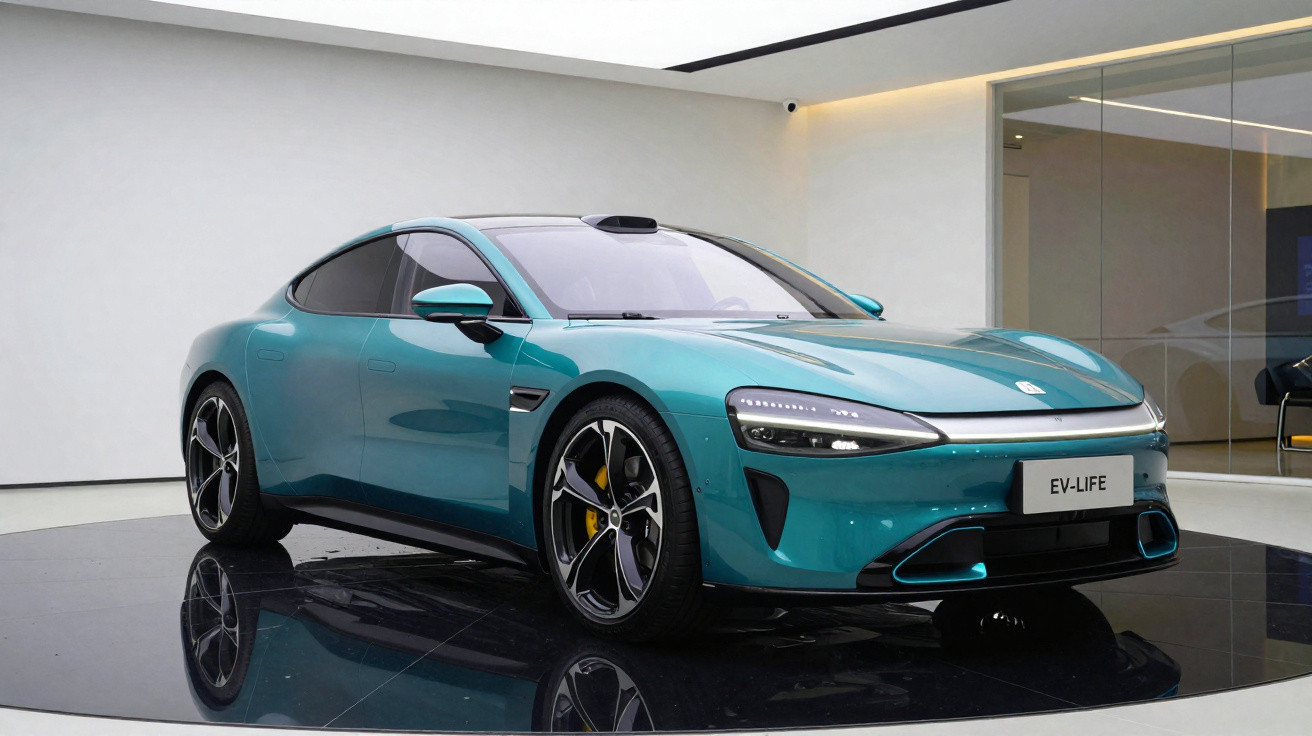
Being trapped behind an overly cautious motorist is frustrating, but driving as though you value staying alive may have a real advantage after all.
Treating your car as if you had to get there yesterday is known to speed up vehicle wear and tear. For electric-vehicle (EV) owners, there may be an additional consequence to consider.
A new assessment of battery-powered EVs in real-world use indicates that aggressive driving can hasten battery degradation. The effect is not trivial: the harshest driving style could lead to roughly 2.5 times the battery-capacity loss associated with the gentlest eco-driving approach.
“This result,” writes a research team at Shanghai Dianji University in China, “demonstrates that optimizing driving style is an effective way to alleviate the aging of power batteries and extend cycle life.”
The findings were published in Scientific Reports.

EV batteries and gradual capacity loss
As EV sales increase worldwide, the lithium-ion batteries powering them are becoming an ever more significant component of the global vehicle fleet.
A lithium-ion battery does not simply stop working once it reaches a specified number of charges. Rather, its capacity to hold charge slowly declines over time compared with when it was new. An EV that initially offered 100 percent of its usable capacity, for example, may ultimately retain just 80 percent.
This means fewer kilometres from a full charge. Battery degradation can also influence matters such as vehicle performance and residual value.
Although an EV battery can be replaced, doing so is far from cheap. It is estimated to account for a quarter of a vehicle's total retail cost.
Some loss of battery life is both normal and inevitable: it results from time and use. However, researchers Hao Cheng, Zhongwei Gu, and Wangqiang Gao set out to determine how much of that degradation might be linked to driving style.
How the EV driving data were analysed
The team examined a complete year of real driving data, collected in 2022 from 15 EVs in Guangzhou.
The vehicles were used in ordinary urban, suburban, and motorway environments across the year, with usage information recorded every 10 seconds.
The researchers arranged the data into 60-second segments containing vehicle speed, battery current, state of charge, voltage, and temperature. These segments were then used to classify how each car had been driven into five categories.
Speed, current, and state of charge were the principal measures for identifying patterns that showed how gently or aggressively drivers accelerated and decelerated, alongside the overall intensity of driving.
Eco-driving represented the smoothest category. At the other extreme, the most aggressive category involved drawing exceptionally high electrical current from the battery, including repeated demands for high torque at comparatively low speeds.
The researchers then calculated how these driving styles affected overall battery capacity.
Instead of merely searching for links between variables such as acceleration and battery strain, they created a machine-learning framework to isolate the effects of driving behaviour from other influences on battery ageing - especially the battery's initial charge level, temperature, and the amount of time spent idling.
Aggressive driving and EV battery ageing
At the most extreme end, the harshest driving style had the strongest and most immediate battery effect: it generated 18.4 times more ageing stress than eco-driving.
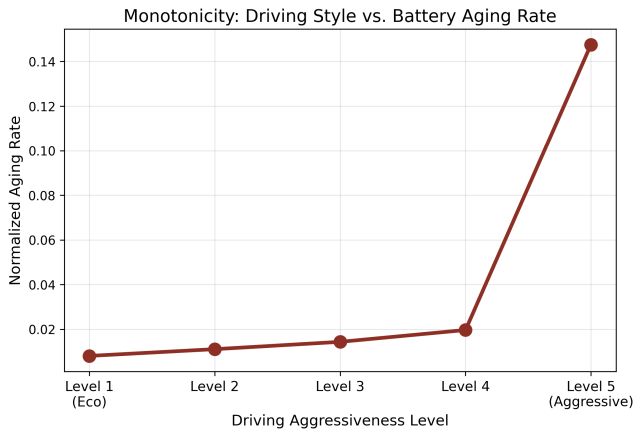
Battery ageing rises as driving becomes more aggressive, with an especially dramatic increase for the most aggressive driving style. (Cheng et al., Sci. Rep. , 2026)
That figure describes immediate stress rather than a forecast of long-term degradation. To estimate the latter, the team entered the characteristics of each driving style into a battery-ageing model and calculated the expected capacity loss after 1,000 charge-discharge cycles.
The contrast was striking.
Under the smoothest driving style, the battery lost 21.15 percent of its maximum capacity after 1,000 cycles.
For the most aggressive style, the loss was a substantial 53.22 percent.
The researchers found that hard acceleration and braking, together with excessive demands for battery current, accounted for the difference.

The aggressive and eco-driving groups had similar average speeds. Yet the extreme aggressive-driving group drew an average RMS current of 66.02 amps, versus 20.56 amps for the eco-driving group.
Related: The Data Are Finally In: Electric Cars Really Do Produce Less CO2 Pollution
The team also modelled a scenario in which all other driving data remained unchanged but driving behaviour alone shifted from aggressive to eco-driving. Short-term battery stress fell by 91.3 percent.
This final degradation rate remains a prediction. The researchers did not have battery-life data spanning 1,000 charge cycles for any of the driving groups.
Nevertheless, several separate parts of the analysis support the same conclusion: making greater demands of an EV battery appears to make it age more quickly.
For the time being, EV drivers may be able to extend the life of an expensive battery by easing off the accelerator a little.
The research has been published in Scientific Reports.
This article was fact-checked by Fiona MacDonald and edited by Fiona MacDonald. Although we take pride in our process, we are only human. If you notice an error, please tell us.





Comments
No comments yet. Be the first to comment!
Leave a Comment