
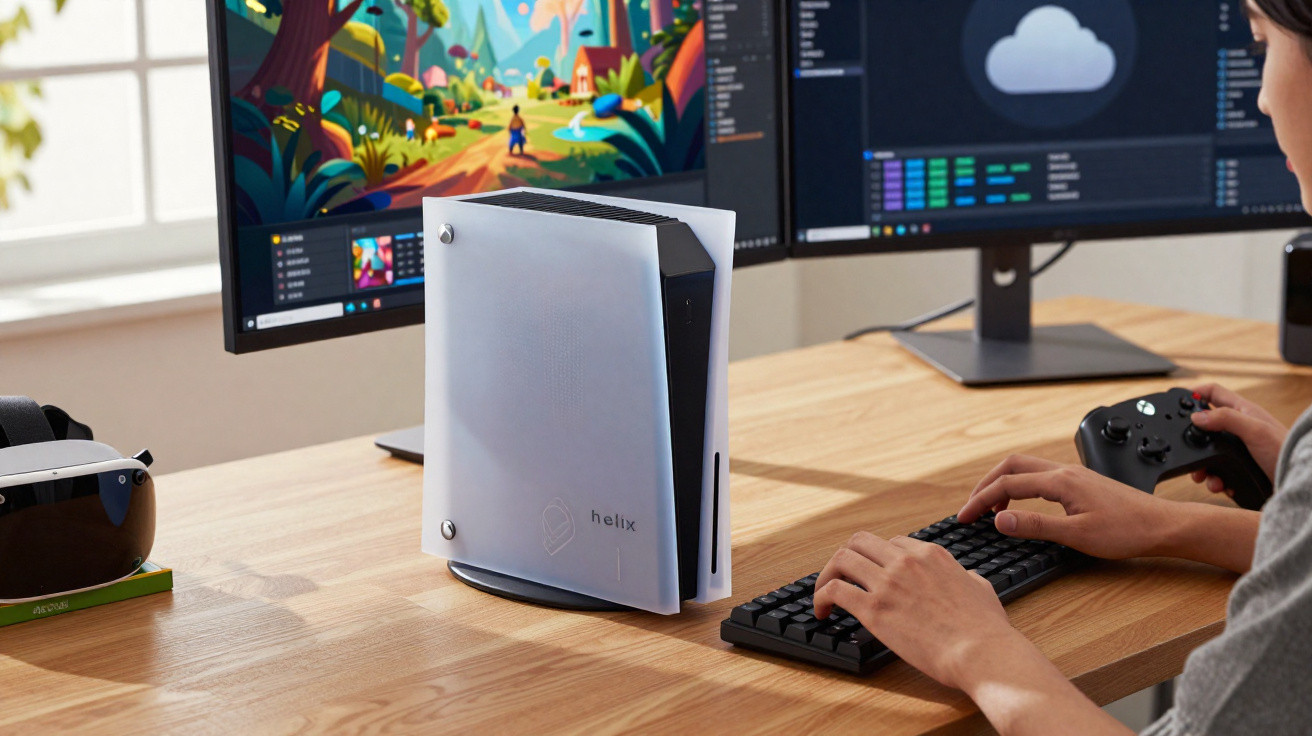
At the Game Developers Conference in San Francisco, Microsoft has published images of a mysterious device for the first time, setting the gaming world buzzing. Officially, it is a development machine for studios; unofficially, many see it as the first tangible sign of “Project Helix”, the next Xbox generation with PC DNA.
What Microsoft actually showed
The images appeared via the official “Microsoft Game Dev” account. They show a black-and-white unit clearly labelled “XDK”, short for Xbox Development Kit. Machines like this are normally found only in game developers’ offices and rarely become public.
The hardware shown appears to be a next-generation Xbox development kit – but Microsoft is being notably tight-lipped.
Based on the photographs, industry observers have classified the device as follows:
- Its form factor clearly recalls earlier Xbox dev kits.
- The casing strongly resembles the kit for “Project Scorpio” (Xbox One X).
- Its labelling and ports point to professional studio use.
Microsoft officially describes it only as hardware “in development”. The company avoids any direct reference to a new console, while leaving ample room for speculation. That is precisely what is fuelling debate on forums and social media.
Project Helix: more than another Xbox
The codename “Project Helix” has been circulating in leaks and internal documents for some time. Only recently, Asha Sharma, Microsoft’s new head of gaming, referred publicly to the project. Based on information available so far, Helix is not simply intended as a conventional new console generation, but as a genuine hybrid solution.
The central idea is an Xbox that is technically even more closely aligned with a Windows PC, bringing the two worlds together more tightly. Rather than creating a separate platform as it did in the past, Microsoft aims to make the boundary between console and PC almost disappear.
Project Helix is regarded internally as a hybrid of an Xbox console and PC – with substantially closer ties to a conventional computer than before.
What the Project Helix hybrid concept could involve
The clues known so far suggest several objectives:
- Improved compatibility with PC games: Bringing games from Windows to the new Xbox could become faster and less expensive.
- Related architecture: The CPU and GPU design is expected to align more closely with PC standards.
- Game Pass integration: Subscribers should be able to move seamlessly between PC and console.
Microsoft has spent years positioning Xbox as part of a broader ecosystem in which PC, cloud and console converge. Helix could be the first time that approach is consistently built into the hardware.
Why GDC was the ideal moment for the teaser
The Game Developers Conference is less a showcase for fans than an industry gathering for programmers. It is a place for technologies, tools and early prototypes rather than necessarily finished products. For Microsoft, it is an ideal venue for gauging studio interest.
Publishing the images looks like a calculated trial balloon. Microsoft has shown enough for everyone to talk about “the next Xbox”, but explained just little enough to leave room for a major reveal later. The tactic is familiar from earlier generations, when dev kits circulated long before an official announcement.
Above all, the images send one message: “The next Xbox is coming – and developers can start preparing for it.”
A signal for developers, a lure for fans
For studios, clues of this kind are extremely valuable. They can assess early on:
- what level of hardware performance to expect;
- what technical foundation is planned (PC-like design, cloud focus, streaming);
- how worthwhile investment in the Xbox ecosystem may be.
At the same time, fans gain an initial, if blurred, view of the brand’s future. The combination of a clearly recognisable Xbox dev kit and missing details creates discussion – exactly what Microsoft needs in the current transition year.
Xbox in transition: why Helix matters so much
The timing is no coincidence. The Xbox division is in a delicate period. Major acquisitions, internal restructuring and the departure of well-known leaders have unsettled the community. At the same time, pressure is growing from strong competitors in the console market.
In this situation, Microsoft needs a convincing signal: the platform is alive, new hardware is coming, and it is meant to be more than a straightforward performance upgrade. Project Helix fulfils precisely that role as a source of hope, even if only fragments have been visible so far.
For Microsoft, the next Xbox is not merely a new device, but a test of whether its own strategy truly works.
What a PC-like Xbox could mean for players
The concept of a hybrid console has very practical implications for users. Several scenarios are already clear:
- A more unified games library: Titles that run on Windows could reach the new Xbox more quickly.
- Better mod and community support: The closer the hardware is to a PC, the easier it becomes to adapt established tools.
- Greater upgrade flexibility: Modular approaches are conceivable, such as expandable storage or upgradeable components.
- A stronger cloud focus: A PC-like architecture works well with streaming services and Remote Play features.
Questions also arise, however: how much of the new Xbox will remain “Plug & Play”? How complex will settings and updates become if it is modelled even more closely on a PC? This balance will determine whether Helix appeals equally to core gamers and casual players.
Why dev kits matter so early
To outsiders, a development device may look unremarkable. In practice, though, this is where the next generation begins. Studios often use such kits years before launch to adapt engines, test prototypes and explore performance limits.
| Phase | Importance of the dev kit |
|---|---|
| Early development | Fundamental technical testing, engine adjustments, initial tools |
| Pre-launch | Optimisation, refinement, use of specific console features |
| After release | Patches, DLC and ports from PC or other consoles |
The fact that Microsoft is already showing images of an XDK with presumed Helix technology suggests that the hardware has at least reached a stable prototype stage. Specific specifications remain under wraps, but the real message is that developers can gradually start tailoring their projects to a new generation.
Context: hybrid console, Game Pass and the role of the cloud
The term “hybrid console” is often misunderstood. In the context of Project Helix, it is less about a handheld device and more about the close integration of:
- a traditional home console beneath the television;
- a Windows PC with a similar architecture;
- cloud infrastructure through which Game Pass titles are streamed.
For players, this could mean that a Game Pass subscription will cover all platforms even more seamlessly in future. Someone who starts on a laptop while away could continue on the Helix console in the evening – ideally with the same save file and features. This brings Microsoft a step closer to its vision of making hardware secondary and placing access to the service first.
At the same time, the strategy carries risks. Too much emphasis on subscriptions could unsettle buyers who prefer to own games in the traditional way. And, for all its flexibility, PC-like hardware must not lose what has defined consoles for decades: switch on, choose a game, and play.
The success of Project Helix will be decided by this very tension. The images published now show only a casing bearing an XDK logo – yet behind it lies a fundamental change of direction that could shape the Xbox brand for years to come.




Comments
No comments yet. Be the first to comment!
Leave a Comment