
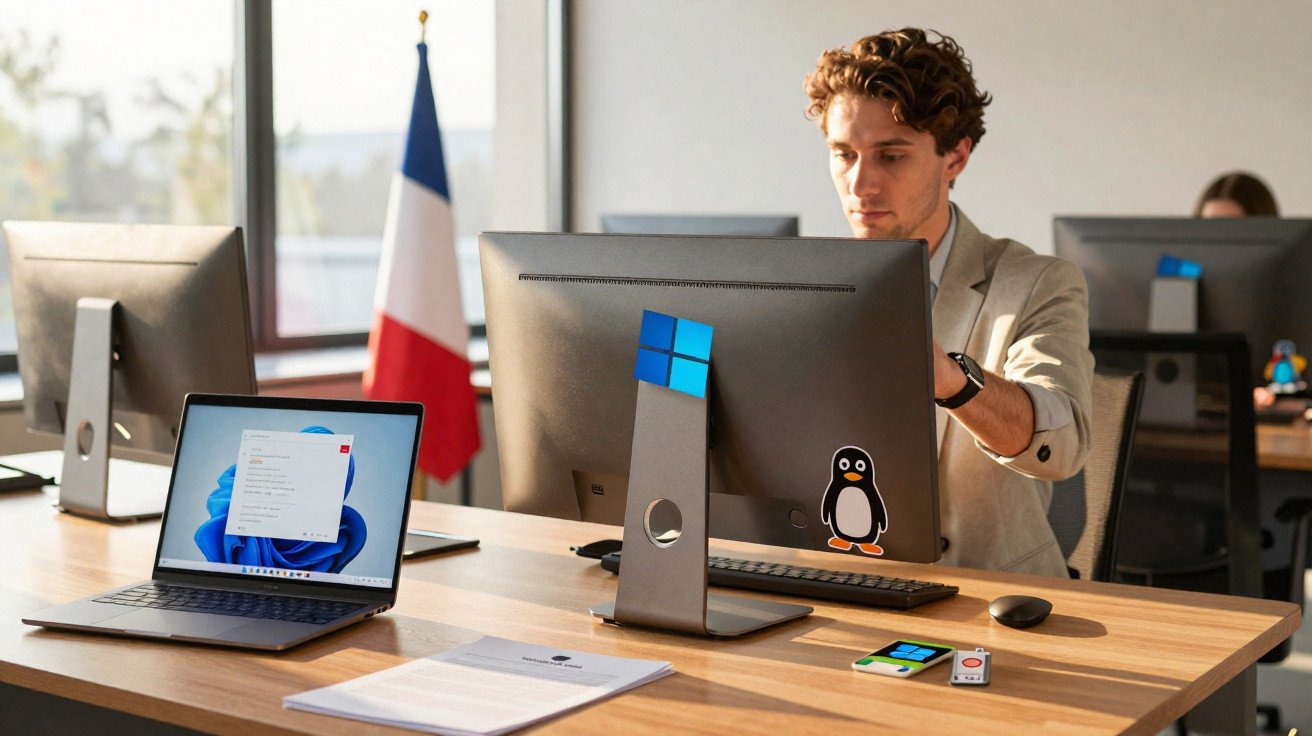
The French administration is set to phase out Windows in favour of Linux. The transition will take time, yet it is considered essential to achieving digital sovereignty.
A few months ago, tensions surrounding Greenland exposed the weaknesses in Europe’s digital model. Excessively reliant on US technology, the continent has begun considering secure, sovereign alternatives. France’s decision to move away from Windows marks a further step in that direction.
Driven by the Prime Minister, the Interministerial Directorate for Digital Affairs (DINUM) has announced a gradual withdrawal from Microsoft’s operating system. Linux will instead be installed on public-sector computers. The move should strengthen data security and support the reliable operation of IT infrastructure.
The approach has already been tested in certain public bodies, including the National Gendarmerie since 2007 and cities such as Grenoble and Lyon. The aim is explicit: “reduce the State’s extra-European digital dependencies”. David Amiel, Minister for Public Action and Accounts, stated:
“The State can no longer merely acknowledge its dependency; it must break free from it. We must wean ourselves off American tools and regain control of our digital destiny. We can no longer accept that our data, our infrastructure and our strategic decisions depend on solutions whose rules, prices, developments and risks we do not control.”
The French State seeks sovereign solutions
Moving away from Windows represents only one part of the programme launched by DINUM. The plan extends beyond the operating system to the full range of tools used daily by civil servants. American software for communication and file transfers, for instance, has been replaced by French alternatives including Tchap, Visio and France Transfert, used by the 80,000 staff of the National Health Insurance Fund. In addition, the organisation’s data is due to be moved to trusted platforms by the end of the year.
A cross-government plan to reduce digital dependencies
This substantial undertaking remains far from complete:
“DINUM will coordinate an interministerial plan to reduce extra-European dependencies. Every ministry (including operators) will be required to set out its own plan by the autumn, covering the following areas: workstations, collaborative tools, anti-virus software, artificial intelligence, databases, virtualisation and network equipment.”
For a long time, Europe did not regard its limited digital sovereignty as a pressing concern. However, tensions between the EU and the United States over Greenland in early 2025 made the situation plain: Europe relies on American tools. Donald Trump has repeatedly threatened to cut off access to those tools. Abandoning Windows is therefore a major step for the French administration. Although the migration will be a long-term process, it can only deliver greater independence.





Comments
No comments yet. Be the first to comment!
Leave a Comment