
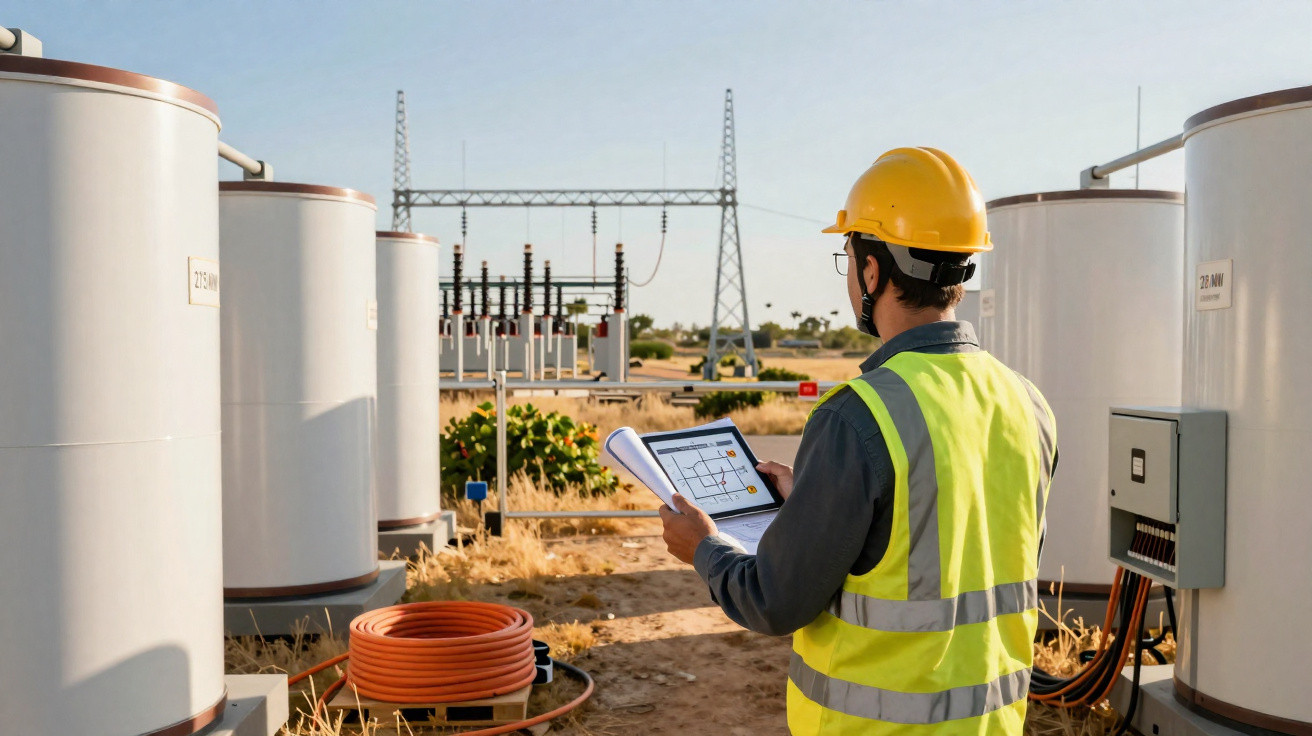
For the British company Aura Power, Portugal appeared to be a highly attractive market. Attractive enough that, in 2019, it entered the Government auction for new photovoltaic plants and secured two of the lots on offer. The company developed those projects and later sold them, but retained its interest in investing in further plants and building a new business in large-scale battery parks. To pursue this latest venture, Aura Power leased land in Santiago do Cacém, intending to install a battery park of up to 275 megawatts (MW), one of Portugal’s largest projects of its kind. Last March, it applied to the Directorate-General for Energy and Geology (DGEG) for permission to seek a connection to the electricity grid operated by REN. However, the plan has hit an obstacle: the allocation of permits for new grid connections is suspended.
The Aura Power project, planned for a two-hectare site, would require investment of around €165 million if its full capacity were approved. The company has not applied to the Government for any subsidies, and an Aura Power source told Expresso that the battery park would be commercially viable through price arbitrage in the Iberian market - charging batteries when prices are lowest and selling electricity to the grid when prices are highest - supplemented by the provision of technical services to the grid. This business has expanded in recent years and became more critical following the Iberian blackout on 28 April 2025.
The company, whose overall portfolio of battery projects in Portugal exceeds 2 gigawatts, asked the DGEG for a restricted grid-capacity reservation title (TRC). This form of electricity-grid connection was introduced under Decree-Law 15/2022, which revised the framework legislation for the electricity system, to enable more efficient grid management. The purpose of allowing “restricted” connections was to make new energy projects feasible where their owners accept that they may be unable to feed electricity into the grid during certain hours of the day, when the network is more congested.
The DGEG told Aura Power that its grid-connection request would not be granted, arguing that a developer seeking a “restricted” title must already hold a standard TRC. The issuing of these standard permits has been suspended by order since 2020, despite the Decree-Law establishing the “restricted” category having been introduced after that order.
Aura Power is not the only company to have been turned down by the DGEG. Another developer, which asked Expresso to remain anonymous, has spent three years trying to move ahead with standalone storage projects - in other words, battery parks connected directly to the electricity grid rather than paired with a solar plant or wind farm. In 2023, it applied to REN and E-Redes for grid-capacity reservation titles covering more than 1 GW, only to receive a response from the DGEG stating that there was no “framework for accepting standalone storage applications”.
In 2025, after the DGEG published information on electricity-grid injection capacity, the same developer tried again. It again received a negative response from the DGEG: new licences to sell energy to the grid were suspended, and battery parks would only be allowed if linked to existing electricity-generation plants.
Batteries will be critical to electricity-grid stability
Portugal has seen photovoltaic capacity expand sharply in recent years, driven by the low cost of the technology. This growth, alongside the expansion seen in Spain, has had a significant effect on price formation in the Iberian electricity market. It has led to an increasing number of hours with zero, or even negative, prices during periods of solar-energy generation, contrasting with higher night-time prices, when the lack of sunlight allows hydroelectric and natural-gas plants to dominate market pricing.
As well as supporting electricity-grid stability, batteries could smooth the price profile in the wholesale electricity market. They can respond to requests from grid operators within milliseconds, faster than conventional plants, helping to prevent negative daytime prices and the high costs currently seen at night.
The Government itself identifies batteries as a priority. In its programme for the current parliamentary term, the administration pledged to “draw up the National Energy Storage Strategy, with particular emphasis on expanding pumped hydro storage and batteries” and to “implement electrical energy storage solutions”.
Last year, following the blackout, the Government had already promised a tender for battery projects to bid for the provision of system services to the grid. The tender, which was meant to cover 750 MW of capacity, was promised for January but has still not taken place. The PTRR, presented days ago, also reaffirmed the commitment to batteries, promising to “encourage investment in electrical energy storage”. It points to €500 million of investment in the medium term, from 2027 to 2029, across pumped-hydroelectric solutions and battery parks, “with a role more specifically geared towards rapid response and the provision of system services”.
So far, the only battery-related initiatives launched have been Environmental Fund calls for applications supporting battery projects financed through the PRR. However, these apply only to storage investments associated with specific renewable electricity-generation projects, excluding standalone battery parks. The latest call allocated around €60 million in grants, covering up to 20% of each project’s investment. An earlier call in 2024 had already provided €100 million in support for similar projects.
Government seeks an orderly project-approval process
Asked by Expresso why the DGEG is holding back the licensing of standalone battery projects when storage is one of the Government’s priorities, the Ministry for Environment and Energy replied that “there has been no instruction from the Ministry for Environment and Energy to suspend or block the licensing of storage projects or any other type of project”.
“What is happening at present is that the DGEG is temporarily and for a limited period giving operational priority to the technical assessment of the 85 applications submitted under the second PRR call for storage and grid flexibility”, since those PRR-funded projects must be contracted by June 2026.
Figures provided by the Government to Expresso show that the DGEG “has 113 storage-related cases under review”. A total of 680 MW has already been licensed, including 27 MW of standalone storage, although this concerns a pilot project. “The remaining applications, corresponding to around 720 MW of additional capacity, are at different stages of the administrative procedure, namely under assessment by the DGEG, being considered for an opinion from grid operators or the Global System Manager, or awaiting further information from developers,” the Ministry for Environment said.
On the fact that several standalone storage projects have so far been unable to obtain authorisation to connect to the grid, the Government says that “the development of storage requires balanced and responsible management of the granting of new rights of access to the electricity grid”. “Grid access is a scarce resource, with high economic value and involving very significant investment ultimately borne by all consumers. For that reason, capacity cannot be allocated in a disorderly or speculative manner,” the Ministry for Environment and Energy noted.
The Government recalls that, in recent years, “grid-capacity reservation titles have been awarded to [electricity-generation] projects which, in many cases, have retained and continue to retain grid access for years without ever moving into actual implementation”. Therefore, the administration adds, “it is important to ensure that the same problems are not now repeated in the development of storage”.
Reiterating that it is preparing a tender for the “allocation of grid-capacity reservation titles linked to around 750 MW of standalone storage with firm grid-access capacity”, the Ministry for Environment and Energy told Expresso that “a new procedural framework applicable to the licensing of storage facilities will be approved later this month, consolidating and clarifying the administrative procedures applicable to the different project types”.
The Government also explained that “the DGEG, grid operators and ERSE, the energy regulator, are likewise developing a harmonised technical framework for the flexibility conditions that may apply to the operation of these facilities”.





Comments
No comments yet. Be the first to comment!
Leave a Comment