
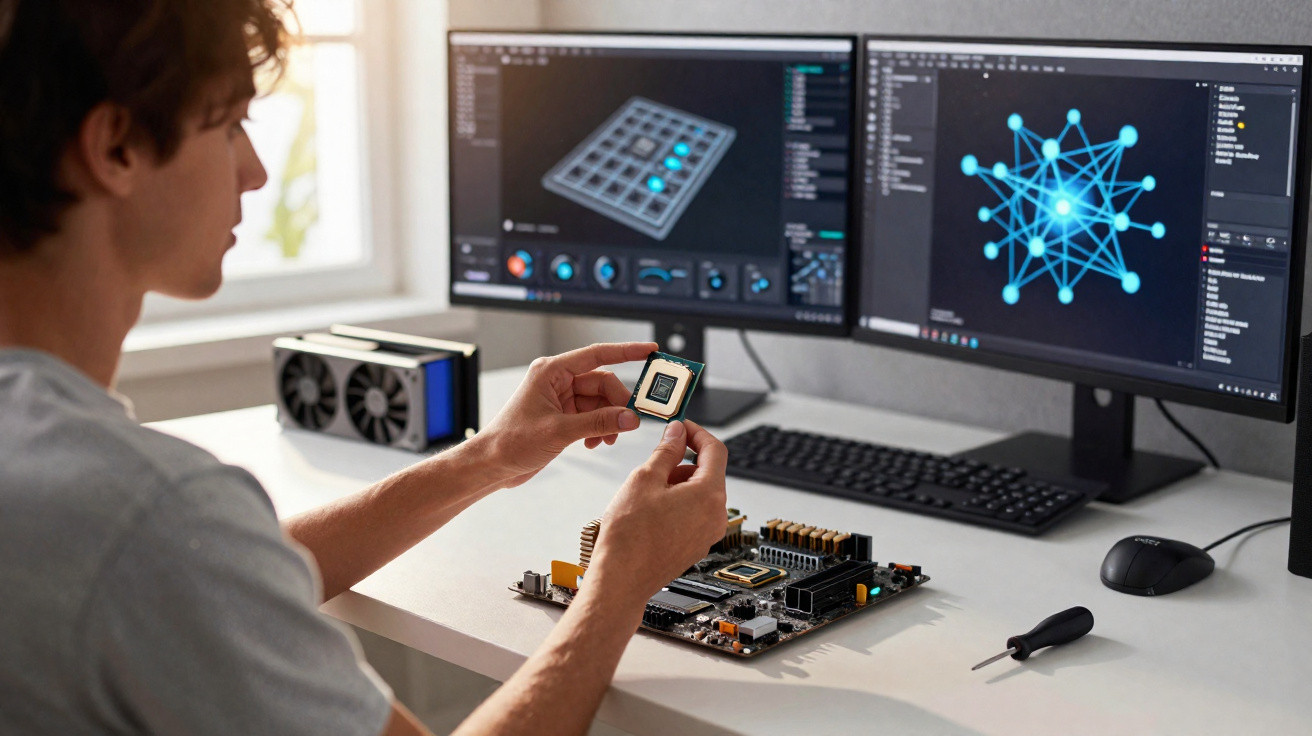
Intel, the Santa Clara chip giant, appears determined to regain lost ground. With Nova Lake, the upcoming Core Ultra 400 processor generation, the company is promising a platform that should make both gaming enthusiasts and power users take notice. Behind the dry specifications lie radical changes that could noticeably shake up the PC market.
Nova Lake aims to end the transitional era
Intel has faced considerable criticism in recent years. Too few genuine innovations, excessive power consumption and too much patchwork applied to ageing architectures were among the complaints voiced by many enthusiasts. Nova Lake is intended to tackle those issues directly, serving not merely as another incremental update but as a genuine fresh start.
At its heart are two entirely new core types: high-performance P-cores codenamed Coyote Cove and efficient E-cores known as Arctic Wolf. This pairing is expected to significantly raise instructions per cycle (IPC) while also reducing power demands. Intel’s high-end chips have previously been regarded as fast, but often difficult to cool.
Nova Lake is designed to clearly boost performance per clock cycle while noticeably reducing power consumption.
Intel is positioning Nova Lake as the foundation of the Core Ultra 400 family. This brings the current transitional period to a close, during which many products appeared more like intermediate steps and failed to deliver the major advances desktop enthusiasts had hoped for.
Up to 52 cores: Intel increases core counts
One of Nova Lake’s most striking figures is its maximum core count. Leaked configurations include versions with up to 52 cores, although these are not simply “monster P-core” designs but carefully tiered hybrid architectures.
The architecture combines:
- high-performance P-cores for games and compute-intensive applications;
- energy-efficient E-cores for parallel workloads;
- additional LPE cores (Low Power E-Cores) for background tasks and standby scenarios.
These LPE cores in particular are intended to ensure that a system uses substantially less energy when idle or handling light tasks, while the “big” cores take charge during gaming and content creation.
Planned Nova Lake configurations at a glance
| Core Ultra 400 (Ultra 9) | Core Ultra 400 (upper segment) | Core Ultra 400 (mid-range) | |
|---|---|---|---|
| Total cores | 52 (48 + 4 LPE) | 42 (38 + 4 LPE) | 28 (24 + 4 LPE) |
| Split | 16 P-cores / 32 E-cores | 14 P-cores / 24 E-cores | 8 P-cores / 16 E-cores |
| L3 cache (bLLC) | 288 MB | 288 MB | 144 MB |
| Socket | New socket | New socket | New socket |
This means even the mid-range model comes with more cores than many high-end chips from recent years. The flagship version, with 16 Performance cores and 32 Efficiency cores, is clearly aimed at enthusiasts, streamers, workstation users and anyone who wants to render, play games and process additional background tasks at the same time.
Huge bLLC cache is a direct answer to Ryzen X3D
The massive expansion of L3 cache is at least as notable as the core count. Intel calls it the “Big Last Level Cache” (bLLC) and plans to offer up to 288 MB in the upper range. That inevitably draws attention to AMD’s Ryzen X3D models, whose 3D-stacked cache delivers high frame rates particularly in gaming.
Up to 288 MB of L3 cache is intended to reduce loading times, lower latencies and increase frames per second.
A large shared cache is especially useful when data is repeatedly required, such as in open worlds, highly detailed scenes and CPU-intensive simulations. Game engines need to access slower system memory less often, reducing latency. Players using high-refresh-rate monitors in particular will see the benefit in smoother and higher FPS.
Professional workloads such as video editing, 3D rendering, CAD and software development also stand to benefit. Large datasets can be cached more quickly, potentially shortening compilation times or rendering passes. The new cache therefore becomes one of Intel’s key weapons in its contest with AMD Zen 6.
AI at the centre: sixth-generation NPU with up to 74 TOPS
PCs with “AI inside” are now far more than a marketing concept. Microsoft’s Copilot+ initiative already requires minimum levels of AI task acceleration. Intel is responding with a sixth-generation Neural Processing Unit (NPU) that is expected to deliver up to 74 TOPS.
For comparison, many current AI PCs operate at around 40 to 45 TOPS. Nova Lake therefore represents a considerable increase, creating scope for locally run AI features that do not need to rely constantly on the cloud, including:
- local voice assistants without a permanent internet connection;
- real-time image and video enhancement;
- faster inpainting, upscaling and style transfer for creators;
- intelligent automation in office workflows and development environments.
For creative professionals, this means AI-assisted tools in video editing, image editing or audio production software could run more smoothly without completely occupying the GPU. Businesses, meanwhile, gain the option to run sensitive AI processes locally on the device, improving data protection and response times.
No Hyper-Threading: a return to “real” cores
A particularly interesting detail is the omission of Hyper-Threading. For decades, the technology was a standard way of turning one physical core into two logical threads. Nova Lake appears to move away from this approach, instead relying on numerous physical cores and optimised pipelines.
More physical cores rather than virtual threads – Intel wants to simplify architecture and scheduling.
This strategy could offer several advantages. The operating system has fewer virtual threads to manage, while workload distribution and thermal behaviour become easier to assess. Higher clock speeds may also be easier to achieve because individual cores have less sharing to contend with.
For developers, this could eventually mean focusing their applications more heavily on high core counts and true parallelism. This trend is already well established in areas such as rendering, scientific computing and server services.
New socket, new ecosystem: what it means for PC builders
Nova Lake requires a new socket. For PC builders, this is both a drawback and an advantage. On one hand, it means no compatibility with existing motherboards, making new boards, new BIOS versions and probably new memory profiles essential.
On the other, a new socket opens up fresh possibilities for power delivery, signal routing and cooling. Motherboard manufacturers can tailor power delivery, VRMs and PCIe connectivity specifically to the new architecture. Combined with the continuing shift towards PCIe 5.0, fast M.2 SSDs and potentially even more powerful graphics cards, this represents a fairly comprehensive platform transition.
What gamers, creators and office users can expect
For gamers, the core count and enormous cache are clearly intended to provide higher and more stable frame rates, especially in CPU-limited titles and at high refresh rates. Those playing shooters at 240 Hz or above are likely to notice the extra headroom most clearly.
Content creators benefit from the combination of many cores and a powerful NPU block. AI-assisted video filters, audio noise reduction, automated image edits and layout suggestions in design tools can run with less waiting time while rendering or streaming continues in parallel.
In office and business use, AI acceleration becomes the main focus. Possible applications include personalised assistants that pre-sort emails, create live meeting notes, prepare presentations and simultaneously analyse data from local archives, without sending sensitive material to external data centres.
Understanding terms such as IPC, TOPS and cache
Three technical terms regularly appear in connection with Nova Lake: IPC, TOPS and cache. Anyone comparing products should have a basic understanding of what they mean.
- IPC (Instructions per Cycle): Indicates how many computing instructions a core executes per clock cycle. A higher IPC value provides greater performance even at the same clock speed.
- TOPS (Tera Operations per Second): A measure of an AI unit’s computing operations. The higher the TOPS figure, the more AI calculations can be processed each second.
- L3 cache: Shared temporary storage for multiple cores. A larger cache reduces access to slower system memory and lowers latency.
Gaming demonstrates particularly clearly that clock speeds alone are not decisive. A chip with strong IPC and a large cache can be faster at the same, or even a lower, clock speed than an apparently “higher-clocked” processor with less cache and an older architecture.
Outlook for the battle with AMD Zen 6
The timetable is clear: Nova Lake is due to arrive towards the end of 2026, placing it directly against AMD’s Zen 6 generation. Both manufacturers are placing heavy emphasis on hybrid designs, large caches and AI acceleration. The deciding factor will be which company delivers the better overall package of performance, efficiency, platform cost and software support.
For users in the UK, the key message is likely to be this: anyone considering a major upgrade now and able to wait a few years could be approaching a particularly exciting generation. Nova Lake promises a clear break from the past and could make the traditional PC considerably more interesting than many might have expected.






Comments
No comments yet. Be the first to comment!
Leave a Comment