
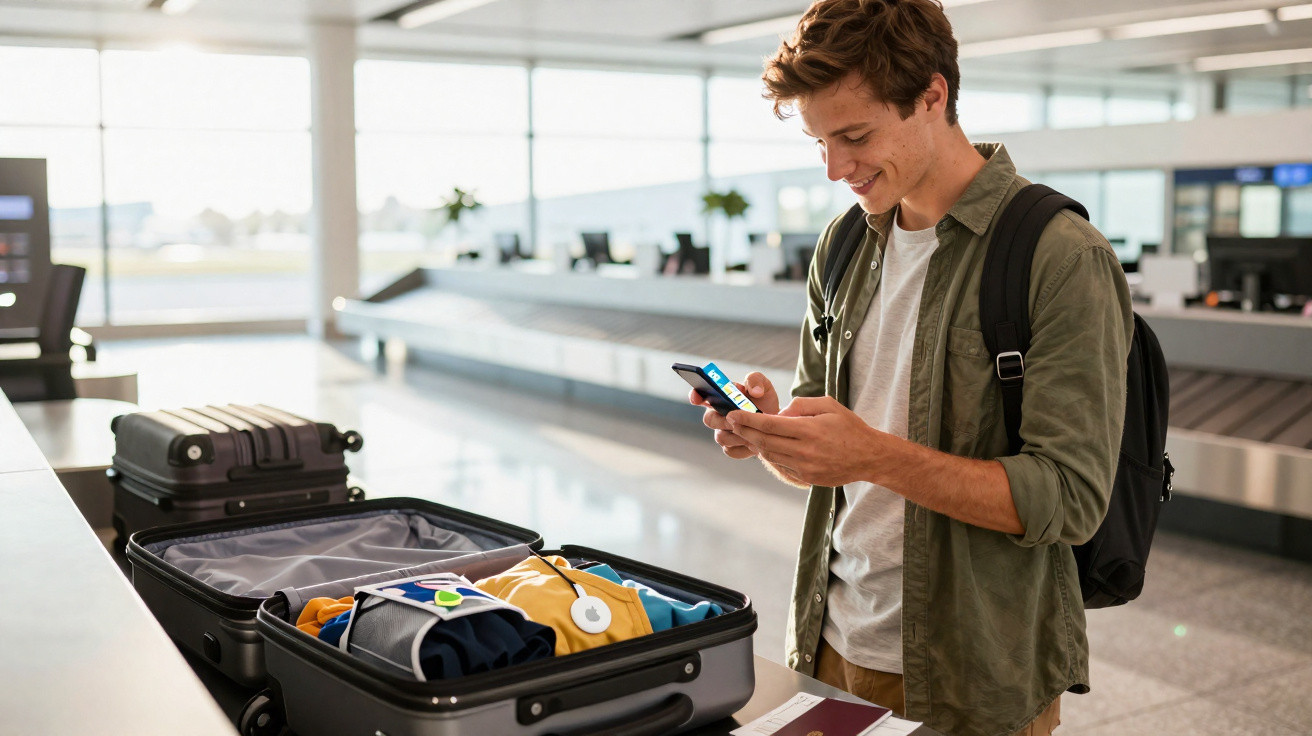
Small Bluetooth trackers offer reassurance, but airport rules can seem unclear to travellers.
Passengers want their suitcase to arrive on the baggage carousel and, if it fails to do so, to understand where it has gone. Apple’s AirTag increasingly fills that space between airline operations and personal peace of mind.
What airlines currently say about AirTags
Most airlines allow AirTags in hand luggage as well as checked baggage. The device relies on a coin-cell battery and ultra-low-power Bluetooth rather than mobile data or Wi-Fi. This construction means it fits comfortably within existing passenger-flight safety rules.
AirTags run on a CR2032 coin cell with roughly 0.1 g of lithium. That falls within baggage-tracker thresholds used by aviation regulators.
A number of major airlines have publicly stated that these tags are not banned from checked baggage. Their low transmission power and minimal lithium content mean they are classed as a “personal electronic device”, not dangerous goods.
- EasyJet: no policy prohibits Apple AirTags on board.
- United Airlines: AirTags face no restriction in checked baggage.
- American Airlines: there is currently no ban on these devices.
The source of the 2022 confusion
In October 2022, Lufthansa briefly stated that AirTags should not travel in the hold, referring to broad dangerous-goods regulations. Travellers objected, technology companies contributed, and regulators clarified the position. Days later, the airline withdrew its stance, saying AirTags were not a safety risk.
Lufthansa rescinded its short-lived restriction after aviation authorities and industry groups clarified the rules for low-power baggage trackers.
The incident continues to circulate online, explaining why passengers raise the question repeatedly during every busy travel season.
What the rules permit
Airline guidance around the world accepts baggage trackers with extremely small batteries. The industry standard sets a lithium-metal limit of 0.3 g for these devices and a lithium-ion limit of 2.7 Wh. AirTags contain a lithium-metal coin cell, putting them far beneath the limit. Regulators in the US and Europe have also said these trackers may stay switched on in checked luggage, as they use negligible power and cannot access mobile networks.
Here is a brief comparison of popular trackers and their batteries:
| Tracker | Battery type | Approx. lithium content/energy | Checked-bag status |
|---|---|---|---|
| Apple AirTag | CR2032 lithium metal | ~0.1 g lithium | Permitted by most airlines |
| Tile Mate | CR2032 lithium metal | ~0.1 g lithium | Permitted by most airlines |
| Samsung SmartTag2 | CR2032 lithium metal | ~0.1 g lithium | Permitted by most airlines |
The key exception involves older GPS/mobile trackers and smart suitcases with power banks. As these contain larger rechargeable batteries, different rules apply: spare batteries must remain in the cabin, while power banks often need to be removed before check-in.
Why travellers took to tags
Following the airport disruption of summer 2022, mishandled baggage became a common topic of conversation. Apple’s Find My network uses millions of iPhones, allowing AirTags to anonymously report their position whenever a nearby device passes them. This crowd-sourced system was especially valuable during disruption, when airline systems were overloaded and call centres were congested.
When bags missed connections, AirTags gave travelers a map dot and a timeline-information that sped up claims and lowered stress.
United Airlines went further by adding “Share Item Location” to its app. Travellers can provide customer support with the tag’s live location, enabling agents to route the bag more quickly. More airlines are likely to introduce comparable processes.
How to fly with an AirTag smoothly
Pack and configure it carefully
- Put the tag where baggage scanners and handlers are unlikely to crush it, such as in a side pocket or beneath the lining.
- Give the item a precise name in the Find My app: “Blue Rimowa Check-in” is better than “Suitcase.”
- Turn on Lost Mode before submitting a claim, then include a telephone number and email address.
- Do not place spare coin cells in checked baggage; carry any spares in your hand luggage.
- Avoid tape or alterations that obstruct the speaker or vent, as these may retain heat and create problems.
Consider airline staff and security
Security staff encounter trackers every day. If questioned, explain that it is a low-power Bluetooth tag using a coin cell. There is no need to turn off its radio: AirTags have no mobile radios and do not connect directly to aircraft systems. Should the tag beep, mute it in the Find My app or fit the battery cover correctly.
Privacy and etiquette remain important
Never put a tracker in another person’s bag without their permission. Apple’s safety tools issue “unknown AirTag” notifications to nearby iPhones and, through dedicated apps, Android devices. These notifications safeguard people against unwanted tracking and may draw attention at the airport when a tag is in the wrong bag. Mark your luggage with your name and airline reference, so both the bag and the tag identify the same owner.
The details travellers often ask about
Can an AirTag interfere with aircraft systems?
No. Its transmission power is exceptionally low and falls within the consumer-electronics standards already permitted on flights. Aircraft manage cabins full of phones, headphones and watches; a coin-cell tracker creates negligible additional radio interference.
How long does the battery last in practice?
Apple estimates around one year from each CR2032 under typical pinging conditions. Rough baggage handling does not greatly affect this. Very cold weather can reduce capacity, so winter flights to extremely low temperatures may result in marginally shorter battery life. Frequent travellers should keep a spare coin cell in their hand luggage.
Alternatives and special cases to consider
For aviation purposes, Tile and Samsung tags work in much the same way. The decision often depends on network coverage: iPhone users benefit from the broader Find My network, whereas Galaxy users may favour SmartThings Find. When checking professional equipment or sports gear, using two tags-one in the main case and another in a pouch-can provide redundancy. If a suitcase has a removable power bank, remove it before check-in and take it into the cabin.
Extra steps that save time when a bag is missing
Take a photograph of your bag and its contents before leaving home. When making a report, give the airline agent the AirTag’s live location and its last-seen time stamp. Store the baggage receipt and claim number in the Find My item notes for easy access. If the tag indicates that your suitcase is at the arrival airport but staff believe it remains in transit, politely ask them to inspect the local baggage room; this discrepancy occurs more often than expected.
Low-power baggage trackers are allowed, useful, and increasingly part of airline workflows. The winning move is simple: tag your bag, label it, and keep your spare battery in the cabin.





Comments
No comments yet. Be the first to comment!
Leave a Comment