
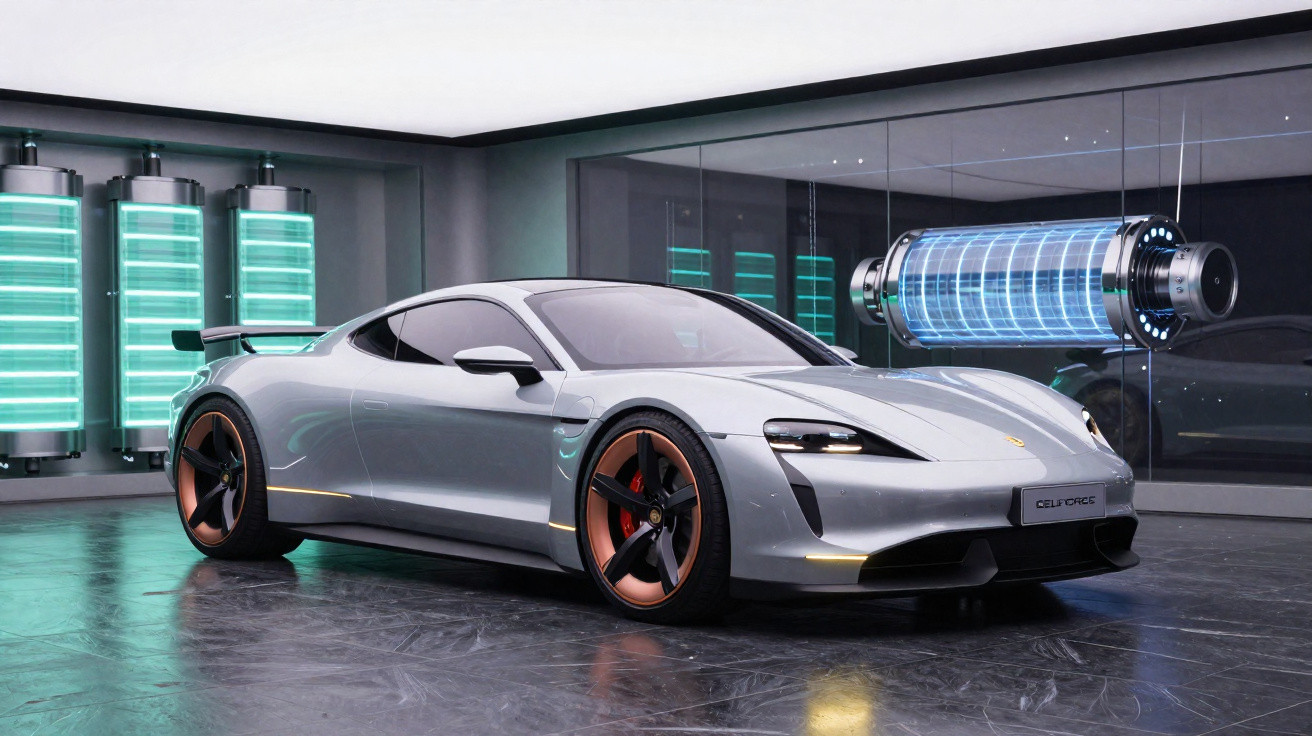
The consequences could extend from Stuttgart to the spreadsheets of every gigafactory.
The German sports-car manufacturer is abandoning a course it chose only a few years ago, redirecting its battery ambitions towards high-performance research rather than volume manufacturing. The decision reshapes its battery division, alters expectations among suppliers and offers a warning to rivals placing major bets on scale.
Why Porsche is changing direction on batteries
Porsche’s recent electric strategy was founded on the belief that controlling the crucial element - the cell - would protect both performance and margins. That calculation has shifted. Slower worldwide demand growth, constrained capital and fierce pricing pressure in the US and China have made a small internal cell factory appear vulnerable beside megafactories operated by established suppliers.
Previous plans envisaged an initial production facility near Kirchentellinsfurt with capacity of about 1 GWh, followed by a second location. Executives now acknowledge that this output level cannot create the economies of scale required to compete on cost. Porsche will instead turn its Cellforce Group into an autonomous R&D operation pursuing advances in power density, charging speed and durability.
Porsche halts its in‑house cell production plans and converts Cellforce into an independent R&D engine for high‑performance batteries.
What will change at Cellforce
Cellforce will no longer operate a gigafactory. Its role will be to develop chemistries, cell formats and thermal approaches capable of providing consistent track performance alongside rapid fast charging for road driving. Without the demands of tooling and yield ramp-ups, its teams can iterate more quickly. Porsche can then buy volume cells from partners while applying its proprietary formulas in the areas where they make the greatest difference.
The division’s work is directly linked to Volkswagen Group’s PowerCo, the battery competence centre responsible for setting standards and awarding development contracts. Information will move in both directions: Cellforce can develop high-power solutions, while PowerCo can scale those that are appropriate for use across the group.
Focus shifts from commodity cells to niche, high-power chemistries that underpin Porsche’s all‑electric future models.
The 2 billion question: who takes on the risk now?
The change reaches beyond Porsche’s engineers and into financial planning. Suppliers preparing to support tooling, pilot lines and materials for a specialist plant must now reconsider their plans. Industry analysts say up to 2 billion of planned investment connected to small-scale European capacity and dedicated equipment could be redefined, postponed or redirected towards flexible platforms.
Write-downs are unwelcome for anyone. However, sharing risk across larger factories serving multiple customers can restrain unit costs while allowing Porsche to retain command of performance-critical intellectual property. Put simply, Porsche will spend on expertise before steel.
The pivot threatens up to 2 billion in tightly coupled battery investments, while de‑risking Porsche’s capital plan in a choppy EV market.
Where Porsche battery technology goes next
High-performance cells are not solely about achieving headline range. Porsche is seeking immediate power, repeatable lap times and rapid recharging. This indicates silicon-rich anodes, durable separators, advanced binders and assertive cooling systems. It also requires more intelligent battery management that measures state of charge accurately, enabling drivers to push harder without range anxiety.
The company already uses German specialist V4Smart for ultra-high-power lithium-ion cells deployed as “booster” packs in the 911 GTS. More hybrids are likely to use this arrangement, in which a small, high-rate sub-pack handles peak bursts while the main battery or engine takes care of cruising.
What will change for future models
- Prototype cells aimed at high C-rates for repeatable track sessions.
- Thermal systems designed to maintain stable performance above 60–70% state of charge.
- Battery management calibrated for quicker, flatter fast-charge curves.
- Tighter integration of cell design with inverter mapping and chassis control.
A market that is growing, but unevenly
Electrification is not collapsing; its growth is uneven. In Europe, 57% of vehicles delivered in the first half of 2025 were electrified when hybrids are included. Worldwide, the proportion was around 36%. Price pressure in China, unstable incentives in North America and charging constraints make forecasts more difficult and cloud plans for factory utilisation.
In this environment, a sports-car marque cannot risk being left with a stranded gigafactory. Porsche’s change preserves flexibility. Should demand surge, it can obtain volume from partners including major Asian and European cell producers. If demand weakens, its R&D operation can continue working without the burden of substantial depreciation costs.
Europe nudges past half of new deliveries electrified, while the world lags near a third-too patchy to bank on a small dedicated cell plant.
How this fits within Volkswagen Group
PowerCo receives a specialist laboratory that it can commission for high-end applications. Porsche, meanwhile, gains a clearer route for defining premium chemistries without taking on mass-production risk. The group will still benefit if Cellforce develops a scalable design, as PowerCo can introduce it through unified cell lines.
This partnership resembles the way racing programmes influence road cars. The R&D division pursues the limit, while the group’s factories standardise what withstands testing.
What competitors can learn from this
Car makers face a clear choice: follow a supplier-led approach and move capital towards software and integration, or continue investing heavily in cell plants to gain vertical control. There is no universal answer. Tesla gains from scale, pure-play start-ups depend on partners, and legacy brands can combine both routes. Yet few can sustain profitable specialist plants for long.
Mass production versus R&D-first: a quick comparison
| Aspect | Mass production | R&D-first |
|---|---|---|
| Upfront capital | Very high | Moderate |
| Speed to scale | Slow ramp, years | Fast prototypes, outsource scale |
| Unit cost at high volume | Low if fully utilised | Depends on supplier contracts |
| Innovation cadence | Constrained by tooling | Fast iterations |
| Risk in demand dips | High stranded asset risk | Lower fixed cost exposure |
| Performance differentiation | Hard if using commodity designs | Strong via proprietary chemistries |
Key signals to watch next
Look for Porsche to reveal a next-generation high-power cell specification and a manufacturing partner for volume models such as the Taycan. Also watch for broader hybrid use of ultra-high-rate sub-packs across the 911 family. PowerCo’s ability to align its unified-cell strategy with Porsche’s specialist performance requirements, without fragmenting production, will be another important indicator.
Useful context for readers
What does 1 GWh actually mean?
A 1 GWh facility can provide roughly 12,500 packs for an 80 kWh premium EV, or tens of thousands of smaller hybrid packs. For a global brand, this is boutique-scale output. Major cell factories operate at 20–40 GWh or more in order to spread fixed costs and exert pressure on supplier pricing.
Why state-of-charge accuracy matters
Precision is fundamental to performance EVs. Reliable state-of-charge estimates allow a car to deliver full power for longer, arrange thermal preconditioning before fast charging and avoid cautious buffers that waste available energy. Improved algorithms can feel like an unseen battery upgrade.
Risks and advantages of Porsche’s move
- Advantage: Reduced capital intensity safeguards returns during swings in demand.
- Advantage: Faster chemistry cycles preserve the brand’s performance advantage.
- Risk: Reduced influence over supplier allocation queues in a constrained market.
- Risk: Greater cost exposure if partners increase prices or currency movements hurt.
- Mitigation: Multi-sourcing through group channels and long-term offtake agreements.
What this means for drivers
If Porsche delivers on its plan, customers will receive cars that charge hard, lap hard and age well. Expect briefer fast-charging stops, stronger mid-range boosts and improved heat management on back roads. The marque will focus its engineering character where it matters, while larger factories manufacture cells at scale.
For investors and suppliers, the message is direct: support the R&D operation, keep capital flexible and avoid becoming attached to bespoke factories unable to support themselves. The next breakthrough may emerge from a laboratory bench rather than a new building.





Comments
No comments yet. Be the first to comment!
Leave a Comment